

Why Do So Many Russians Not Believe That Americans Have Been To The Moon?
60- 16.04.2026, 18:07
- 18,390
A prank that got out of hand.
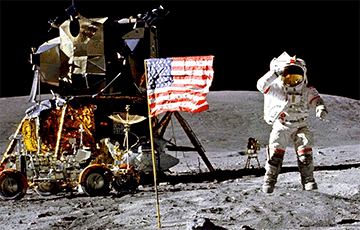
The recent completion of NASA's Artemis 2 mission, in which four astronauts flew around the moon, has sparked a new wave of debate about whether the Americans actually managed to successfully land on our planet's satellite six times in 1969-1972, or whether it was all a malicious staging.
If you believe the results of a survey conducted this month by Moscow's M125 network of neighborhood communities, 73% of residents of Russia's capital believe that there were no Americans on the moon. Of course, it's hard to say how seriously people answered the questions in this survey. However, in 2020, when VTsIOM decided to find out how much Russians trust common scientific myths, 49% of respondents called the 1969 moon landing a falsification by the U.S. government, and only 31% of respondents recognized this fact as true.
With the attitude toward the United States in society having only gotten worse over the past six years, one should not be surprised by the anomalous numbers. Although not so long ago it seemed that the "lunar conspiracy" was something along the same lines as singer Yuri Loza's claims of a flat Earth or Pop Mechanics leader Sergei Kurekhin's famous airing that Lenin was a mushroom.
In principle, the "lunar conspiracy" is nothing more than a hoax. And the fact that it has become part of the mass consciousness in Russia only emphasizes the suggestibility of people. Here is an example of the size to which the most incredible myths can grow, which for many people have now become part of reality.
Of course, in the USSR, and then in Russia, few people read the book by American conspiracy writer Bill Keesing "We've Never Been to the Moon: The American Thirty Billion Dollar Swindle!". It, incidentally, also lay on fertile ground - the popularity in the U.S. this book gained after a rather tragic for the nation war in Vietnam. Fortunately, the publication was quickly forgotten, and now only 6% of Americans are sure that the Moon was actually filmed in movie pavilions.
By the way, in the same book Keesing made statements and that Yuri Gagarin has never been in space. But this version in the U.S. is also not supported by public opinion because of its obvious stupidity.
In the Russian Federation it was customary to refer to a completely different source - an interview with the widow of the director of the film "2001 Space Odyssey" Stanley Kubrick Christiana, who in 2002 said that her husband at the request of U.S. President Richard Nixon filmed the moon in the pavilions of Hollywood. However, even in the credits of the pseudo-documentary movie "Dark Side of the Moon" it was written that it was a hoax and a hoax. True, the Russian journalists who passed the news to the tapes of news agencies did not see it. After all, who among us watches the credits?
Actually, this hoax turned out to be a worsened version of Sergei Kurekhin's performance about Lenin. So there is nothing to discuss here in principle, and there are no other sources, except for Keesing's conspiracy book.
What's more, in the USSR, official propaganda never questioned American success in the lunar program, although relations with the West were very cool.
Already in Russian times, specialists associated with the Soviet space program had to refute numerous (as spam) articles by publicist Yuri Mukhin that the American lunar program was filmed by Stanley Kubrick. Here it is worth saying that Mukhin himself grieves over the collapse of the USSR, but denies not only the American lunar program, but also the achievements of Soviet genetics, calling himself a follower of scientist Trofim Lysenko.
Soviet space technology designer Boris Chertok, in turn, said that the authors of conspiracy theories about the American lunar program earn money from lies.
Another associate of Sergey Korolev, engineer Konstantin Feoktistov, who himself had been in orbit on the Voskhod spacecraft, said that our radio equipment received signals from Apollo 11, and Soviet specialists not only heard conversations but also saw a television picture at the moment the astronauts reached the surface of the Moon.
Russian President Vladimir Putin explicitly called "nonsense and complete nonsense" talk that Americans did not land on the moon, as did claims that they blew up the Twin Towers in New York City on September 11, 2001.
There, perhaps, Feoktistov's colleague, cosmonaut Alexander Lazutkin, is right, who believes that the disbelief in American flights to the moon is not scientific but social in nature.
It can be said that this myth is not even particularly related to space and the moon. Its origins are quite earthly, it is a generation of anti-American and anti-Western sentiments. When you see someone as an adversary, you want to not only accuse him of lying, but also to present him as knowingly weak. For example, Gagarin definitely flew into space, and you could not answer with anything except the fact that you hired Stanley Kubrick to make a movie (although many adherents of the conspiracy theory do not know the director's name).
By the way, there is another similar myth about the successes of the USSR and the failures of North America. Only it is not based on a conspiracy theory, but on a free interpretation of the facts. It's about the first hockey Super Series in 1972 between the USSR and Canada. Of course, the Soviet hockey players showed themselves to be real fighters in it, demonstrating a skill that no one expected to see. However, the fact remains that in general, the USSR national team lost this Super Series. Another thing is that if all the time to remember only the winning matches, and even about one of them to make a feature film, then the people's memory will be stored that the Soviet hockey players won everything that is possible.
In discussions about the authenticity of the American lunar program is seen only one positive moment - the topic of space people are still interested in. It excites, excites, makes people look for information and bring it to their children. This is very good and deserves special attention of those who formulate the state policy in the sphere of education. But it is only necessary to tell the truth, be objective and refute conspiracy theories.
Kirill Shulika, "Rosbalt".

Bank's name: Bank Millennium S.A.
Address: ul. Stanislawa Zaryna, 2A, 02-593, Warszawa
IBAN: PL97116022020000000216711123
SWIFT: BIGBPLPW
Name of the account holder: Fundacja “KARTA ‘97”
Purpose/title of payment: Donation for statuary aims
You can contact us by the e-mail [email protected]