
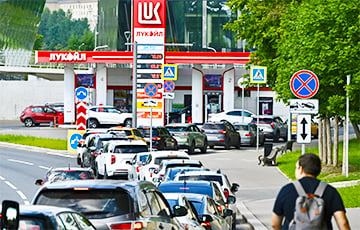
Gasoline Shortage In Moscow: The Russian Capital Has Never Seen Anything Like This
17- 20.08.2026, 15:09
- 4,974
Fuel availability fell by 73%.
Data from the Russian app "GdeBENZ" shows that gasoline availability in Russia has once again dropped significantly.
While fuel was available at approximately 40% of the gas stations in the service’s database in early August, by August 19 that figure had fallen to 28% (a 72% drop). The lowest point was recorded on August 18—27%.
This has never happened before in Russia’s modern history. It is an all-time low.
The service compiles this picture based on user reports: Russians indicate whether it is possible to refuel without a long line and whether fuel is available at a specific gas station; therefore, these data clearly reflect not official statistics, but the actual everyday availability of gasoline for drivers.
The graph shows two waves of the crisis. The first “gasoline crash” occurred in June, and the second wave began in mid-August. Nationwide, the percentage of gas stations with fuel dropped from about 40% to 28%—a decline of more than 6 percentage points in just one week.
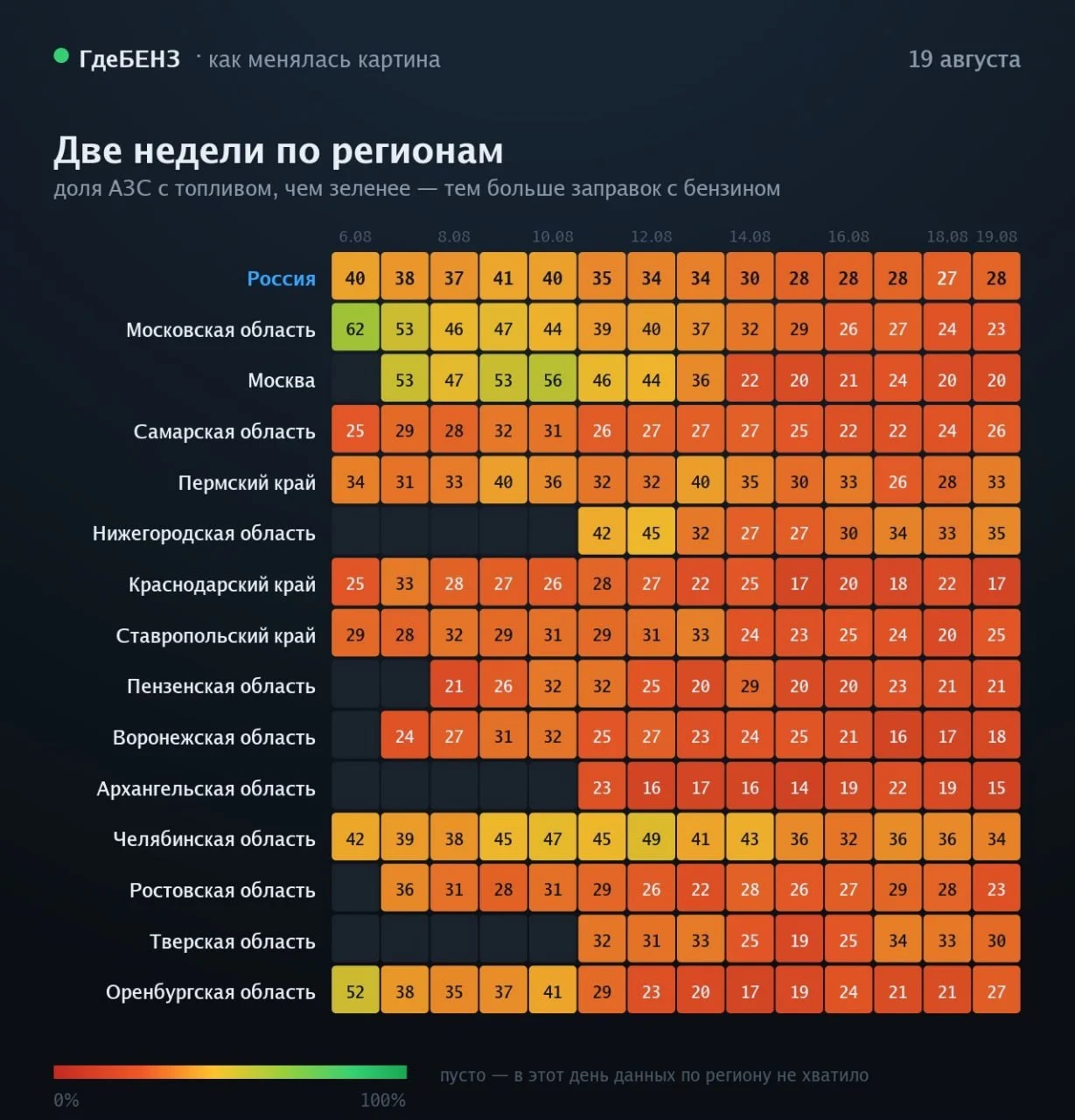
Moscow and the Moscow Region saw a particularly sharp decline.
In the Moscow Region, fuel availability fell from 62% on August 6 to 23% on August 19. In Moscow itself, the figure dropped from 53% to 20%; in other words, in the capital region—which is usually better supplied than other areas—gasoline became available at only about one in every five to four gas stations in the service’s database.
The situation is also dire across the regions. In the Krasnodar Krai, fuel was available at only 17% of gas stations on August 19; in the Voronezh Oblast, at 18%; in the Penza Oblast, at 21%; in the Rostov Region—at 23%, and in the Arkhangelsk Region—at 15%.
Even where the situation appears slightly better, the figures remain far from normal: for example, in the Chelyabinsk Region—34%, in the Nizhny Novgorod Region—35%, and in the Perm Krai—33%.
Analysts note that this is an unwelcome trend for the Kremlin. The fuel crisis no longer appears to be a one-off disruption: after brief improvements, the market is once again collapsing.

Bank's name: Bank Millennium S.A.
Address: ul. Stanislawa Zaryna, 2A, 02-593, Warszawa
IBAN: PL97116022020000000216711123
SWIFT: BIGBPLPW
Name of the account holder: Fundacja “KARTA ‘97”
Purpose/title of payment: Donation for statuary aims
You can contact us by the e-mail [email protected]