
Soldiers Of A Free Belarus
10- Irina Khalip
- 14.08.2026, 22:43
- 18,306
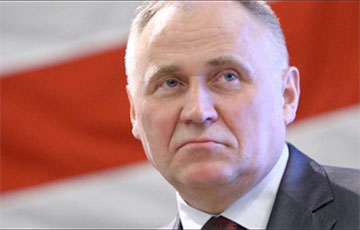
Statkevich's Choice.
On February 19, when Nikolai Statkevich returned home—having suffered a stroke after five and a half years in prison, during which he endured several bouts of COVID-19, pneumonia, a heart attack, and an attempt to expel him from the country— — I decided: that’s it, now he’s with his loved ones, free, and in Belarus. Now there’s no need to write about him—after all, we need to keep reminding people about the political prisoners who remain behind bars. But on Wednesday, Nikolai celebrated his 70th birthday, and it’s simply impossible not to write about him again.
The regime had hoped that Statkevich wouldn’t live to see this anniversary. The stroke came at a very opportune moment (incidentally, we have yet to learn the details of what preceded this stroke): they could have sent the man home to die—they saved his life but took away his voice, so let him go live out his days. And the deal with the Americans remains in effect: they promised to release him—so they did. And they didn’t even take him out of the country. But the regime still hasn’t figured out what kind of man Statkevich is. His survival rate is such that all the green, blue, maroon, and gray-brown-crimson berets can do is step aside and sit on the edge of their seats.
No, Statkevich doesn’t consider himself immortal or all-powerful. All these years (and in total, Nikolai has spent more than 12 years behind bars), he understood perfectly well that they could simply kill him in prison. He knew that Lukashenko could dispose of his life as he saw fit, but never of his choices, his conscience, or his values. And the greatest value for Statkevich is Belarus. It is to her that he has dedicated his life. It is with her that he has shared his suffering. It was for her sake that he returned to prison when freedom was just a few meters away—he just had to walk through it.
I remember a few years ago, when I was writing the story of two classmates from the Minsk Suvorov Military School who died in the war between Russia and Ukraine on opposite sides of the front, I spoke with many former officers who, in the early ’90s, found themselves at a crossroads: the USSR, to which they had sworn an oath, had collapsed, and what came next was unclear. At that time, all the new independent states began forming their own armies. And those who wanted to continue their service had to choose where to go and which country to pledge allegiance to anew. And many Ukrainian and Belarusian military personnel left to serve in Russia—the Russian army provided better rations than the utterly impoverished Belarusian and Ukrainian armies. Russian military personnel lived better. That was what determined their choice.
Nikolai Statkevich could have done the same. Especially since he had already served several years in the north, in the Murmansk region. He had plenty of connections and contacts. An experienced officer, and a candidate of sciences to boot—they would have snapped him up in a heartbeat. But he was the first—and the only one among Belarusian military personnel—to condemn the August coup in 1991 and announce the creation of the “Belarusian Military Union.” He then became one of the first to swear allegiance to Belarus on the anniversary of the Battle of Orsha in 1992—an oath that was the officers’ own initiative, which the high command strongly disapproved of. In the former Soviet Army, not even a leaf would fall from a tree in the fall without an order from a superior officer, yet here some rebellious officers decided on their own to swear allegiance to their homeland when no one had asked them to do so. It was clear that Statkevich’s military career would end there. And it did end in 1993, even before Lukashenko came to power. However, Nikolai Statkevich remained a soldier. A soldier of a free Belarus.
And everything Statkevich did afterward— — whether it was founding a party, leading people into the streets, providing protection for strikers, running for president, marching at the head of any procession, or going back to prison — he did so, like a true soldier, on the orders of his commander. His commander is freedom. His trench is wherever there is a threat to his country’s independence. His army is those who are ready to stand by his side. His love is Marina. His life is Belarus.
I hope that one day we will all celebrate Nikolai Statkevich’s birthday together in a free Belarus. And may it not be his next anniversary, but much sooner. Stay well, soldier!
Irina Khalip, exclusively for Charter97.org

Bank's name: Bank Millennium S.A.
Address: ul. Stanislawa Zaryna, 2A, 02-593, Warszawa
IBAN: PL97116022020000000216711123
SWIFT: BIGBPLPW
Name of the account holder: Fundacja “KARTA ‘97”
Purpose/title of payment: Donation for statuary aims
You can contact us by the e-mail [email protected]