


Orcas Spoke In Human Language For The First Time
3- 17.06.2026, 17:46
- 2,212
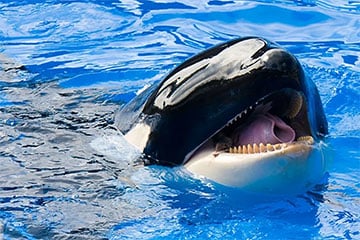
Scientists revealed what the whales said.
A few years ago, scientists observed, for the first time in history, an astonishing behavior in orcas—the whales are capable of imitating human speech.
In 2018, scientists observed orcas imitating human speech for the first time in history. The results showed that some of the ocean’s most fearsome predators have learned to mimic common phrases, including “hello,” “bye-bye,” and a long farting sound, according to IFLScience.
For decades, scientists from the Cetacean Language Translation Initiative (CETI) have been studying whale language and recently discovered that whale language is actually quite complex. The researchers studied sperm whales and found that these marine giants not only produce vowels but also diphthongs—a linguistic feature previously thought to be unique to humans.
According to the founder and president of the CETI project David Guber, thanks to the integration of linguistics and non-human communication, scientists were able to determine that sperm whales’ voices contain structures similar to vowels and diphthongs, and that they have developed a completely independent way of producing vowel sounds. It should be noted that ultimately, scientists aim to learn as much as possible about whale communication and, eventually, to learn how to communicate with them.
At the same time, in a 2018 study, scientists documented surprising behavior in orcas: over a period of time, the scientists trained the whales to imitate and reproduce certain sounds, including several words spoken by the trainer. Although the whale ended up saying words such as “hello,” “bye-bye,” “one, two, three,” and “uh-huh,” the study was motivated by observations of vocal mimicry in other animal species. This is an important factor in verbal communication and is of great significance to human culture.
The study’s authors note that comparative data have shown that, while the ability to mimic the sounds of conspecifics is largely unique to humans among primates, some distantly related taxa of birds and mammals have also independently developed this ability. At the same time, other studies have already shown that orcas possess a variety of vocal dialects, which are often referred to as traditions and cultures. It is also believed that these dialects were acquired non-genetically.
In the first part of the experiment, scientists from the Group for the Study of Animal and Human Behavior (GECAH) at the University of Madrid trained Moana, a 3-year-old male orca, to produce five different new vocalizations on command.
In the next stage of the experiment, the researchers observed a 14-year-old female named Viki as she attempted to reproduce these sounds made by Moana, doing so with ease whether the sounds were produced directly by Moana or played back through a speaker. The researchers then experimented with a wider variety of vocalizations and sounds, including six different human sounds and phrases, the creak of doors and elephant sounds, as well as a loud sound resembling a snort or a fart.

Bank's name: Bank Millennium S.A.
Address: ul. Stanislawa Zaryna, 2A, 02-593, Warszawa
IBAN: PL97116022020000000216711123
SWIFT: BIGBPLPW
Name of the account holder: Fundacja “KARTA ‘97”
Purpose/title of payment: Donation for statuary aims
You can contact us by the e-mail [email protected]