
Newsweek: Putin Is Running Out Of Cards In Big Politics
6- 22.04.2026, 9:47
- 4,328
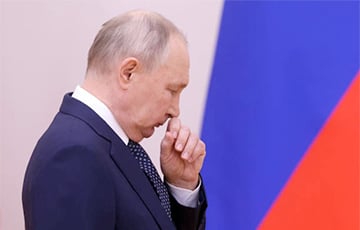
Russia is losing its superpower status.
Kremlin dictator Vladimir Putin has become a conspicuous absentee in the Iran war, only occasionally raising his voice, and even then without much consequence. This is eloquent evidence of Russia's real influence under Putin - a picture that stands in direct contrast to the bluster of some of the Kremlin's most active apparatchiks.
Iran cements the truth about Putin's Russia: despite all the Kremlin's rhetoric, it is now a second-order power that events shape more than it shapes them, writes Newsweek. The journalists emphasize, while Russia remains dangerous, it is increasingly absent from where the world's most significant deals are made.
The Kremlin's attacks as an admission of weakness
Putin's spokesman Kirill Dmitriev likes to rile up Western allies amid tensions with the United States, with whom he is negotiating a reset in Washington-Moscow relations and a settlement of the war in Ukraine.
For example, he recently claimed that "Europe and Britain will be begging for Russian energy resources." In another message, he called Starmer and other European leaders "warmongers from the UK and EU" and "leaders of chaos." Dmitri Medvedev, Putin's deputy on Russia's Security Council, has been pushing the same line in more blunt terms.
The purpose of such rhetoric is obvious: to flatter American unilateralism, to belittle London, Paris and Berlin, and to widen any visible crack within NATO. However, the facts about Russia's own situation are disappointing, the media outlet writes.
As the Carnegie Russia-Eurasia Center notes, "Russia, which has become an economically hopeless case, is mired in a stalemated and extremely costly war from which society may never truly recover." Moreover, the EU Institute for Security Studies describes the Russia-China relationship as deeply asymmetric, where Beijing has much more room to maneuver. Russia is clearly the junior and dependent partner.
In addition, NATO allies can say "no" to the US, as we have seen with Iran, much to the annoyance of US President Donald Trump. Could Moscow afford to say no to Beijing in the same way?
At the same time, the European Commission says the EU's dependence on Russian gas has fallen from 45% of imports at the start of the war to 12% in 2025, and the bloc has passed legislation to phase out the remaining imports, radically reducing Moscow's most significant leverage over Europe in decades. In this light, Dmitriev and Medvedev's attacks on Europe look like pure projection.
They insist on the weakness of Britain, France and Germany, while the facts show: it is Russia that has its hands tied in Ukraine, limited relations with China and is cut out of Europe's energy future. The rhetoric is not proof of the Kremlin's strength. It is an admission of Russia's weakness.
Pakistan got the call
A telling feature of the Iranian crisis was that it was Pakistan that helped reach a ceasefire agreement and is preparing the next round of talks. Russia has not been at the center of this diplomacy, which runs through Islamabad. Moscow has been unnecessary, even as its last remaining ally in the Middle East faces an existential question about its future.
Kremlin is a marginal power, not an indispensable force. It has no credibility or authority to play the role of crisis manager. Instead, it is relegated to the position of an outside observer with interests.
"When reports emerged that Russia was supplying Iranian forces with intelligence for strikes against U.S. targets, the White House simply shrugged: not because it was false, but because it was irrelevant to the situation on the ground," the piece said. Russia's strategic partnership treaty with Iran, signed in January 2025, has also failed to become a mutual defense pact, with the obvious implication that neither side is capable of coming to the aid of the other.
Russia's Profits and America's Choice
The strongest argument for Russia's power in this crisis is economic, not strategic, the media outlet said. Russia's revenues have risen because of high oil prices after the Gulf disruptions and the U.S. decision to ease sanctions against Russian oil, not because of Russia's ability to negotiate, contain or command conflict.
Before this influx of funds, Russia's export revenues had plummeted, its budget deficit was becoming politically uncomfortable, and calculations showed that a war in Iran would double Russia's main oil tax collections in April to about $9 billion. That's a real relief.
But it's not proof of global primacy. Opportunism is not the same as leverage. A power that profits because of Washington's policy shifts is not a creator of events. It is an accidental winner in someone else's game. And the situation could easily turn the other way.
A hard limit for Putin
A larger problem is the narrowing of Moscow's room for maneuver in its relations with China. The EU Institute for Security Studies describes a "pronounced dependency gap" that gives Beijing "asymmetric strategic flexibility."
China can realign if costs rise. Russia, by contrast, has far less leverage because it is more dependent on Chinese goods and markets, especially given its reliance on sub-sanctioned oil exports to Beijing to finance the war in Ukraine.
This is a clearer understanding of the current hierarchy than the old lazy strains about an "anti-Western axis." Russia is not China's equal in this relationship: it is a more constrained partner. This will likely become evident during Trump's postponed visit to China, rescheduled for May 14-15. Beijing's geopolitical priority is a stable relationship with the United States, its great power rival.
The strategic partnership with Russia, while very important to Beijing, is ultimately secondary to managing the relationship with the United States, which directly concerns its top priorities: Taiwan, the Indo-Pacific region, and global trade and investment. Russia, whose most important foreign relations are determined by China's discretion, is not at the top of the world order. It operates under someone else's ceiling.
Putin still has "spoiler"
Putin still has cards to play, even if none of them change the system. Russia can still increase hybrid pressure on NATO allies through cyberattacks, political interference, economic coercion and threatening rhetoric - for example, moving more explicitly to nuclear threats.
It could try to increase pressure in Ukraine while a new offensive is underway and diplomacy is stalled, perhaps by using its new hypersonic weapons such as the Oreshnik more often. Moscow could also deepen covert support for Tehran while the war drags on, raising Washington's costs, though that risks reversing any progress made with the Trump administration on Ukraine and sanctions.
These are serious threats. But they are spoiler tactics, not the behavior of a state capable of dictating a diplomatic agenda or achieving desired change through overwhelming economic or military power.
"Putin still has the cards. But they are the cards of a player with a weak hand who relies on bluffing rather than being able to dictate the terms of the game," the piece said.

Bank's name: Bank Millennium S.A.
Address: ul. Stanislawa Zaryna, 2A, 02-593, Warszawa
IBAN: PL97116022020000000216711123
SWIFT: BIGBPLPW
Name of the account holder: Fundacja “KARTA ‘97”
Purpose/title of payment: Donation for statuary aims
You can contact us by the e-mail [email protected]