
“We must remind Putin that Russia can fall apart”
8- 22.04.2026, 16:15
- 18,818
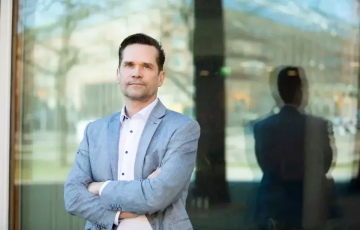
Photo: terve.fi
Moscow could run out of steam quickly.
How can the European Union respond to Putin’s threats against the Baltic states? Is China really aligned with the Kremlin? Can Ukraine defend Europe? Member of the European Parliament, former Finnish presidential candidate, and political analyst Mika Aaltola answered these questions in an interview with Charter97.org.
— China watches the unprovoked war of aggression which Russia launched against Ukraine and continues to carry on for four years and counting. What conclusions is Beijing making?
— There is a strategic link between them. To my knowledge, Putin told Xi about the war beforehand. There was at least a kind of tacit approval of the war but within certain limits: China has been saying that nuclear weapons cannot be used in the conflict. Yet within these limits of escalatory window, China gave Russia free hands and has been providing supplies to Russia. Without the backbone of Chinese investments and Chinese sources of technology — like drone technology — Russia wouldn't have survived this war. One could say that the Chinese hand is behind the fact that Russia has been able to fight for four years.
It is naive to say that with one phone call Xi could stop the war. I think, the time for that phone call was a couple of weeks before the war. After that, there was approval from China — at least some sort of a green light to do what Russia was going to do.
But there was, of course, an unpleasant surprise for China — because they like the concept of harmony so much — that the war didn't go very well. The Russian failures in the war caused, I'm sure, head scratching in Beijing — how messy the war became. China doesn't like messy situations.
So, strategically they are allies, but politically Russia and China sometimes have disagreements. Russia wanted to get more support from China — they were desperate. They got some oil and gas deals, some Chinese investments, but nothing like an overwhelming type of support. China was also careful not to be too much associated with the Russian war because nobody knows the outcome of it.
Right now tactically Russia has won some victories, but strategically they are losing the war. Because they can not reach the strategic aims of the war: to swallow Ukraine, go to the Polish border, threaten Central Europe — basically cause a situation where Europe would have to either face a war or give Russia quite a lot — a new security order, with a return to the pre-1997 situation. That's how they frame it. So tactically yes, victories — but strategically, a loss.
—Clearly in the beginning China was taken aback — it was not "Kiev in three days" as promised. But today, four years later, has China become more audacious towards Taiwan, or more cautious?
— There is a Chinese saying that the best war is a war where you win by not fighting it. There is also a saying attributed to Napoleon, Never interrupt your enemy when he is making a mistake. Trump is very radical as a president. He radically believes in American military might and the hard power component. He doesn't care much about soft power or loss of reputation. So, from the Chinese perspective, I think, right now it's best to stay out of the situation. They see that the West is getting more divided — that's good for them.
At the same time, there is growing nationalism in China, combined with the decline of economic growth. When the economic justification for one-party rule is no longer there, then perhaps the more nationalistic justification takes over: unification of China, taking over Taiwan, threatening territorial expansion. Recently, they established a new artificial island very close to Vietnam. They are making moves constantly, changing the status quo in the surrounding regions.
We now have two global wars — Russian aggression in Ukraine, and the Middle East in flames. Wars usually lead to further wars. For China there is a dilemma. Although Putin failed to demonstrate the leadership he hoped for, yet he still did do something. Trump also has been failing, perhaps, to show clear leadership, but he has been doing things. But China hasn't been showing anything from a traditional angle. There's a question mark: is China able to show anything?
I don't know what Xi is thinking right now. He has been cleaning the military leadership, which shows either dissatisfaction with the leadership or that he's preparing something — wanting the lines to be in order, loyalty to be maximum, in preparation for something. That is one of those known unknowns: we know that China is going to take over Taiwan, but we don't know the date.
— How does the war in the Middle East influence the developments on the battlefields of Ukraine?
— When the Russian aggression had started, Ukraine needed weapons. In the beginning, Ukraine had a very limited number of effective anti-tank missiles from the US and some drones from Turkey. What Europe had was money — macro financial assistance for the Ukrainian state — and that was important. But you cannot fight wars with money. You cannot shoot with euros at the front line.
But gradually the situation has turned. Ukrainians are becoming more self-sufficient in fighting the war. They have the best drones. They have missile capabilities that many of us here in the European Union only dream about. They have long-range missiles — we are just thinking about developing something years from now. Right now you can fund Ukrainian defense companies or collaborations between Western and Ukrainian defense companies and thus fight the war. That's a big change. And the costs for Russia are growing. Yes, Russia is a big state, 140 million people, but still they have wasted about a million casualties in the war.
The situation was desperate when the war started. But now there's more and more hope and self-confidence. A year ago there was a period where the US decided to cut down all the aid besides intelligence aid, and they were trying to force peace onto Ukraine — that would have given Russia quite a lot. It seems that in Alaska there was overall agreement on a kind of partnership between Russia and the US. Trump has this strange fascination with Putin and the ideas of a reverse Kissinger (the detachment of China from the Soviet sphere in reverse). The overall geopolitical game is this: Washington wants to give Russia something in return for a system where China is more isolated. But I think they are mistaken in Washington, because for Russia this is a very beneficial situation — if you can milk two cows, China and the US at the same time, it's better than one cow. Russia has historically always wanted to be in a position where they can have allies of different types. But in the end the Trump administration's attempts will turn out to be foolish in this respect when it comes to Russia.
— The way you see it there is a conscious policy of the Trump administration to decouple Russia from China?
— Trump, in his usual way, reacts to a particular moment in a kind of emotional way — he doesn't give you geopolitical strategic plans. But the Vice President and the Secretary of State have both been expressing their hopes that an arrangement of this type could be made with Russia. They have said it in multiple interviews.
— What is your assessment of the threat Russia potentially poses to the Baltic states?
— We have to take those seriously, but Russia is not the Soviet Union. It is not even the Russia we thought it to be before the war. It's weaker. But there is a saying in Finland: Russia is never as weak as you think, and never as strong as you think. So it's something in between. What they are actually doing is showing their muscles, threatening this or that country. We should be prepared for the eventuality of war, because it could be that war is coming. Putin made foolish decisions before. It could be a different type of war, because the American National Security Strategy now says the US is going to defend Europe or NATO — if, and that's a big if — if it is in the American national interest. So there might be an incursion, something below the threshold of war, drone warfare or missile warfare that they claim is for the self-defense of the St. Petersburg region, for example. Something low-scale — I could imagine incursions across the border. But nothing major. They are contained right now. Ukraine is sucking all the resources they have, so starting another war would be very difficult for them.
— But if that eventuality should occur — if there is a minor incursion into the Baltic states from Russia in one form or another — what is the responsibility of Northern Europe and Finland in particular?
— The Northern European role is growing, and we see the world in the same way. Countries from the UK to the Netherlands, Denmark, the Baltic states, Poland, Sweden, Finland, and Norway — there is a common assessment of the Russian threat. I think Northern Europe is very solid. And if you think about the resources — the European Union's gross national product is 10 times bigger than Russia's. We have close to 500 million people living in the European Union. We have potential deterrence that is huge, and we have been trying to make that potential deterrence into actual deterrence. But I think we have been a little bit slow. I could be critical on that. We are thinking about a 90 billion loan to Ukraine — how about making it 10 times bigger, close to a thousand billion, not only for Ukraine but for common defense and industrial projects? That would make Putin blink. Because then he would see that there's so much resources being mobilized that he cannot match those resources. That would be one easy way and quick way to end the war.
But instead we decided when the war started that let's have sanctions packages (now there are like 29 of them). Actually we have been prolonging the war. We could have stopped it right away. Americans under the Biden administration were saying just before the war started, "Let's shift Russia away from the dollar economy," — that would cut off its sources of revenue. But Europeans were resisting that idea because too much economic chaos would have been caused by that because of the European dependence on Russian oil and gas at the time. So, we owe it to Ukraine. They have been fighting for four years and it is partly our fault that we have been prolonging it for so long. We have to act decisively. If there would be Russian tanks coming across the Finnish border — we would destroy those tanks. Russia knows that, and that's the reason why they would never send any tanks across the Finnish border.
— When I talk to experts they note that Finland is very well prepared for any Russian threat in comparison to other countries. What is so special about Finland's preparations?
— European Union member states taken all together have a reserve of about 3 million. It's bigger than the Russian reserve. Out of that 3 million mobilizable troops, 1 million comes from Finland.
There is a national conscription system — if Finland is existentially threatened, it fights back very hard. The best deterrence is our unified population. If you ask Finns, are you ready to defend the country even if the outcome would be uncertain? 95% of Finns answer, "Yes." Our national historical experience shapes the deterrence level. So, it's not the weapons as such.
Russia has learned that if you existentially threaten a country — Ukraine — it fights back. The willingness to defend is the first step. They didn't have enough weapons but they were ready to defend the country. That what actually stopped Russia 30 kilometers north of Kyiv. People were observing where the Russian troops are, they were posting that in Telegram. So, the Ukrainian eyes and ears were all over the place. It tells you something about the unity of the nation. It's very difficult to beat.
— Let's compare the European Union and Russia potentials. On its surface they are incomparable. Whichever metrics you take, be that quality of life or the number of navy warships, the European Union is much mightier than Russia. What can Brussels do so that Ukrainians feel that their ally is much, much stronger than their enemy?
— The European Union's gross national product is 10 times bigger than Russia's. We have close to 500 million people living in the European Union. So we have a potential deterrence that is huge. And now we have been trying to make that potential deterrence into actual deterrence.
Then, we have been talking about a coalition of the willing to send troops to Ukraine if there would be some kind of a pause in the fighting. We, of course, should not ask for Putin's permission to do that.
I know that there are hesitations in Europe to become a party to the war. But I think hesitation has been the main problem from the very beginning. The response to Crimea was weak — nothing from Europe; Obama's response was very alike. He was saying to Ukrainians to stay off, he was going to handle this with sanctions. It is supposed to be clean — nobody has to die here, let's just do a sanctions package on Russia and Russia will then revert. And there were a lot of talks. Hesitations led into talk about giving Putin an opportunity to save his face. We should have taken much bigger actions back then. In Belarus 2020 — we were weak. So, there's a series of Western weakness and indecisive actions that have allowed room for Russia to do what it is now doing. We should stop the hesitations and think in terms of Ukraine as a European fortress. We are not assisting them because we like freedom and democracy. We are assisting them because we like our own security. They have been carrying huge responsibilities and burdens. What is needed from Europe is decisive actions to make Russia blink. And as you know, when there have been losses for the Russian army in history — 1905 when they lost to Japan — that has always led to internal consequences in Russia.
We should remind Putin that Russia can disintegrate. Russia can lose. He can lose his power. The more we make bold statements of this kind, the more Putin listens to us. Right now we are basically yielding him quite a lot of space. We don't talk anymore that much about Belarus. We have been sidetracked by American approaches because they do what they would do with Russia or Belarus — they like to make a good deal. It doesn't matter to them if you're a democrat or autocrat, or a totalitarian leader.
What Trump likes is two things: deals and prestige. When he says that he wants to have a Nobel Peace Prize, he actually likes the idea because he thinks of himself as a great man of peace. And he also thinks of himself as a great man of war. So he sees himself as a hero of a very odd, paradoxical period in world history.
And we should remember one thing about European civilization: we have always been pulling it together when there have been external enemies.
— Let's look at the future Russia after the war is over: an impoverished state with hundreds of thousands of men who know how to handle weapons but at the same time don't have visible appreciation of basic values such as the value of human life. How do you deal with Russia as a next-door-neighbor in the future?
— After the First World War, Germany was facing the same situation. They had to reintegrate soldiers from the front, and partly the failures of the Weimar Republic had to do with the failure of integrating millions of those soldiers. Russia is facing the same problem.
Ukraine is also going to face that problem — 800,000 is a big army. We have to think also about that.
If the Americans are really eager to withdraw their 100,000 troops from the continent, then the question becomes where we can get something that is militarily experienced. I would say that we could partly solve the problem by creating a European rapid reaction force based on Ukrainians, paying salaries, having them in different states. So I see opportunities here.
It is a big challenge that Russia and Ukraine are going to face after the war, if the war ends within the next five years. But we can help Ukraine.
Russia is going to be a big question mark. It has always been that. Russia's borders have no limits, as Putin says. The modus operandi of Russia is to expand. The modus operandi of Finland is to defend the country. We have no dreams of crossing the border. So that's going to be an issue — how Russia can deal with its legacy of aggressive imperialism.
They know how to influence, they are running active influence campaigns here inside the heart of Europe. Russian intelligence services spend about 70% of their budgets on active influence and destabilization operations. We haven't been matching that. Russia is spending billions on destabilization and doing really active operations.
We should influence Russians directly, message them through different means. We should do destabilization in the sense of spreading democracy to Russia. We should invest money into that. We should create modern means of doing it, something akin to Radio Free Europe but in a modern way. But we are hesitating. That's the problem of Europe. Of course, the European Union was created to be slow. It's an example of balancing of power in such a way that it actively tries to prevent any leadership, because the member states have always been fearful of somebody taking the lead. The system is created to hesitate and to be slow. But once it is moving (and right now it is moving it's difficult to stop that movement. It is a different type of engine than what Russia has. Russia is very quick in moving, quick in reacting. But it might run out of steam much faster than we can predict.

Bank's name: Bank Millennium S.A.
Address: ul. Stanislawa Zaryna, 2A, 02-593, Warszawa
IBAN: PL97116022020000000216711123
SWIFT: BIGBPLPW
Name of the account holder: Fundacja “KARTA ‘97”
Purpose/title of payment: Donation for statuary aims
You can contact us by the e-mail [email protected]