

Ales Bialiatski Spoke At The University Of Warsaw
8- 22.04.2026, 8:48
- 2,582
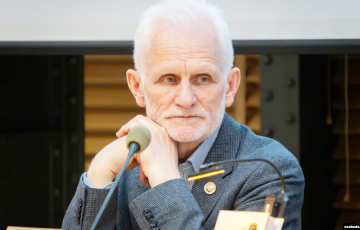
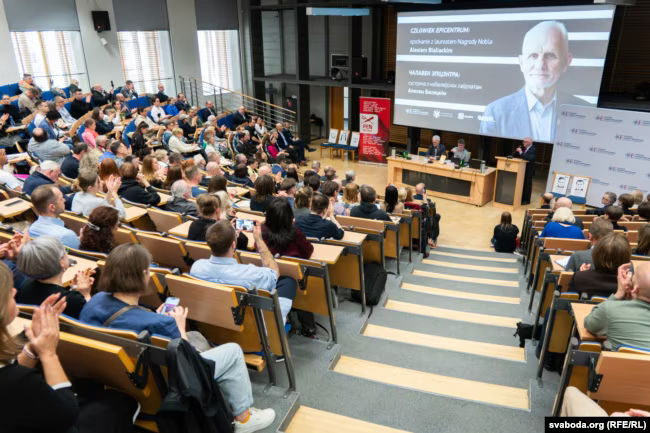
The auditorium was full.
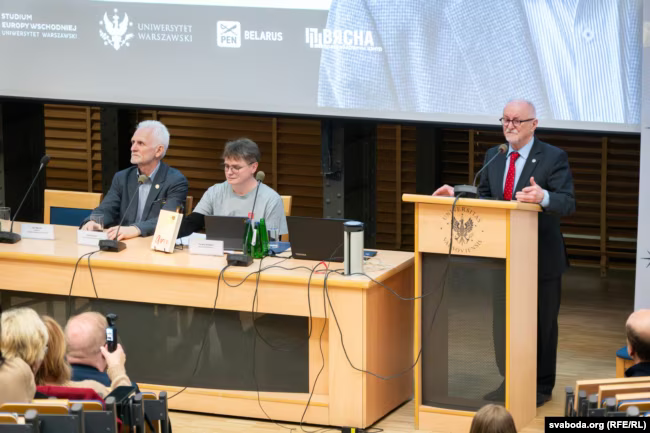
April 20, the University of Warsaw hosted a meeting with the winner of the Nobel Peace Prize in 2022, head of the Human Rights Center "Viasna", former political prisoner Ales Bialiatski, reports Radye Svaboda.
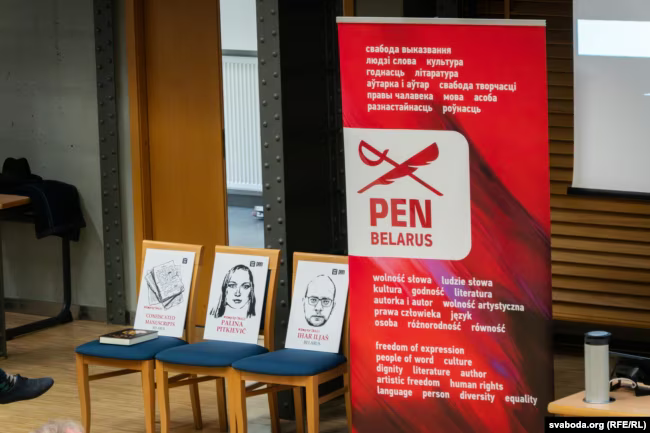
On the evening of April 20, chairs with portraits of Belarusian prisoners, who are now behind bars: Andrzej Poczobut, Igor Ilyasz, Polina Piatkevich and others, as well as a symbolic separate chair for manuscripts, left in prison and possibly destroyed there, were placed in the large historical hall of the University of Warsaw.
There were many famous people in the audience: Poland's first ambassador to Belarus Professor Elżbieta Smulek, director of the Center for East European Studies, head of Kalinowski's program Jan Malicki, diplomats, writer Vladimir Orlov, former political prisoners Maksim Znak, Olga Filatchenkova, counselor to Svetlana Tihanovska Franak Viachorka, as well as Belarusian democratic activists and Polish students.
Opening the meeting, the head of the Belarusian PEN Tatiana Nedbai noted that about 900 political prisoners remain behind bars. Ales Bialiatski expressed hope that all of them would soon be released.
"Maybe the manuscripts are in the KGB, or maybe they have already been burned."
The first question to Bialiatski was about the books he wrote in prison, which he was not allowed to take away upon release.
"Here and Maksim Znak, who wrote 22 books in prison and read even more. By the way, it's only now that I've seen him. In July 2021, I found myself in the so-called "Shanghai". - a few cells on Volodarka, in its cellars. Maxim Znak was in the neighborhood. After spending three days there, I realized that it was not yet "hell", but already "purgatory". The cells were overcrowded, the heat..." - Ales recalls.
In the pre-trial detention center there was time to write books. They took him for interrogation once a week. But Bialiatski refused to testify, citing Article 27 of the Constitution (the right not to testify against himself).
"I forced the investigator to ask questions in Belarusian, and she prepared in advance - translated them. Our meetings quickly ended because I refused to answer. I spent almost a year in that cell, then in another cell - closer to the "suicide bombers". And I wrote two books in the detention center. But not twenty-two, like Maxim Znak. The censor then said: "Just don't write about Lukashenko and don't write about prison," recalls Bialiatski.
Some fragments he sent to his wife Natalia in letters. But when Russia's war against Ukraine began, political prisoners were banned from correspondence.
"What to do with the manuscripts? I left them in a warehouse in the hope that if we were released, they would be returned. There was our sentence - almost 400 pages long. And a letter from the tax office - to pay the tax on the Nobel Prize," Ales recalls with a smile.
But he was released without documents and manuscripts - probably, there was a strict order not to return anything.
"Maybe the manuscripts are in the KGB, or maybe they have already been burned," he suggests.
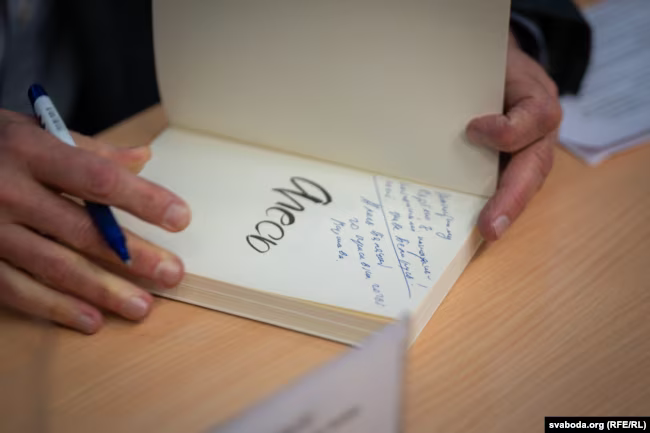
Belyatski thanked the Belarusian PEN for the book "Ales", published during his imprisonment. The cover was shown to him at the trial, but he was able to read the book only after his release - and he liked it.
When asked how he held up in prison, Bialiatski joked that "a writer must have a tight ass." He said that he had to work hard in prison:
"You take a wheelbarrow - and go. Or a shovel. The hard labor was exhausting. I worked in a woodworking shop, pounding pallets. After work you could hardly drag your feet."
"If they had told me in 1996..."
Belyatsky recalled the creation of the human rights center "Viasna" in 1996. At that time, the Chernobyl Shlyakh actions gathered tens of thousands of people protesting against integration with Russia.
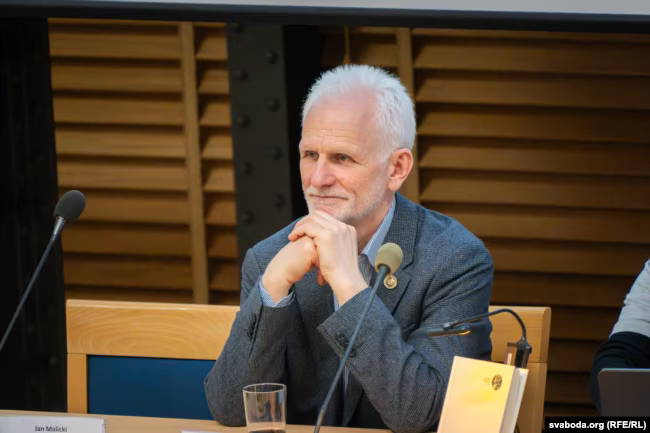
"If I had been told then that Viasna would work for 30 years, I would not have believed it. I'm a literary scholar, I love writing, I didn't want to be a human rights activist. But life has set such tasks."
He also told the story of the registration of the organization:
"Officials are sitting, drinking. They ask, "Will you be with us?" - "No." - "How do you want to register: quickly or according to the law? Quickly - two bottles of cognac and in two weeks registration. By law - a month." I chose the law".
In 2003 "Viasna" was deprived of registration, but it continued its work.
Bielatski emphasizes the importance of the Belarusian language:
"Without the Belarusian language we will dissolve. We will be torn apart. Officials, army, civil servants must know the Belarusian language."
He even tried to speak Belarusian in prison and demanded to conduct the trial in this language, but was refused.
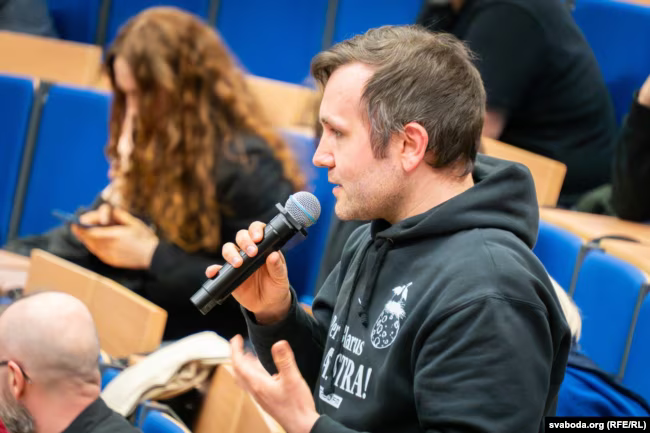
"Books in Russian should be published in Russia."
He believes that books by Belarusian authors should be published in the Belarusian language:
"Russian can be used by those who speak it. But books in Russian should be published in Russia."
This position caused great applause, but also discussion.
"It is necessary to return the soul to the people."
Beliatski believes that the main problem of Belarus is the Soviet legacy:
"Belarusianization is necessary, it is necessary to return the soul to the people. The chances of the current regime to hold on to power are minimal."
Beliatski noted that the EU provides serious support to Belarus, although there are problems (visa, banking).
He believes that Belarus is important for Europe:
"If we forget about Belarus, it's dangerous for Europe. It is both migration and destabilization of borders."
He expressed hope for the end of the war in Ukraine and stressed:
"We will catch up with other countries. Belarus will be surrounded by democratic states."
Polish Attitude
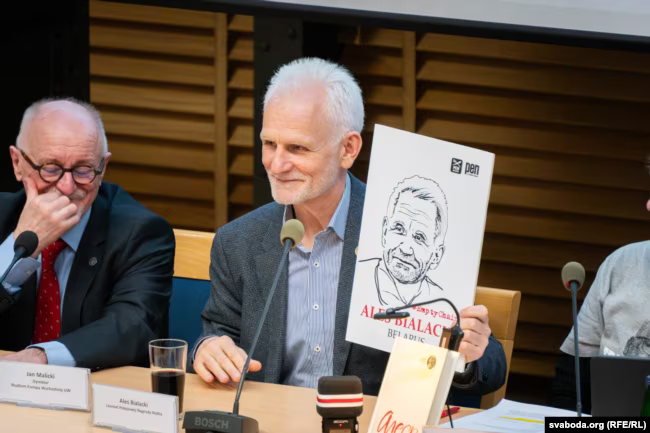
Bielacki noted that Polish society supports Belarusians:
"You are our reliable ally and partner. This is very important."
And he added:
"Let's continue this work - it will be for the benefit of our peoples, as it has been for centuries."

Bank's name: Bank Millennium S.A.
Address: ul. Stanislawa Zaryna, 2A, 02-593, Warszawa
IBAN: PL97116022020000000216711123
SWIFT: BIGBPLPW
Name of the account holder: Fundacja “KARTA ‘97”
Purpose/title of payment: Donation for statuary aims
You can contact us by the e-mail [email protected]