
"After He Was Fired, Things Started To Come To Light That We Hadn't Known About At All."
3- 1.10.2026, 12:14
- 10,360

The Belarusian man has been trying to get his salary for four years now.
For nearly four years, former employees of a Mogilev-based design firm have been trying to collect the wages they were never paid before being laid off. The employees won their court cases and appealed to the prosecutor’s office, the Federal Tax Service, and other government agencies, but some have still not received a single ruble. The company was declared bankrupt, and the court ruled that more than 340,000 rubles should be recovered from the business’s founders. “Onliner” spoke with one of the former employees and figured out why even a court ruling does not necessarily mean the money will actually be returned.
“At first, they were delayed by a couple of days, and then the pay practically disappeared”
At first, Alexei (name changed at his request) had no reason to quit his job: he was getting paid, projects were moving forward, and the company was still operating. He took the first payment delays as a minor inconvenience that would soon be over. As a result, he still hasn’t been able to receive his salary for two months of work.
“I started working at ‘Brandproekt’ on March 21, 2022, and at first I didn’t think for a moment that any serious problems might arise. It was a fairly well-known design firm in Mogilev that had been quite successful in its day. The office was located in a nice business center practically in the heart of the city; it was easy to get to, and I was satisfied with the salary.
According to the contract, salaries were supposed to be paid twice a month. The money came in, and I didn’t notice any serious problems. It turned out later that some delays had started even earlier—in 2021—but when I was hired, I simply wasn’t aware of all these internal details.
And even if the paycheck is delayed by two or three days, you don’t immediately think that the company will soon stop paying altogether.
Gradually, those two or three days started turning into a week, and by the end of summer, the delays were already reaching about a month. What’s more, for a while they were still paying out money selectively—meaning one employee might get paid while another kept waiting. By the end of September, the situation had gotten really bad; payments had practically stopped. In the end, I worked until December 13 and effectively received no salary for the last two months.
Of course, no one told us right away that we wouldn’t be paid for several months. We were constantly asked to wait a little longer.
The explanations varied, but most often it all came down to the Russian clients for whom we were carrying out projects. We were told that the clients hadn’t yet paid the company, so we had to wait for the money, and only then would our salaries be paid to us. At the same time, we were constantly in contact with Russian colleagues about work-related matters and tried to gently probe them to find out whether there really were payment issues.
As far as I understood at the time, the money for the work we’d done was actually coming in, so we naturally wondered where it was going and why none of it was reaching the employees.
There were about 50 people in the organization in total, though it’s hard to give an exact number because some people worked remotely. When it became clear that the situation wasn’t changing, employees began gradually resigning; some took unpaid leave, and many were simultaneously looking for a new job. I, too, kept coming into the office and doing my job until the very last days, even though by that point I was already looking for another company. Fortunately, I had a side job, so I managed to get by during those two months.
But there was no point in continuing to work indefinitely for nothing but promises.
In December, I resigned by mutual agreement. At the time, we were a bit hesitant to risk further conflict and state that we were resigning due to the employer’s violations, so many of us simply collected our documents by mutual agreement.
“We won the lawsuit. But that didn’t bring us any more money”
Then a whole new phase began—dealing with lawsuits, enforcement orders, and attempts to get the employer to pay the money they owed.
— When they stopped paying salaries altogether, employees began filing lawsuits en masse. As far as I recall, this began back in the fall of 2022, and from then on, one after another, people filed lawsuits to recover unpaid wages and compensation for late payment. Moreover, there were no complicated proceedings; the courts sided with the employees, granted our claims, and recognized the debt.
I also received a court ruling in my favor and thought at the time that the hardest part was already behind me. If there’s a ruling stating how much you’re owed, then surely they’ll just collect that money. But it turned out that winning a court case and actually receiving your wages are two completely different things.
Personally, I’m owed about 5,500 rubles; the amounts owed to other employees varied widely—from about 1,000 to 15,000 rubles.
The documents were submitted for enforcement, but in all this time, I personally haven’t received a single kopeck.
It’s a rather absurd situation, because no one is disputing the fact of the debt itself anymore—there’s a court ruling, there’s a specific amount they owe me—but almost four years have passed, and the money is still nowhere to be found.
To figure out what’s going on with the collection process and what can actually be done next, I had to consult lawyers and pay them out of my own pocket. That’s probably why some former employees just gave up at some point, especially those who were owed a thousand or two rubles. When a person spends several years dealing with paperwork, spending time and money on lawyers, and sees virtually no results, they simply lose the will to continue.
As a result, some employees withdrew their claims and effectively forgave the company this debt.
As far as I know, a representative of the former management personally visited some employees—especially those owed large sums—and the people signed documents waiving their claims. No one came to me with such an offer, and I did not waive my 5,500 rubles.
Looking at the situation as a whole, at one point the wage arrears alone exceeded 300,000 rubles. Then it decreased to about 200,000, partly because some people waived their claims. And if we factor in taxes, government fees, and the organization’s other obligations, then, according to the information we have, the total amount of debt exceeded half a million rubles.
“After we were laid off, things started coming to light that we had no idea about at all”
The longer the former employees tried to get their money back, the more questions they had—and not just about unpaid wages.
— It wasn’t until after we were laid off and went through the courts that things began to come to light that we had no idea about while we were still working there. For example, I started looking into my insurance record and discovered that there had been problems with contributions to the Social Insurance Fund during my last three months of employment. While we were working, no one told us about this, of course, and we only found out later, when we started making inquiries ourselves and sorting through the documents.
— How did you get paid?
— Some of the money was transferred to a card, but only pennies were deposited there; the bulk of the amount was paid out in cash. When we began to dig deeper into this story, it turned out that there were several affiliated companies, including some in Russia, through which the project work was carried out. Who was a founder where, who was a manager, and how the work was divided among them—it was very difficult for an outsider to make sense of all this.
There were three main founders. At some point, the directors changed, other organizations were created, and work on the same projects continued through these new legal entities.
“Over three years, they billed almost everyone. People never received their salaries.”
By the end of 2024, the situation had escalated to bankruptcy, but even that did not put an end to the dispute between the former employees and the company. At the same time, the employees tried to figure out what role the company’s executives played in what was happening.
— In December 2024, the commercial court initiated bankruptcy proceedings against the organization, and a crisis manager was appointed. We had hoped that, at least at this stage, we would be able to resolve the debts and find a way to pay the employees, but in reality, we never saw any money.
Over this entire period, we were able to collect some small amounts, but they hardly ever reached the employees because tax liabilities were settled first. As far as we understand, very little was recovered from the organization’s own assets—in fact, it was just some old items that couldn’t have had a significant impact on the size of the debt.
— And what happened to the company’s founders?
— Initially, the company was run by a married couple—let’s call them Alexei and Marina. As we later discovered from the documents, Alexei was the one who initiated the company’s creation; he was also, as the court later determined, the one who set the main directions of its financial activities. Officially, however, 95% of the company belonged to Marina.
The remaining 5% went to Sergey, who was appointed director. When I started working there in the spring of 2022, he was the one running the company. In the fall of 2022, it was decided to remove Sergey from his position as director, and in February of the following year, he sold his 5% stake to Marina for 7 rubles and 50 kopecks. After that, Alexey became director, but he remained in that position for just over a month. Control of the company was then transferred to another affiliated organization headed by Marina.
As a result, as far as we know, Alexei and Marina left for Russia and obtained citizenship there, while Sergei was the only one of the three to remain in Belarus. According to rumors, a criminal case was opened against this couple in Russia, but of course we couldn’t verify this on our own, which is why we began contacting various authorities with a request to investigate the company’s activities and its management. The first collective appeal to the prosecutor’s office was in March 2023. We asked them to investigate the situation and consider opening a criminal case, but our request was denied.

Over the course of three years, we appealed to the Mogilev Regional Prosecutor’s Office several times, wrote to the General Prosecutor’s Office twice, and appealed to the Department of Financial Investigations, the regional office of the State Labor Inspection Department, and the Mogilev Regional Executive Committee. We tried to reach out to the Assistant to the President and the Chair of the Council of the Republic. We submitted documents, explained the debt and the organizations involved, and asked them to investigate what had happened to the money.
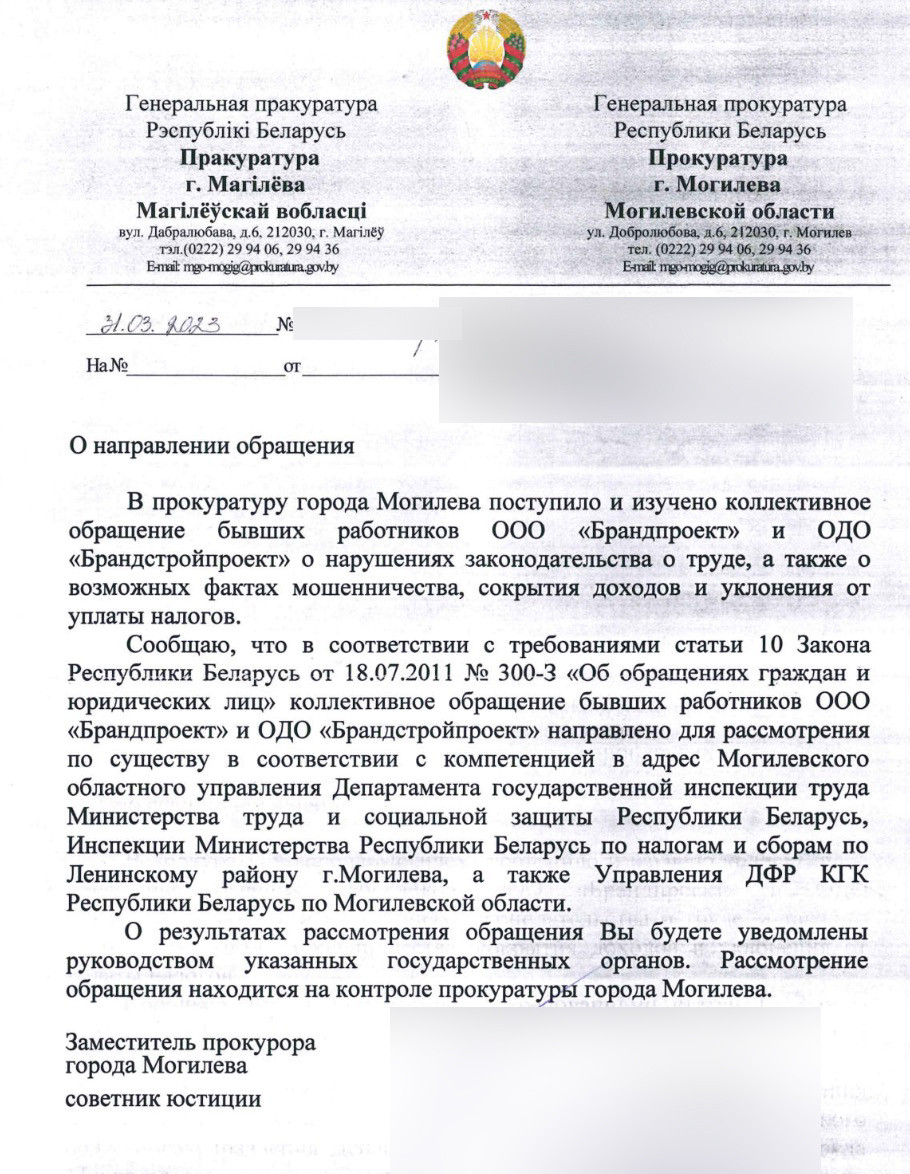
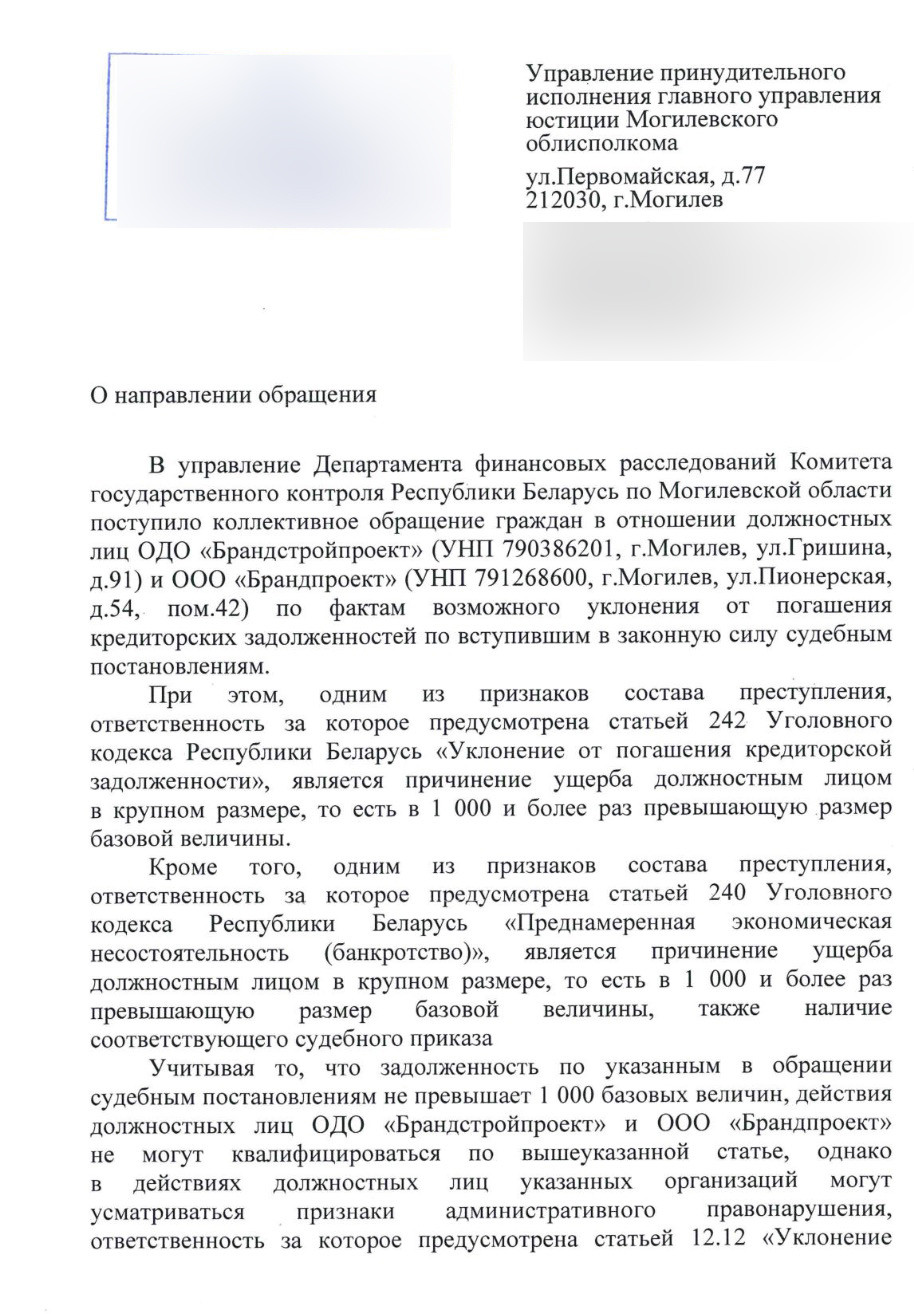
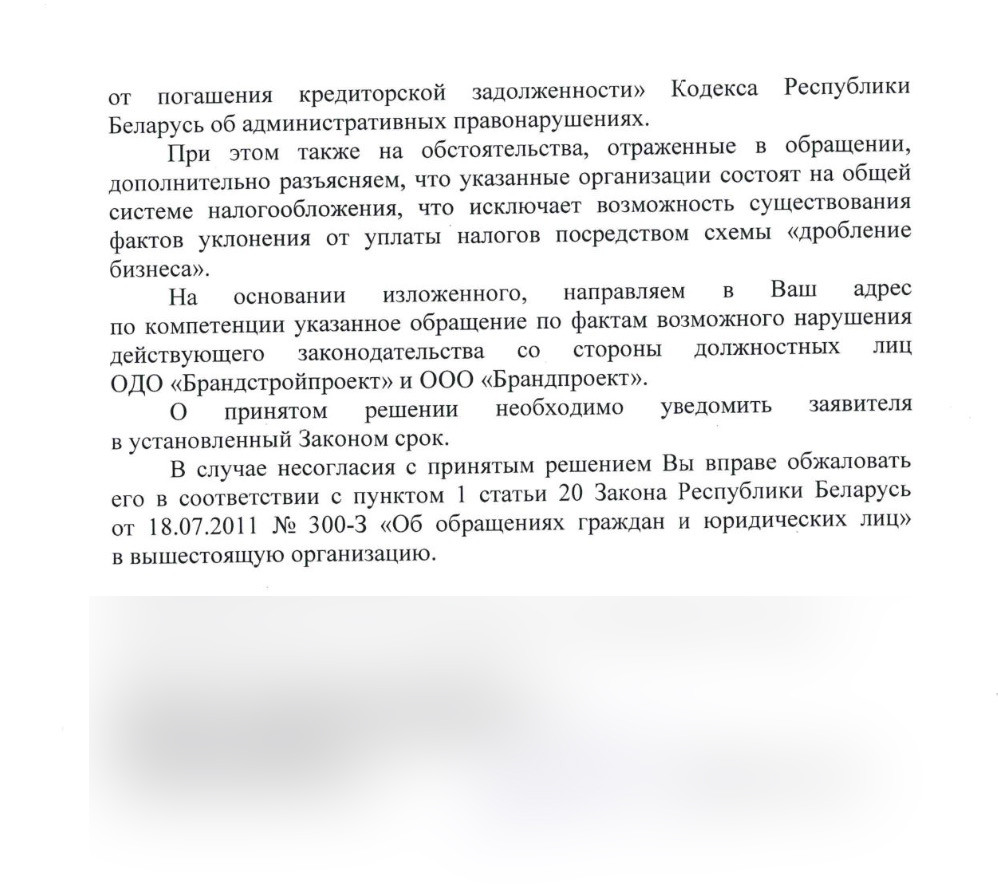
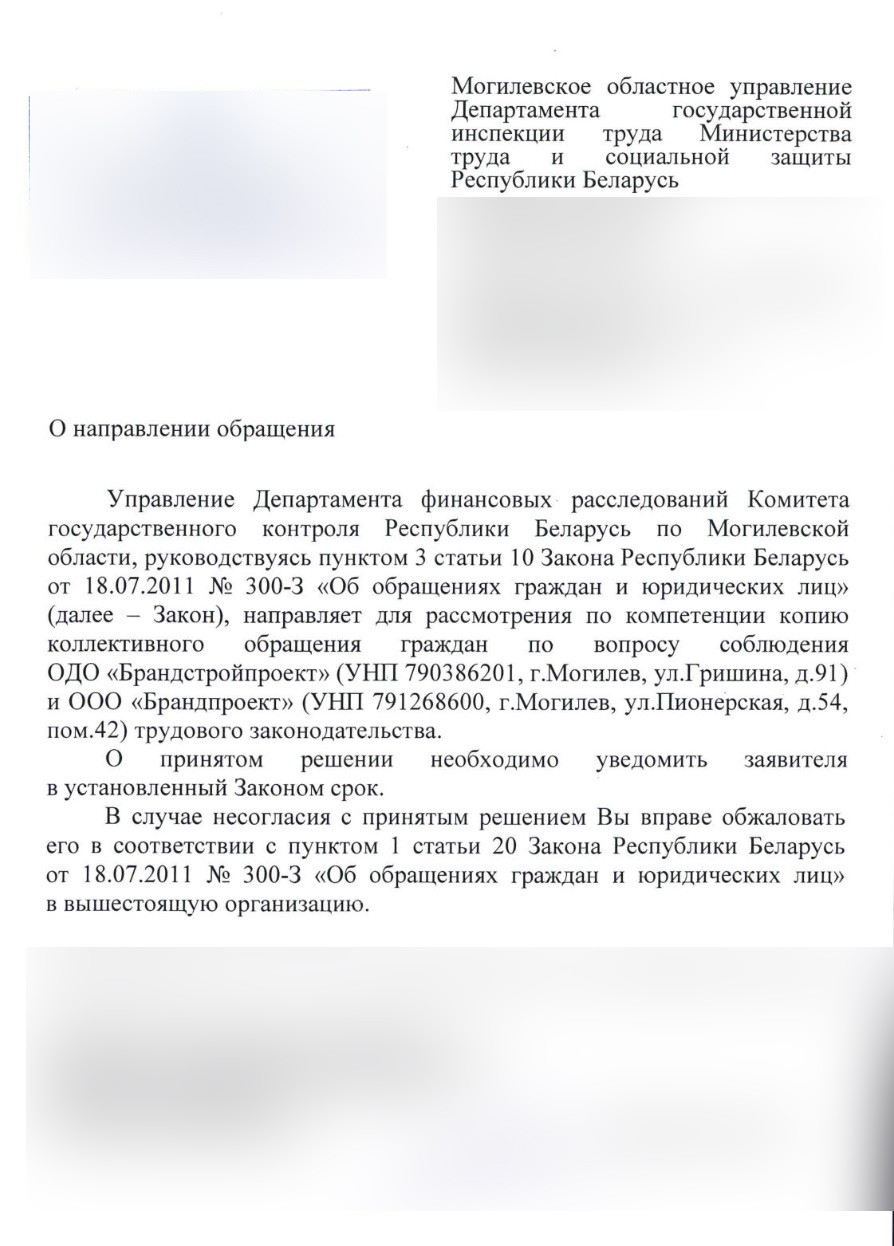
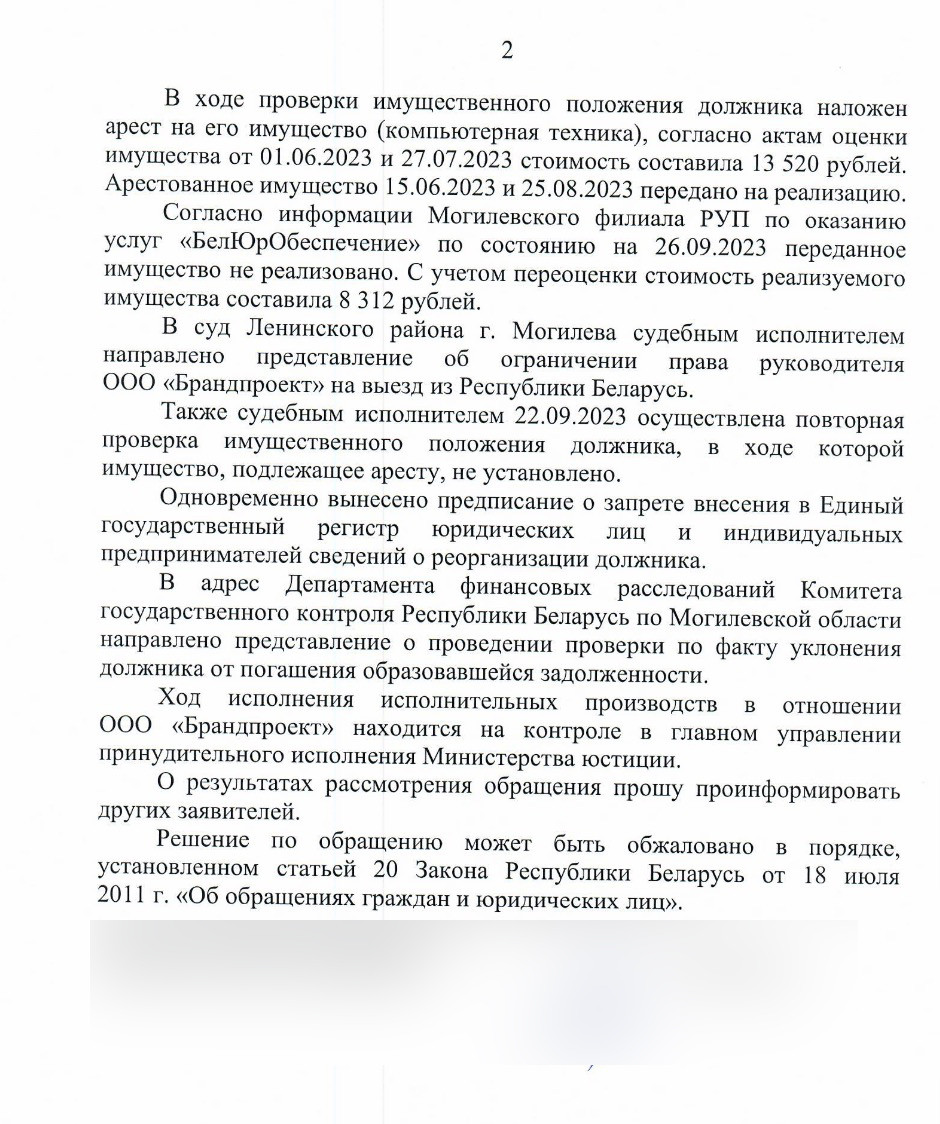
However, these appeals did not yield any results that would have helped us receive our salaries.
It was decided to collect the company’s debts from its management
In December 2025, a creditors’ meeting decided to seek to hold three individuals liable on a subsidiary basis—individuals who, as the court later determined, had the authority to direct the organization’s actions. Simply put, if the company’s own assets were insufficient to repay the debts, they intended to collect the money directly from those individuals.
On April 1, 2026, the Economic Court of the Mogilev Region granted the claims in full (the court’s decision is on file). All three were held subsidiarily liable, and the court ordered them to pay 340,537.26 rubles jointly and severally. This amount included unpaid employee salaries, debts owed to the state budget, and other company obligations.
The case file also states that the company transferred large sums to affiliated organizations and individuals in the form of interest-free loans, and also assumed payment of third-party obligations. The court concluded that such transactions were not consistent with the project company’s normal business operations. Moreover, new loans were issued even when previous ones had not yet been repaid.
According to an expert’s report, the company was still solvent at the end of 2021, but by the end of 2022, its insolvency had become permanent. The expert assessed some of the interest-free loan transactions as having been entered into on terms that were knowingly disadvantageous to the company. The court linked these actions to the subsequent bankruptcy and concluded that all three had the ability to determine the company’s actions.
Simply put, more than 340,000 rubles will now be recovered not from the bankrupt company, but from the executives whom the court held subsidiarily liable.
And what does the former director have to say? His position turned out to be different
We tried to contact Sergey, the former director of the company, but he is not yet ready to speak with a reporter. However, his position is laid out in detail in the court documents.
Sergey did not agree with the decision to hold him subsidiarily liable. In court, he insisted that the interest-free loans and the payment of the affiliated company’s obligations were part of normal business operations. According to his account, the money went, among other things, toward salaries and taxes for another organization, and some of the loans issued were subsequently repaid.
Sergey also drew the court’s attention to errors in the calculations and asserted that the company’s own assets were sufficient to settle with creditors. Separately, he pointed to the accounts receivable of the affiliated organization, which, in his opinion, the crisis manager should have attempted to collect; therefore, Sergey saw no grounds for him to be held personally liable for the company’s debts with his own money.
The court took these arguments into account but ultimately granted in full the claims seeking to hold him and two other defendants liable on a subsidiary basis.
We won the case—but how do we get paid now?
To understand what employees can actually do in such a situation and how to secure actual payments following a ruling on subsidiary liability, we turned to attorney Tatyana Revinskaya for comment.
— Since June 21, 2026, Law No. 134-Z has been in effect in the Republic of Belarus, introducing unconditional subsidiary liability of business owners for wage debts in the event of bankruptcy. This means that if a company has no assets left, the debts are transferred to the personal assets of its founders.
Previously, the liquidation of a company effectively “wiped out” all its debts if the legal entity had no assets, and it was extremely difficult to prove management’s guilt in court. Now, with regard to “social” debts—salaries, vacation pay, severance pay, and compensation under contract agreements—it is no longer necessary to prove intent or fault on the part of the founders in driving the company into bankruptcy. The mere fact that the firm closed and left people in debt is sufficient.
For the director, chief accountant, or liquidator, the rule remains the same: they will be held personally liable if their specific fault is proven—for example, if they intentionally siphoned off assets while knowing about the debts owed to people, or if they failed to file for bankruptcy in a timely manner.
Debts are allocated among the founders in proportion to their shares in the authorized capital.
The new rules on strict liability apply to companies for which insolvency or bankruptcy proceedings were initiated after June 21, 2026. If bankruptcy proceedings began earlier, employees will have to prove management’s fault in court under the old rules.
A claim for subsidiary liability may be filed within three years from the date the company is removed from the Unified State Register. If this deadline is missed, it will no longer be possible to recover the funds.
What steps must employees take to recover such debts? First and foremost, they must verify the company’s status. They must request an extract from the Unified State Register or check the information on the Unified State Register portal to determine exactly when the company was officially removed from the register and under what procedure: ordinary liquidation or bankruptcy.
Next, you can contact the State Labor Inspection Department. By law, the State Labor Inspection Department of the Ministry of Labor and Social Protection and its regional offices are authorized to represent citizens’ interests and file such claims in court. For employees, this is the simplest option, since the agency independently files a lawsuit in court to protect their rights.
There is another option—filing a lawsuit in court on your own. Employees can do this either individually or as a group. As evidence, you can submit previous court rulings ordering the payment of wages and documents from court enforcement officers stating that it is impossible to collect the money due to the company’s lack of assets.
If the court has already ruled to hold the responsible parties vicariously liable and to recover the wage arrears from them, the enforcement phase begins.
Once the court’s decision becomes final, you must obtain a writ of execution or a court order—depending on the type of legal proceeding. If there are multiple employees, the enforcement document is issued to each claimant individually for their respective amount of debt.
The enforcement document, together with a petition to initiate enforcement proceedings, must then be submitted to the enforcement authority at the debtor’s place of residence or where the debtor’s property is located.
Once proceedings are initiated, the court enforcement officer begins searching for and seizing the debtor’s personal property. Precautionary enforcement measures may be applied: seizure of bank accounts, deposits, and e-wallets; withholding of up to 50% of official earnings; and seizure and forced sale of property, including real estate and vehicles. A ban on leaving Belarus, restrictions on the right to drive a car, and a ban on the use of mobile communications and the internet may also be imposed.
At the same time, it is important for employees not to take a passive stance but to cooperate with the court enforcement officer in order to expedite the collection process.

Bank's name: Bank Millennium S.A.
Address: ul. Stanislawa Zaryna, 2A, 02-593, Warszawa
IBAN: PL97116022020000000216711123
SWIFT: BIGBPLPW
Name of the account holder: Fundacja “KARTA ‘97”
Purpose/title of payment: Donation for statuary aims
You can contact us by the e-mail [email protected]