
"That Doesn't Make Any Sense"
2- 15.06.2026, 16:22
- 3,508
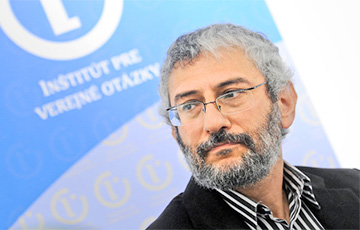
An expert assessed the potential agreement between Tehran and Washington.
The U.S. and Iran have announced agreements that could halt hostilities and open the Strait of Hormuz. But key issues—sanctions, Tehran’s nuclear program, and Israel’s position—remain unresolved.
How realistic is it that the U.S. and Iran will sign an agreement on June 19 in Switzerland? The website Charter97.org discussed this with Slovak political scientist and president of the Institute for Public Affairs (IVO, Bratislava) Grigory Mesezhnikov:
— I would be cautious, because over the past few weeks there have already been reports that a signing is in the works. Then this was denied, followed by some leaks from the Iranian side that angered Donald Trump. So I would still wait until June 19. We’ll see if they sign it or not.
But in principle, I don’t think what is currently being discussed will meet with universal approval in the United States and Israel. From what we know from published leaks and reviews, it is clear that the Iranian regime has managed to hold its ground. The way this regime is approaching the ceasefire agreement shows that it wants to use this document to strengthen its position within the country, and in the region as well.
Once the text of the agreement is known in more detail, it will be possible to assess its implications. But for now, skeptical voices are more prevalent. I think this agreement, from the perspective of the U.S. and Israel, will be met with criticism.
— What can already be said about the text of the agreement? Is Iran really ready to give up nuclear weapons in exchange for U.S. concessions on sanctions?
— I find that hard to imagine at all. I think it’s all just a bluff. The fact is that the Iranian regime has made the issue of potential nuclear weapons possession one of the main pillars of its foreign policy and, in essence, has kept the entire region on edge. It’s clear that this regime’s attitude toward Israel is absolutely clear, as is its attitude toward the U.S., which the country’s leadership considers the “Great Satan.”
I think this regime’s expansionism hasn’t gone anywhere; it’s still there. I find it hard to imagine that they will simply give up their nuclear weapons, even though Donald Trump claims that this is precisely what will result from all these negotiations.
There is also this technical detail. Donald Trump tried to time the signing of this agreement to coincide with the celebration of his 80th birthday. And that, of course, looked rather strange. Perhaps he was expressing his optimistic view because he really needed to tie this to the festivities, to the celebration. But it didn’t work out. So, maybe now his enthusiasm will wane a bit.
I’ll return once again to the issue of Iran’s renunciation of nuclear weapons. The fact is that the democratic world has experience dealing with outcasts such as Iran and North Korea. Russia, in essence, has also joined this category of states. It was very difficult to reach an agreement with them, and with some countries it was impossible altogether.
The fact that, at the time, treaties between the United States and the Soviet Union on the limitation of strategic arms were signed following negotiations was, of course, a great success. But the Soviet Union was, after all, a more predictable player in this regard than today’s Russia. Therefore, it is hard to imagine even Russia signing such a document. This is evident now in Russia’s attitude toward war and its aggression against Ukraine. And Iran, as they say, is an even more isolated and reckless regime. So it’s very hard for me to imagine that they would openly agree to such a deal.
— When might the Strait of Hormuz be opened? How will this affect oil prices and the global economy?
— That is probably the main question right now. What is happening in the Strait of Hormuz is indeed putting a lot of strain on the global economy. Apparently, this is also the most important issue for Trump. First, it is important for him to achieve this result so that the whole world understands: only the United States is capable of solving this problem in this way. This is evident from Trump’s social media posts. Second, Trump wants to prevent a significant rise in fuel prices at American gas stations.
Maybe he’ll even manage to resolve the issue somehow. But again, judging by how the U.S. and Iran are approaching this, it must be linked to all the other points. It will be difficult to simply agree to open the Strait of Hormuz without taking all the other points into account.
If the most important points disappear from the agreement—first and foremost, the issues of nuclear weapons and ballistic missiles—and the opening of the Strait of Hormuz is presented as the main victory, and everything else ends up taking a back seat or is excluded from the agenda altogether, then in that case it would likely be viewed as a defeat for the U.S. For Israel, this is an existential issue, a matter of the very existence of the state. Therefore, such a situation would look very strange.
But again, we are all in the realm of assumptions, of speculation. It’s not even a moving target that you can see. It’s moving somewhere in the dark, and it’s generally unclear what’s happening there or how the negotiations are proceeding. Trump claims that the negotiations are direct. At the same time, we know that Pakistan is participating as some kind of mediator. So there is a lot of fog that prevents us from accurately assessing what is happening and, most importantly, the consequences of signing this agreement.
— How will Israel react to the U.S.-Iran agreement? Will it halt the operation in Lebanon?
— I follow the Israeli media, and it seems to me that attitudes toward this agreement in Israel are very mixed. In general, I think Israel will find it difficult to accept the link between what is happening in Lebanon and what is happening in the context of the conflict with Iran. There is a dynamic of its own there. Moreover, this allows Iran to put forward a pretext for its stance both on this anticipated agreement and on the conflict itself.
Hezbollah is like Iran’s pocket player. That is, in any situation where Iran needs to resolve its own so-called geopolitical issues or escalate tensions, it is enough simply to ask Hezbollah—or order it—to start shelling Israel. Israel cannot remain idle.
It will, of course, respond. Israel, by the way, has been saying this all along: if you don’t stop shelling our northern territories, we will start shelling Beirut. Beirut itself, not just some isolated Hezbollah units from which they are firing. But, you see, that didn’t stop them from shelling Israel again. And they knew perfectly well that Beirut would be shelled.
And despite all this, Trump criticized Israel. Israel cannot accept such an equation. That is my view, though, of course, I may be wrong. It is clear that Benjamin Netanyahu’s relationship with Trump is currently strained. But overall, he understands well that for him personally, for the government, and for Israel, the Republican administration is, of course, a much more important partner than, say, a Democratic administration, and that it does, after all, take Israel’s position into account.
So I don’t think Israel will agree to such a deal, regardless of whether the document includes a clause stating that Israel essentially becomes a party to an agreement it hasn’t signed. That is, this isn’t even about relations between Lebanon and Israel. They say “Lebanon and Israel,” but what they really mean is “Hezbollah.” In fact, this is an agreement with “Hezbollah” that Israel did not discuss, did not sign, and had absolutely no involvement in this negotiation process.
And now relations between these two players—a normal, fully-fledged state and, essentially, a terrorist organization—will be tied to this agreement. U.S.-Iranian relations will also be tied to it. I would say that from Israel’s perspective, this makes absolutely no sense.
Therefore, I think that even if such an agreement is signed, Israel will act primarily in its own security interests and will respond to any provocation by Hezbollah regardless of how Washington views it.

Bank's name: Bank Millennium S.A.
Address: ul. Stanislawa Zaryna, 2A, 02-593, Warszawa
IBAN: PL97116022020000000216711123
SWIFT: BIGBPLPW
Name of the account holder: Fundacja “KARTA ‘97”
Purpose/title of payment: Donation for statuary aims
You can contact us by the e-mail [email protected]