
Yuri Felshtinsky: After Lukashenko's Overthrow, Belarus Will Join The EU And NATO
18- 25.04.2026, 12:03
- 23,356
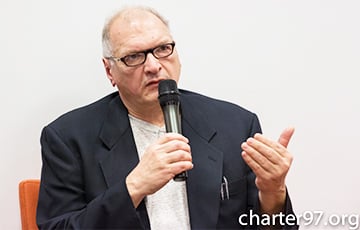
Photo: charter97.org
This will secure the entire region.
Famous American writer Yuri Felshtinsky, author of the book about modern Belarusian history "Natalia Radina's Belarus. Journalist against the dictator" gave an interview to the Polish edition niezalezna.pl.
Yuri Felshtinsky is sure that the lack of interest of Europe and the rest of the world in Belarus is a historical misunderstanding, while the accession of our country to the EU and NATO will secure the entire region. The site Charter97.org translates the interview from Polish.
- You have been dealing with the history of Russia and its special services for years. And at the beginning of this year your new book dedicated to Belarus and based on the experience of the Belarusian opposition was published. What is the reason for your interest in this subject? And is there still a trace of special services in all this? What, in your opinion, is the relevance of this book?
- One does not need to be a great strategist to realize that in the modern world Belarus is the key to the security of Europe. In the east, it borders Ukraine. To the west, it borders Lithuania and Poland. Before the invasion of Ukraine in February 2022, Russia used Belarus as a crucial springboard to prepare its offensive, and an attack on Kiev from Belarus became the Russian army's main strike direction. It was assumed that a lightning-quick capture of Kiev would lead to the surrender of Ukraine and the return to Ukraine of the government of Viktor Yanukovych, and Russian troops could reach the borders of Moldova via Odessa, where the region called Transnistria also had a long-established Russian bridgehead necessary to capture that small republic, which until 1991, like Ukraine, had been part of the USSR.
At the next stage, the Russian leadership planned to give NATO an ultimatum to withdraw the Baltic states from NATO, threatening otherwise with a full-scale invasion. In the next stage, the countries that joined NATO after 1991 were to leave. This was Putin's plan to restore the USSR and the influence the Soviet Union enjoyed in Europe.
But all this was only possible if Belarus remained a springboard for a possible invasion of Ukraine and the rest of Europe. Having lost control over Belarus, Russia would no longer be able to threaten or invade Europe.
The lack of interest of Europe and the rest of the world in independent Belarus should be considered a tragic historical misunderstanding. In December 1991, together with Russia and Ukraine, Belarus signed the Belovezhskie Agreements, which officially ended the existence of the USSR. But at the first presidential elections in Belarus after the collapse of the USSR, the pro-Russian politician Lukashenko came to power and remained to rule this country forever as a dictator.
Opposition anti-Lukashenko movement started in Belarus already in 1995. It was brutally suppressed by the government, which killed Lukashenko's rivals for power and critics of his regime, kept in force the death penalty, which was abandoned not only by Europe but also by Russia (since 1996), and resorted to mass arrests and imprisonment of opposition members, leaving the old Soviet KGB intact and not even renamed.
The mass protests that began in Belarus in August 2020 after Lukashenko, who lost the election, declared himself the winner of that election, lasted several months. It was essentially a revolution, suppressed by Lukashenko with incredible brutality. And all the while, Europe and the United States watched without giving the rebels any real help.
Not surprisingly, the revolution was crushed. The opposition was crushed. Lukashenko remained in power and put his country at Putin's disposal, authorizing the concentration in Belarus of Russian troops needed to invade Ukraine.
The defeat of the 2020 protest movement, which was not assisted by Ukraine, Poland, or Lithuania, which bordered Belarus, became the root cause of the beginning of a full-scale war in Ukraine in February 2022.
- The main character of your book is journalist Natalia Radina. Why her and not say - Svetlana Tihanovska, who, by the way, in February moved with her office from Vilnius to Warsaw.
- When I write books devoted to complex issues beyond pure history, I very often rely on the help of my co-authors, who help me understand the topic. "FSB blows up Russia", "The Corporation", "The Third World: Battle for Ukraine", "From Red Terror to Terrorist State" - all these books were written thanks to the help of my co-authors.
Belarus I tried to understand through the life of a Belarusian politician. That was my intention: to show Belarus through the life of one particular person. You asked the right question about Svetlana Tikhanovskaya, because I went to see her. I met with her and members of her team in Vilnius; then I flew to Washington, D.C., because several members of her team were in Washington at the time. But Tihanovska made no impression on me, and it seems to have been mutual. I did not meet any enthusiasm on her part.
This was even before I knew that before leaving Belarus, Tikhanovskaya had taken $15,000 from Lukashenko. If I had known about it earlier, I would not have met Tikhanovskaya.
The next on the list was Natalya Radina. We had known each other for some number of years. Natalia occasionally interviewed me for her website "Charter'97". But the final decision to write about Belarus through the life of Natalia Radina was made by me after we participated in a panel at the Forum of Free Russia in Vilnius in February 2024, and then in the presentation of the collection of articles "Belarus in NATO" in Warsaw, one of the authors of which I was. These two events determined everything. I realized that I could tell about modern Belarus - its history, significance, problems and prospects - through the life of Natalia Radina. I hope that I succeeded.
- According to the Polish migration portal, as of January 2026, about 141 thousand Belarusians with a residence permit lived in Poland. Between 2020 and 2025, this number increased tenfold. And if we compare it with the beginning of 2016, then more than 30 times (about 4,500 Belarusian citizens with residence permits lived in Poland then). Poland has been home to many Belarusian oppositionists for decades. As a historian, what do you see as the possible pros and cons of the increasing flow of Belarusians to Poland?
- The statistics of emigration of Belarusians - and Poland is not the only country to which Belarusians are fleeing - testifies to Belarusians' rejection of Lukashenko's regime. I tried to show in my book that Belarusians never considered themselves a secondary appendage of Russia, but oriented themselves towards the Europe to which Poland and Lithuania belonged. This path is open for Belarus even today - through joining the EU and NATO. The obstacle is Lukashenko and Putin.
But these are temporary difficulties, although they have lasted for several decades. All dictators are mortal. Lukashenko and Putin are no exception. When Lukashenko's dictatorial regime will be overthrown, Belarus will gain freedom and join the EU, migration will cease to be a forced phenomenon.
Poland, bordering Ukraine and Belarus, has turned out to be a natural refuge for Ukrainians fleeing Russian aggression and Belarusians fleeing Lukashenko's dictatorship. The statistics of these migrations are very approximate. Up to one and a half million Ukrainians went to Poland, one and a half or two million Poles live and work abroad. Against this background, 140 thousand Belarusians do not change the demography of the country much. Hospitality towards the neighbors who find themselves in a desperate situation is a noble quality and as a rule mutually beneficial.
- Your book has been published in three languages - Belarusian, Russian and Ukrainian. Will it also be in Polish? And why?
- I very much hope that my book will be published in Polish, first of all, because the history of Belarus is inextricably linked with Polish history and should be of interest to the Polish reader. In the current situation, when Russia has unleashed a war in Ukraine and threatens the pan-European peace, the awareness of the strategic importance of Belarus - to which the publication of this book will contribute - is an integral element of the defense policy of the states of Eastern Europe. Regime change in Belarus, its induction into the EU and NATO, will permanently secure Poland from Russian invasion, while Belarus, used by Russia as a springboard for troop concentration and invasion of its neighbors, poses a threat to Poland as well.

Bank's name: Bank Millennium S.A.
Address: ul. Stanislawa Zaryna, 2A, 02-593, Warszawa
IBAN: PL97116022020000000216711123
SWIFT: BIGBPLPW
Name of the account holder: Fundacja “KARTA ‘97”
Purpose/title of payment: Donation for statuary aims
You can contact us by the e-mail [email protected]