
The CDU Loses, But Merz Stays: Results Of The German Elections
2- 21.09.2026, 8:14
- 3,648
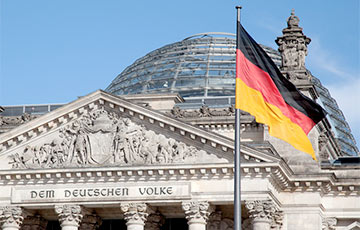
Today, the chancellor will meet with his party's leadership.
"Catastrophe." This is the word that German Chancellor and leader of the Christian Democratic Union (CDU) Friedrich Merz (Friedrich Merz) used to describe the results of the state elections in Mecklenburg-Western Pomerania and Berlin on September 20. He made this statement even before it became known that, for the first time in history, the conservatives would not be represented in one of the state parliaments, reports "Deutsche Welle".
In Mecklenburg-Western Pomerania, the CDU received only 4.9% of the vote—a party must receive at least 5% to enter the state parliament. First place, as in Saxony-Anhalt two weeks earlier, went to the far-right “Alternative for Germany” (AfD). In Berlin, the Left Party won. The Christian Democrats came in second, but the AfD received only slightly fewer votes.
Even if the CDU had managed to win a seat in the Mecklenburg-Western Pomerania state parliament, the results for the chancellor’s party would still be a disaster. The CDU has never performed this poorly. Nevertheless, after the election, Merz declared his intention to continue the reforms, demonstrating “fortitude, resilience, and patience,” and dismissed rumors of a possible resignation as chancellor, which had begun circulating widely following the AfD’s victory in Saxony-Anhalt.
Results of the State Parliamentary Election in Mecklenburg-Western Pomerania
The AfD secured victory in Mecklenburg-Western Pomerania with 38.2% of the vote. In the previous election, in 2021, it received 16.7%. In second place are the Social Democrats (SPD), with 35.5%—down from 39.6% in 2021. Next came the Left Party with 6.5% (-3.4 percentage points) and Alliance '90/The Greens with 5.7% (-0.6 percentage points). Other parties failed to clear the 5 percent threshold.
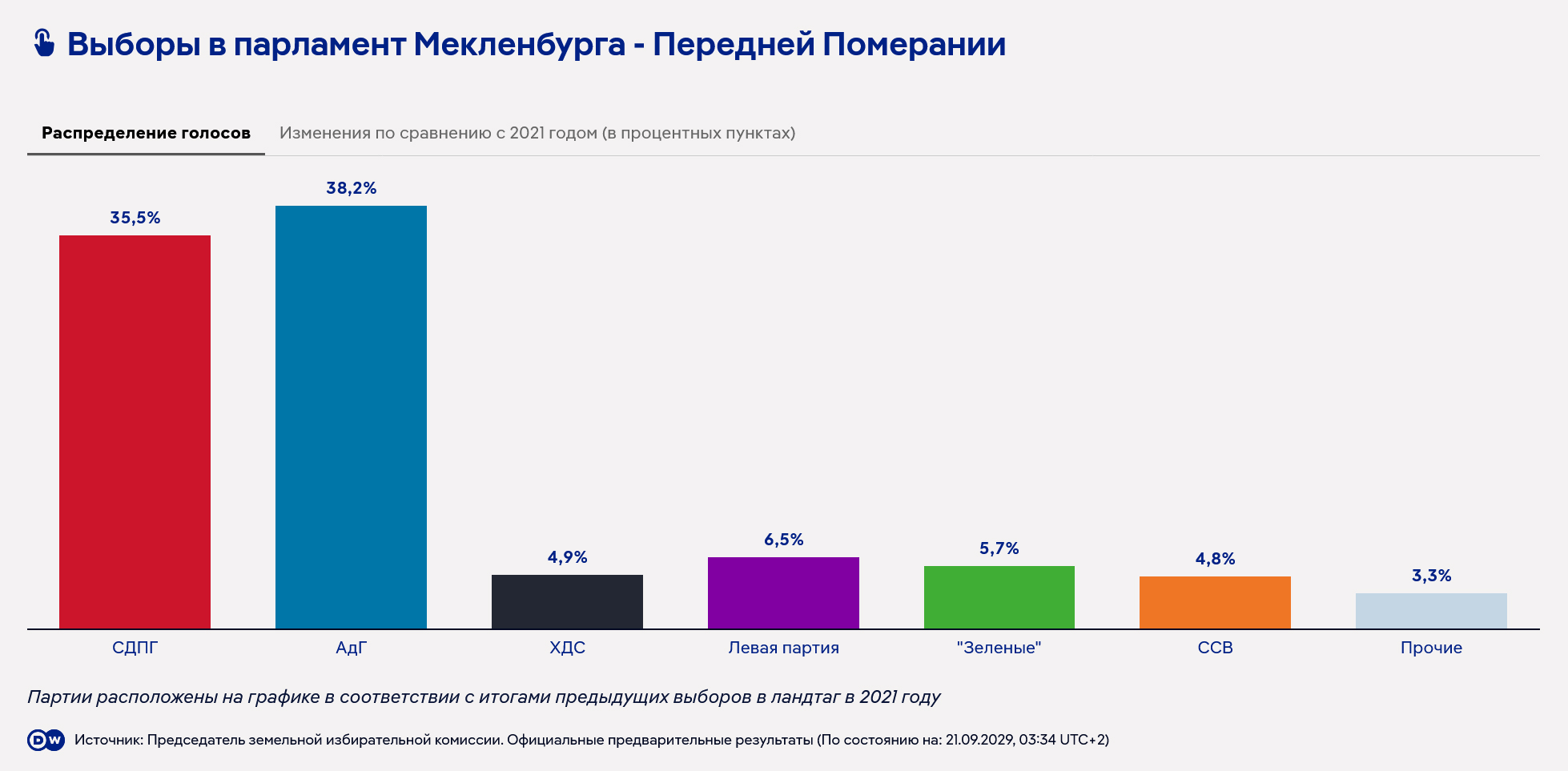
Thus, the AfD became the only party among those that participated in the 2021 election to improve its result. However, this victory is largely symbolic. While in Saxony-Anhalt, where the AfD garnered 43.8% of the vote, the far right has a real chance of coming to power, this is not the case in Mecklenburg-Western Pomerania.
The head of the state government, Social Democrat Manuela Schwesig, built her campaign around opposition to “Alternative for Germany.” One of her campaign symbols has been posters bearing the slogan “Frau gegen Blau,” which can be translated as “Woman Against the Blues.” Blue is the AfD’s color. “The situation is serious: the AfD is capable of damaging our economy and undermining our unity,” Schwesig warned in an interview with DW.
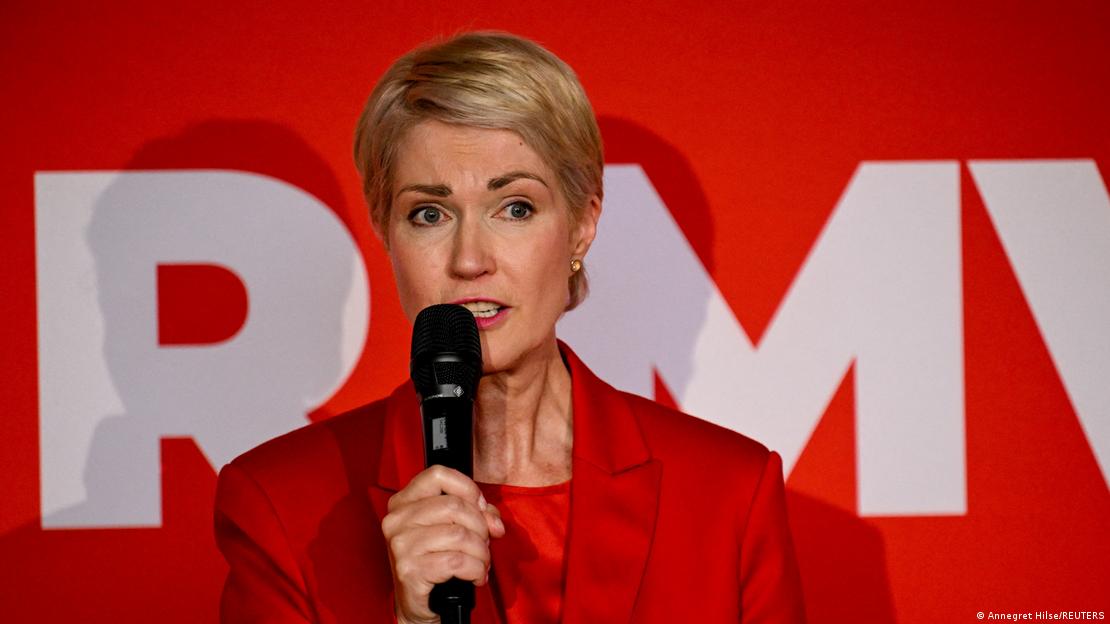
On election day, in an interview with ZDF, Schwesig outlined two reasons why the AfD is gaining ground, taking votes away from the SPD, among others. “First, in my federal state, many people oppose providing support to Ukrainians—both financial and military—and the AfD actively built its election campaign around this,” the politician said. “Second, many want gas deliveries via the Nord Stream pipeline to resume.” We do not support either of these two positions and understood that we would lose votes because of this, but I felt that in these times it is important to stand by our principles.”
At the same time, during her campaign, Schwesig distanced herself from the ruling coalition, of which her party is a junior partner. On election day, commenting on the CDU’s defeat, Schwesig said she was “puzzled” by Merz’s reaction. In her view, “the chancellor must honestly ask himself whether he can simply carry on as if nothing had happened.”
Schwesig’s strategy paid off: as recently as the beginning of the month, the SPD was polling at just under 30%, and a year ago, it was below 20%. The final result of 35.5% will allow the Social Democrats to form a coalition with the Left Party and the Greens.
Results of the Berlin House of Representatives election on September 20
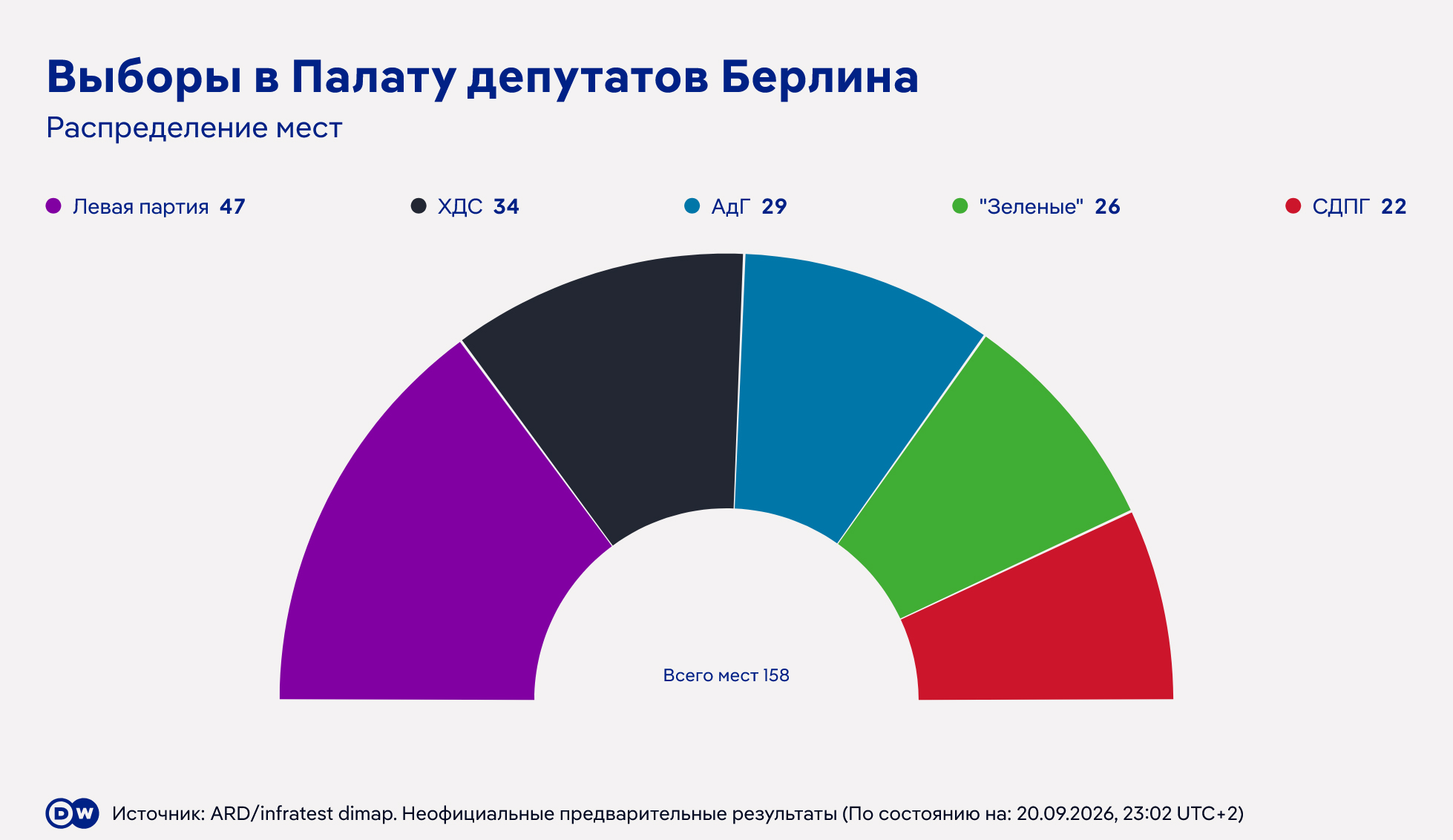
The Left Party secured a decisive victory in the Berlin election, winning 25.7% of the vote. This is roughly twice as much as in the previous election in 2023. Although the CDU came in second, it saw a significant drop in its share of the vote: 18.8% compared to 28.2% in 2023. The AfD took third place with 16.3% (+7.2 percentage points). Alliance ’90/The Greens also secured seats in parliament with 14.3% (-4.1 percentage points), as did the SPD with 12.1% (-6.3 percentage points). Other parties received less than 5%. Voter turnout was 74.2%.
The Left Party’s main demand is the socialization (Vergesellschaftung) of approximately 200,000 apartments owned by corporations such as Deutsche Wohnen, Heimstaden, and Vonovia. The Left accuses these companies of profiting from the housing shortage by inflating rent prices and proposes transferring their assets to the state to establish strict price controls. Owners are to be paid compensation—but only at 40–60% of market value and under a rather complex scheme. In a 2021 referendum, 59.1% of Berliners already supported this initiative.
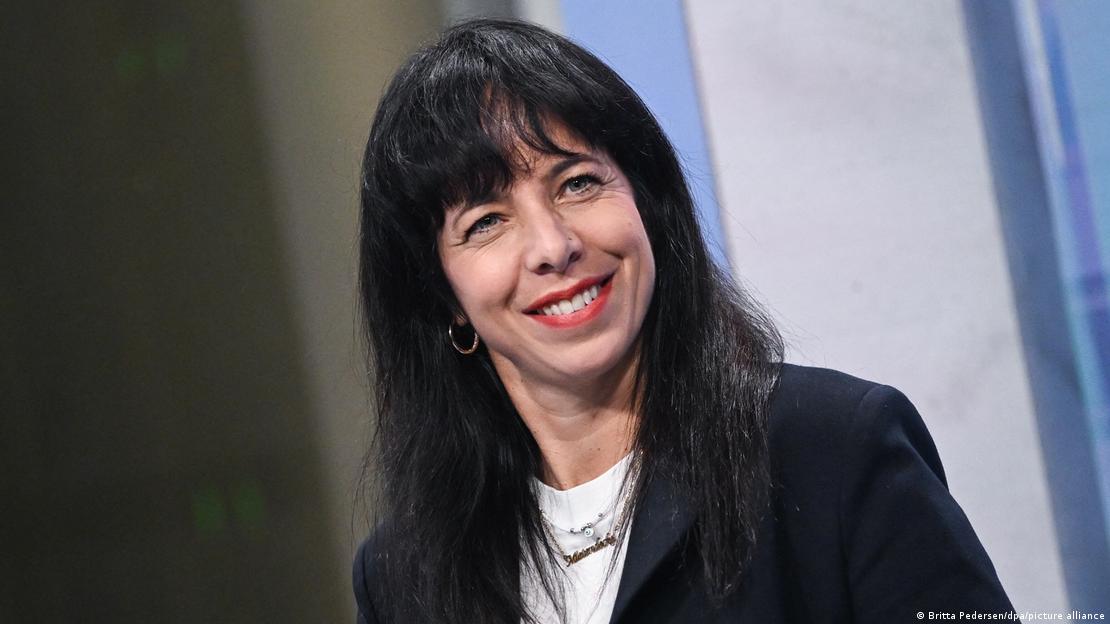
“We maintain that the ability to live in an apartment is a basic human right, and we want to protect this right from speculation,” said Elif Eralp (Elif Eralp), in an interview with the publication Genau. On the evening of September 20, when it became clear that her party was securing a decisive victory, Eralp declared: “If the Left comes to power, socialization will take place.”
But it’s not that simple. To form a government, the Left Party needs coalition partners. A coalition of the left, the SPD, and the Greens is mathematically possible, but the negotiations promise to be difficult.
As early as September 20, the co-chair of Alliance ’90/The Greens Felix Banaszak (Felix Banaszak) stated that a “clear statement against antisemitism” would be a key condition for dialogue, evidently referring to the scandals involving the radical wing of the Left Party. The Social Democrats, for their part, are extremely critical of the Berlin election winners’ proposal to make housing publicly owned.
What the Results of the September State Elections Mean for the German Government
According to sources at Die Zeit and Table.Briefings, the text of the statement read by Friedrich Merz shortly after the elections ended had been prepared several days earlier. This may indicate that the politician decided to retain his positions as chancellor and CDU chairman regardless of the results. However, Merz’s decision alone is not enough—he also needs the support of at least his own party.
On September 16, the heads of government of eight federal states from the CDU/CSU bloc published a letter stating that “Germany needs reliability and decisive action,” not “discussions about personnel.” They emphasized that the EU needs a “stable and strong Germany”—given that elections will be held next year in several countries at once: France, Italy, Spain, Poland, and Greece. However, this letter does not appear to be an expression of unconditional support—the chancellor is not even mentioned by name in it.
The internal party debate will evidently continue. On Monday, September 21, Merz will meet with the CDU leadership, and on Tuesday, with the party’s parliamentary group in the Bundestag.

Bank's name: Bank Millennium S.A.
Address: ul. Stanislawa Zaryna, 2A, 02-593, Warszawa
IBAN: PL97116022020000000216711123
SWIFT: BIGBPLPW
Name of the account holder: Fundacja “KARTA ‘97”
Purpose/title of payment: Donation for statuary aims
You can contact us by the e-mail [email protected]