
Exit Poll Results From The State Elections In Germany
1- 20.09.2026, 21:57
- 3,280

Elections were held for the state parliament of Mecklenburg-Western Pomerania and the Berlin House of Representatives.
In the state parliament (Landtag) elections in the eastern federal state of Mecklenburg-Western Pomerania, the far-right party “Alternative for Germany” (AfD) performed strongly. In Mecklenburg - Western Pomerania, it is in first place, trailing the Social Democratic Party of Germany (SPD) by a narrow margin, according to unofficial preliminary results released after voting concluded on Sunday, September 20.
In the Berlin House of Representatives election, however, the right-wing populists came in third—behind the leading Left Party and the Christian Democratic Union (CDU).
State Parliament Elections in Mecklenburg-Western Pomerania
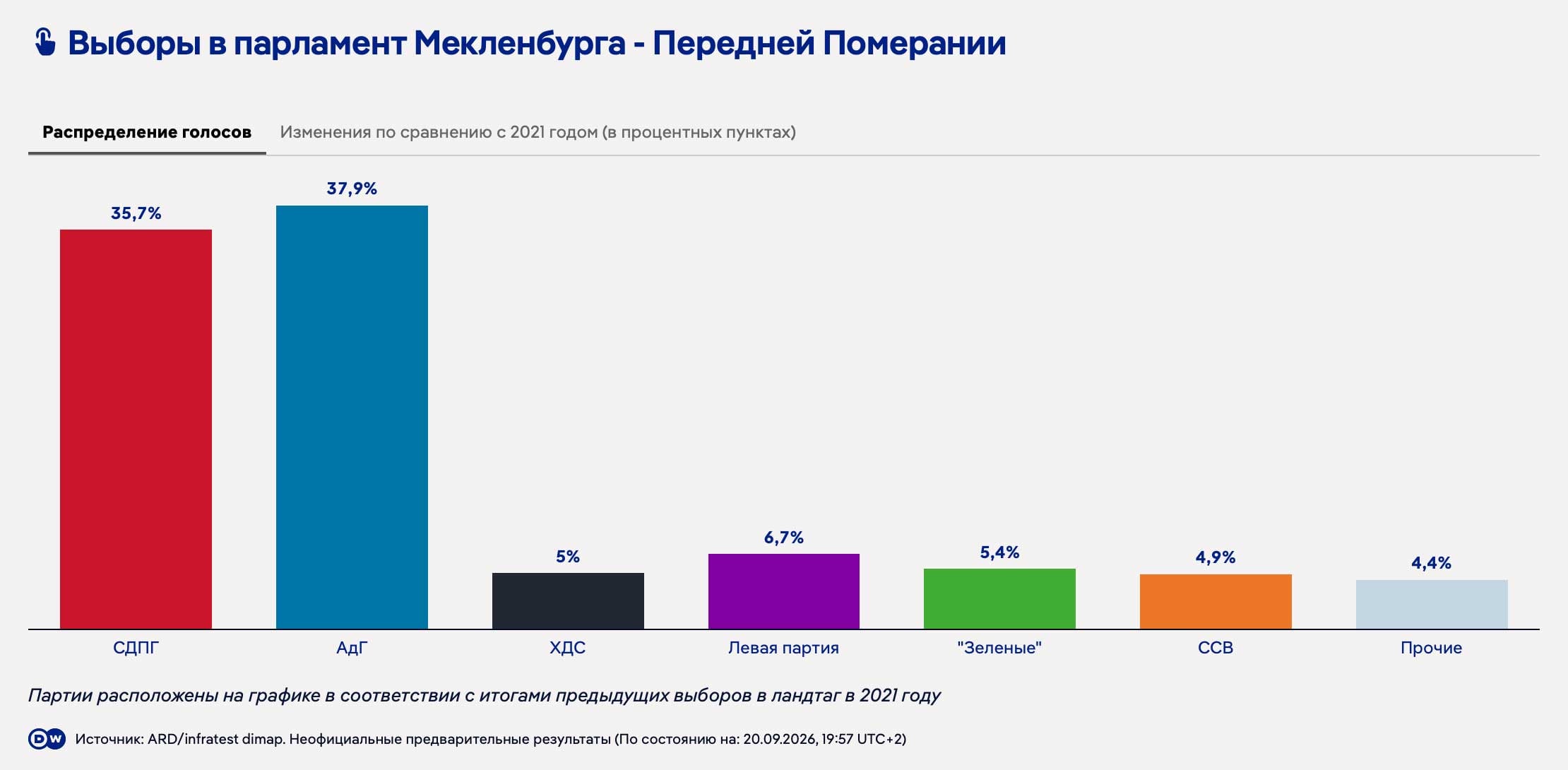
According to these figures, the AfD is leading the state parliament election in Mecklenburg-Western Pomerania with 37.9%. This is 21.2 percentage points higher than the party’s result in the previous state election.
The SPD of the state’s incumbent Minister-President Manuela Schwesig, who is also the top candidate on her party’s ticket, is, according to this data, receiving 35.7% of the vote and is in second place. Thus, compared to the last state parliament election, the party’s result has declined by 3.9 percentage points.
The CDU, of which German Chancellor Friedrich Merz is a member, received 5% of the vote, marking a decline of 8.3 percentage points compared to the last state parliament election.
5.4% of voters cast their ballots for Alliance ’90/The Greens. This is 0.9 percentage points lower than the previous result.
The left-wing populist party “Sary Wagenknecht Union” (SSV) received 4.9% of the vote. If it clears the 5% threshold, the party will secure a seat in the state parliament. The Free Democratic Party (FDP) received such insignificant support that it was lumped into the “others” category. All parties in this category collectively garnered 4.4%.
The AdG’s candidate for Minister-President of Mecklenburg-Western Pomerania is 56-year-old Leif-Erik Holm — a member of the Bundestag, a former electrician, and a former radio host. However, observers pointed out from the very beginning that he had no chance of becoming head of the state government, since all other parties had already announced that they were not prepared to enter into a coalition with the far right.
Elections to the Berlin House of Representatives
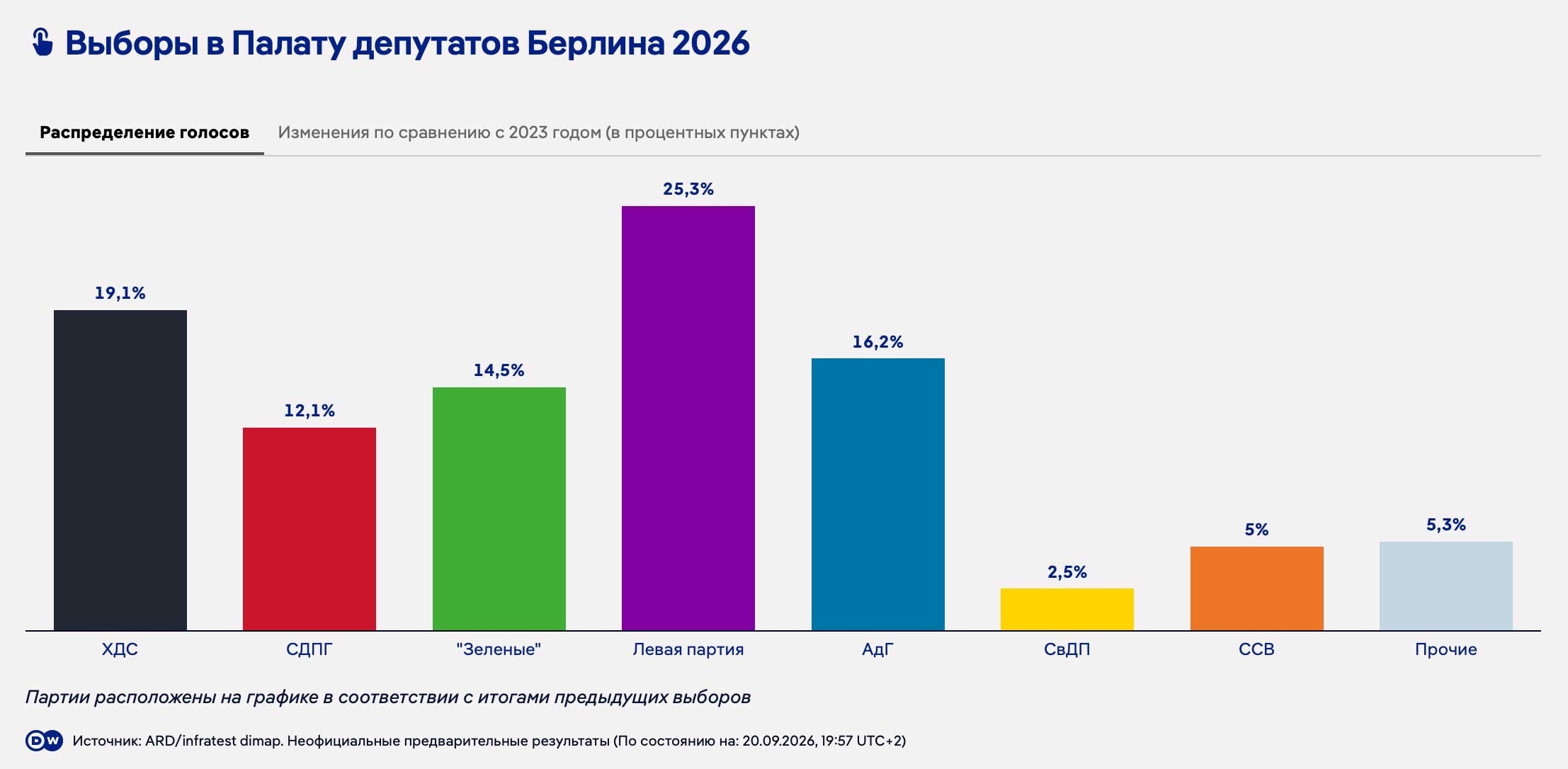
On the same Sunday, September 20, elections were held for the Berlin House of Representatives (parliament). According to exit polls, the Left Party emerged as the frontrunner, garnering 25.3% of the vote (up 13.1 percentage points). In second place was the conservative CDU with 19.1% (a loss of 9.1 percentage points). The right-wing populists of the AfD came in third with 16.2% (an improvement of 7.1 percentage points). Next are: the Greens with 14.5% (a 3.9 percentage point decline), the SPD with 12.1% (down 6.3 percentage points), and the FDP with 2.5% (a loss of 2.1 percentage points). According to these figures, the SSV is entering the Berlin House of Representatives for the first time with 5% of the vote.
In Mecklenburg-Western Pomerania, approximately 1.3 million people are eligible to vote; in Berlin, approximately 2.5 million. For the first time, 16- and 17-year-olds were eligible to vote in elections in these federal states.
Elections for 12 district assemblies were also held in Berlin on September 20. 2.75 million people are eligible to vote in elections at this level, as the right to vote extends not only to Germans but also to citizens of other EU countries residing in the German capital.
The Question of Friedrich Merz’s Political Future
In the run-up to the elections to the state parliament of Mecklenburg-Western Pomerania and the Berlin House of Representatives, many experts pointed to their importance for the political future of German Chancellor Friedrich Merz. Following the decisive victory of “Alternative for Germany” (44%) and the CDU’s (17.2%) poor showing in the Saxony-Anhalt state parliament election held on September 6, his position within Germany and even within his own party has been significantly weakened.
Following those elections, many observers speculated that Merz might resign early from his post as head of the German government. Poll data from German citizens also pointed to the likelihood of such a scenario.

Bank's name: Bank Millennium S.A.
Address: ul. Stanislawa Zaryna, 2A, 02-593, Warszawa
IBAN: PL97116022020000000216711123
SWIFT: BIGBPLPW
Name of the account holder: Fundacja “KARTA ‘97”
Purpose/title of payment: Donation for statuary aims
You can contact us by the e-mail [email protected]