


Media: Russia's Starlink Counterpart Is Facing Problems Both In Orbit And On The Ground
4- 20.09.2026, 22:02
- 1,382
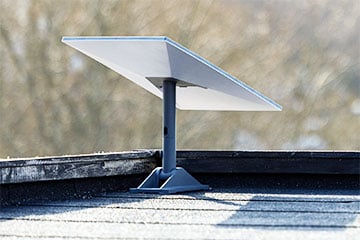
The satellites aren't reaching their intended orbit, and Ukraine is destroying the infrastructure on the ground.
Russia is attempting to develop its own alternative to the Starlink satellite system, but the “Rassvet” project is facing challenges both in placing satellites into the required orbits and in manufacturing ground equipment. This is reported in an article by "Radio Free Europe/Radio Liberty".
As the authors of the article note, satellite communications have become a crucial element of modern warfare. The Starlink system was used not only by the Ukrainian military but even by the Russian military to command units and drones on the front lines. In February 2026, Starlink restricted Russian forces’ access to its terminals in Ukraine, which created certain problems for the Russians.
Analyst Jakub Janowski explains that traditional military communications systems are primarily geared toward voice transmission, whereas the modern battlefield requires the constant exchange of large volumes of data, particularly video from drones.
“That is precisely why Starlink and similar systems are practically indispensable for the military,” he told Radio Free Europe.
The Russian “Rassvet” system is being developed by Bureau 1440. Its satellites operate in low Earth orbits, which helps reduce signal latency. At the same time, a single satellite remains over a specific area of the Earth for only a limited time, so a large number of satellites are needed for continuous communication.
The first three “Rassvet-1” satellites were successfully launched in June 2023. In May 2024, three “Rassvet-2” satellites were placed into orbit, and they also reached their planned altitude of 800 kilometers. However, difficulties arose with the “Rassvet-3” series of satellites.
The first group of 16 satellites was scheduled for launch in 2025, but the launch was postponed to March 2026. After reaching an altitude of about 300 kilometers, the satellites were supposed to ascend autonomously to 800 kilometers. As a result, one satellite fell out of orbit and burned up in the atmosphere, 13 remained at an altitude of about 510 kilometers, and two more at approximately 360 kilometers.
In July, another 16 satellites were launched, but this group also encountered problems: three satellites descended to 300 kilometers or lower and may not become fully operational. Space expert Anatoly Zak described the failure rate as “very painful” and “probably close to unacceptable.”
According to plans submitted by “Bureau 1440” to the International Telecommunication Union, the Russian system could consist of 292 satellites at an altitude of 800 kilometers or 1,350 satellites at an altitude of 600 kilometers. At the same time, according to Zak’s assessment, Russia is unlikely to reach the target of 292 satellites by the end of 2027. Analyst Yanovsky suggests that, in an optimistic scenario, the Russians might achieve continuous coverage over Ukraine by 2028, though it is more likely to happen only by 2030.
Ground terminals pose a separate challenge. Unlike Starlink, which has already produced millions of such devices, there is no public evidence of large-scale production for the “Rassvet” system. Due to the complexity of phased-array antennas and a shortage of necessary components, Russia will likely have to source some parts from China.
Furthermore, the “Rassvet” infrastructure could become a target for Ukrainian strikes. Ukraine has already carried out strikes on Russian facilities related to satellite communications and the space industry, specifically the satellite communications center in Dubna and the Progress enterprise.
As the publication notes, Russia will need to ensure not only the launch of satellites but also the production of terminals, rockets, ground stations, and components. Vulnerabilities in even a few key links in this chain could slow the deployment of Russia’s alternative to Starlink.

Bank's name: Bank Millennium S.A.
Address: ul. Stanislawa Zaryna, 2A, 02-593, Warszawa
IBAN: PL97116022020000000216711123
SWIFT: BIGBPLPW
Name of the account holder: Fundacja “KARTA ‘97”
Purpose/title of payment: Donation for statuary aims
You can contact us by the e-mail [email protected]