

An Anthropologist Proposes Rewriting The Human Family Tree
- 26.08.2026, 19:57
- 1,120
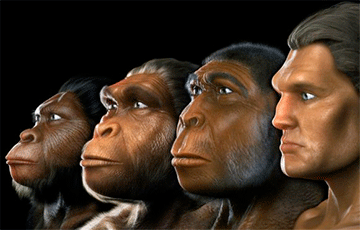
The traditional classification of human ancestors contradicts the principles of biology.
Ian Towle, an Australian researcher at Monash University, has proposed a radical reevaluation of the taxonomy of hominins—the extinct direct ancestors of humans and their side branches. He has proposed merging the genera Australopithecus and Paranthropus with the genus Homo. The rationale for this decision was published in the American Journal of Biological Anthropology.
Modern systematics requires that taxa be clades—that is, they must include a common ancestor and all of its descendants. However, Australopithecines are considered a paraphyletic group; in other words, their group includes a common ancestor but not all descendants due to significant evolutionary changes. Some species of Australopithecus (for example, A. afarensis) are closer to humans than to other Australopithecines, which makes the genus Australopithecus a “bin” taxon into which all bipedal apes that do not fit into the genus Homo are lumped. At the same time, the age of the genus Homo is estimated at only 2–3 million years—much less than that of typical primate genera (5–10 million years)—which is why the boundaries of the genus are constantly being blurred by new discoveries.
By comparing the evolution of hominins with that of baboons and mangabeys, Towell showed that genera with a recent common ancestry (less than 5 million years ago) often have a convoluted history of hybridization. To avoid such problems, he proposes extending the genus Homo back to 4–5 million years ago, including all bipedal African hominins. This corresponds to the temporal depth typical of most primate genera and would reduce the risk that the discovery of yet another skull or jawbone would force a complete rewrite of the taxonomy.
Previous discoveries have blurred the former distinctions between species even further: Paranthropus turned out to be omnivorous, while late Homo species (Nalid, Flores) had brains the size of monkeys and retained climbing traits. For anthropologists, such a reform would represent a major shift, but without it, Towell emphasizes, the field will remain in logical contradiction with general biology.

Bank's name: Bank Millennium S.A.
Address: ul. Stanislawa Zaryna, 2A, 02-593, Warszawa
IBAN: PL97116022020000000216711123
SWIFT: BIGBPLPW
Name of the account holder: Fundacja “KARTA ‘97”
Purpose/title of payment: Donation for statuary aims
You can contact us by the e-mail [email protected]