


For The First Time In The World, The Third Corps Of The Armed Forces Of Ukraine Deployed Combat Robots Deep Behind Enemy Lines
2- 21.09.2026, 11:25
- 1,822
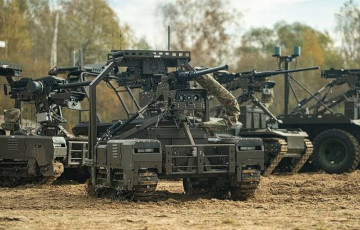
The heavy bomber drones were deployed 10 km behind the front lines.
The Third Army Corps, during "Vivaldi" offensive operation in northern Donbas, for the first time in history, deployed NRK kamikaze drones more than 10 km behind Russian lines. The drones were deployed there by heavy bomber drones from the Third Assault Brigade.
This was reported by the Telegram channel of the Third Army Corps.
Robots were deployed deep behind enemy lines
The commander of the Third Army Corps, Brigadier General Andriy Biletsky, stated that the corps was the first in the world to begin deploying ground-based robotic systems. According to him, heavy bombers are delivering kamikaze ground robotic systems more than 10 kilometers behind enemy lines.
According to the Third Army Corps, drones and ground robots always lead the way ahead of the infantry during assault operations.
How the offensive plan was concealed
In parallel with the deployment of robots, Ukrainian units employed air defense and electronic warfare systems to blind Russian reconnaissance drones. This prevented the enemy from uncovering the offensive plan.
According to the corps, artillery and unmanned systems simultaneously fired on enemy command posts, communications nodes, logistics facilities, crossings, and reserves.
Delivering ground robots by air in combat conditions is not an entirely new idea for the Ukrainian army, but this is the first time it has been used for kamikaze UAVs over such a distance. RBC-Ukraine had previously reported on a similar tactic, in which a heavy drone delivered the ARK-1 ground-based robotic complex behind Russian lines—this method of deployment was dubbed “marsupial,” by analogy with marsupials, where one vehicle transports and deploys another.
According to Viktor Pavlov, an officer with the UAV battalion of the 3rd Mechanized Brigade , this tactic has limitations—namely, the payload capacity of the carrier drone and the complexity of the robot’s soft landing — and so far remains more of a point solution than a systemic approach, suitable primarily for overcoming obstacles that UAVs cannot cross on their own, such as rivers, swamps, or dense forests.

Bank's name: Bank Millennium S.A.
Address: ul. Stanislawa Zaryna, 2A, 02-593, Warszawa
IBAN: PL97116022020000000216711123
SWIFT: BIGBPLPW
Name of the account holder: Fundacja “KARTA ‘97”
Purpose/title of payment: Donation for statuary aims
You can contact us by the e-mail [email protected]