
Lukashenko Is Following Someone Else's Script
- 4.08.2026, 9:50
- 1,968
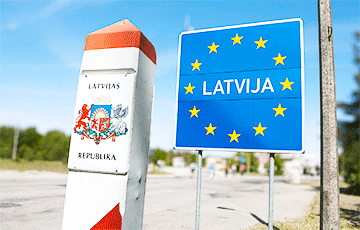
Riga's intention to close its border with Belarus is becoming easier to understand.
Belarusian authorities are threatening Latvia with "asymmetric" measures in response to Latvia's closed the Paternieki border crossing—the only one operating between the two countries. The Latvian side cited technical reasons. But this clearly smacks of politics. According to the latest reports, the Latvian Ministry of the Interior is proposing to close the border with Belarus entirely to both people and freight traffic.
The Belarusian Ministry of Foreign Affairs emphasizes that the decision to close Paternieki last week “was made urgently and personally by Interior Minister Janis Dombrova.” Minsk is convinced “of the pre-election nature of this cynical move on the eve of the October 3 elections to the Latvian Saeima.”
Indeed, Dombrova is also the deputy chairman of the conservative “National Alliance” party, which advocates for a hardline national security policy and restrictions on illegal migration.
But it is unlikely he would have been allowed to hold the keys to the border were it not for a real, large-scale threat.
Where Illegal Immigrants Are Flocking
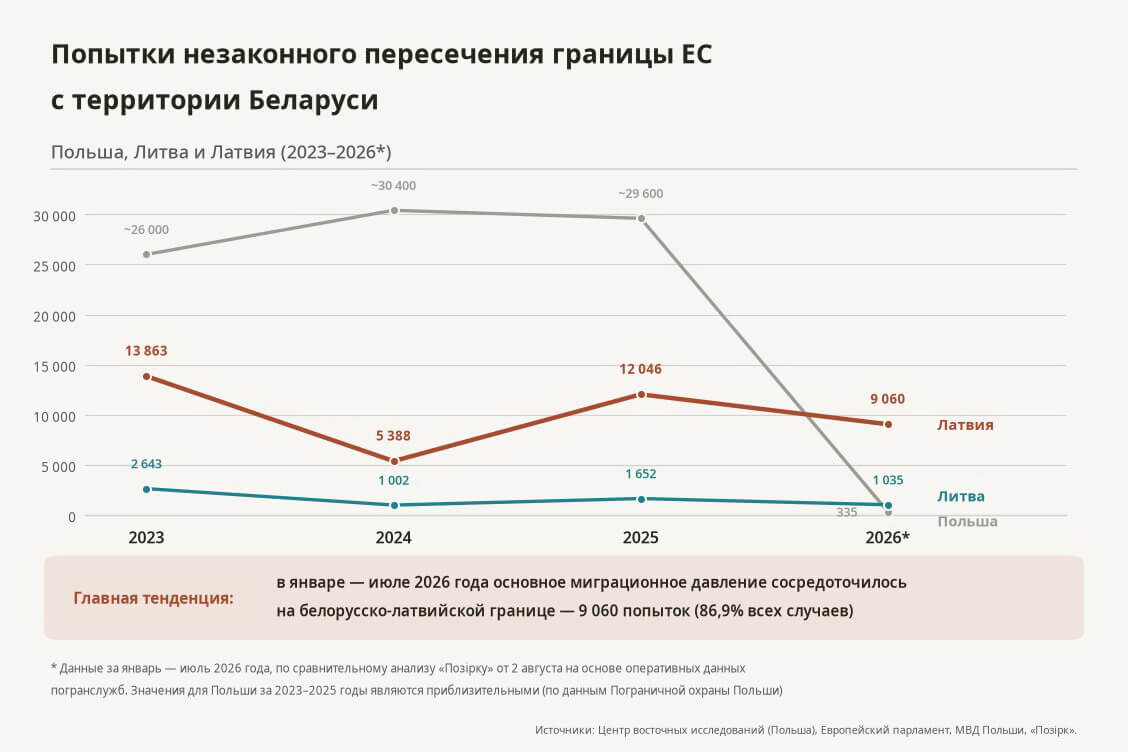
Statistics show that Latvia accounts for the lion’s share (86.9%) of attempts this year by third-country nationals to illegally cross EU borders from Belarusian territory. Over the course of seven months, Latvian border guards recorded 9,060 such attempts.
It is telling that, previously, the main influx of undocumented migrants from Belarus was directed toward Poland.
But over the past year, Minsk and Warsaw have managed to resolve some pressing issues. The Polish authorities opened (apparently as a “goodwill gesture”) two border crossing points, while the Belarusian authorities finally released Andrzej Poczobut, a political prisoner of great symbolic importance to Poles, from prison.
Moreover, the Belarusian regime’s acute conflict with its western neighbor was affecting China’s transit interests, and there is reason to believe that Beijing had a serious talk with Alexander Lukashenko.
And just like that, as if by magic, the illegal migrants—leaving the Poles alone—rushed to storm the Latvian border. However, neighboring EU and NATO states are convinced that there is no magic at play here, but rather a hybrid war waged against these countries by the Lukashenko regime, backed by the Kremlin’s malevolent intent.
It is clear that it is difficult for a small country like Latvia to cope with such pressure on its border. Lithuania and Estonia have sent groups of their border guards to help, but this is likely not enough.
In July, the head of Latvia’s State Border Guard (SBG), Guntis Pujats, stated that his country is currently the main target of hybrid actions by Belarus and that the situation is becoming increasingly tense. At that time, he requested broader support from the national armed forces.
“Technical glitch”—seems like an excuse
It should be noted that Riga has not provided any information on the expected timing or conditions for opening the Paternieki border crossing. According to the State Border Guard, “technical problems arose there due to malfunctions in the information systems.”
If that is the case, then fixing the problem is merely a technical matter. Especially since Latvian experts say no signs of a cyberattack have been detected.
But is it really that simple? It is noteworthy that Mr. Dombrova, mentioned earlier, urged his compatriots the day before the border crossing was closed to abandon any plans to travel to Belarus or return from that country.
The minister added: “In the context of the hybrid migration war unleashed by Belarus, safe travel between countries may become difficult.” And he certainly saw it coming!
But seriously, it seems very likely that the technical reasons are just an excuse. It’s entirely possible that the Latvian authorities simply ran out of patience and decided to take drastic measures.
And the latest information confirms this. The Latvian Ministry of the Interior is proposing that its government effectively close the border with Belarus completely. This is justified by the need to “guarantee the integrity of the state, prevent threats to public order,” and so on.
There is no longer any mention of a computer glitch. The issue at hand is threats to the country’s security.
Has Lithuania’s unfortunate experience been taken into account?
But if so, how effective will such a measure be?
At first glance, this won’t stop illegal immigrants at all. After all, they don’t go through checkpoints anyway—they sneak through the green belt.
In fact, such a measure can be justified to some extent: for example, it frees up personnel who can then be redeployed to guard that very green belt. In fact, the Latvian Ministry of the Interior states in its appeal to the Cabinet of Ministers its intention to “optimize the resources available to border guards in a crisis situation.” However, the effect is unlikely to be significant.
Furthermore: to what extent have the Latvian authorities taken into account the experience of the Lithuanians, who last fall attempted to rein in Minsk with a similar measure?
Lukashenko did indeed respond asymmetrically at the time: he blocked many hundreds of trucks with Lithuanian license plates on Belarusian territory and even imposed exorbitant fees for the forced parking.
As a result, Vilnius was forced to back down—reopening the border crossings without its conditions being met. And then it took a long time to get the trucks released—fortunately, the Americans, who were playing their own game with Lukashenko, eventually stepped in.
There are currently fewer Latvian-registered heavy-haul trucks on the Belarusian side. Still, if Minsk were to take a similar step, it would certainly be painful for Latvian carriers.
They’re already complaining about the surprise closure of the Paternieki checkpoint, talking about losses, and Lukashenko’s propaganda machine is diligently hyping up the issue. In the case of Lithuania, discontent among domestic businesses was one of the factors that forced Vilnius to back down.
The Ghost of the “Latgalian People’s Republic”
Why, then, did Riga take such a step, knowing that one shouldn’t mess with a dictatorship and that the retaliation could be severe?
It’s possible that the Latvian authorities have more than just the migrant threat itself on their minds.
There has been a lot of talk lately that Vladimir Putin, having hit a snag in Ukraine, might test NATO’s resolve. To distract and intimidate Europe, which is actively aiding Kyiv.
Moscow lacks the firepower for a full-scale conventional war, but it may well have enough resources and ill will for a hybrid one.
Meanwhile, analyst Igor Tyshkevich believes that Latvia—which, by a number of measures, appears to be the weak link on the North Atlantic Alliance’s eastern flank—could become the target of a “limited operation” by the Kremlin.
There is a so-called Russian-speaking minority there, as well as parties that supposedly defend it, Tyshkevich points out. He emphasizes that Latvia’s geographical location is such that Poland and Finland—these NATO heavyweights—would be unable to come to its aid quickly.
A hybrid operation would require nothing more than “a couple of sabotage groups like Strelkov’s, to destabilize the local situation,” says the analyst. He points out that Russian (and, to some extent, Belarusian) propaganda against Latvia has recently become noticeably more active. This could be part of preparations for an operation involving the declaration of some sort of “Latgalian People’s Republic,” Tyshkevich suggests.
For reference: Latgale is a region of Latvia with a large Russian-speaking population. It borders both Russia and Belarus.
And a unit led by Igor Strelkov (Girkin) crossed the Russian-Ukrainian border in April 2014 and seized Slavyansk, declaring it part of the “Donetsk People’s Republic.” This is how the flames of the bloody conflict in the Donbas were ignited.
The Belarusian government is forced to play by someone else’s script
European analysts generally believe that a Russian attack on one of the Baltic states, following the model of the 2022 invasion of Ukraine, remains unlikely for now. In their view, there is a greater risk of a limited military incident that would force NATO to decide whether or not to respond.
In July, Latvian President Edgars Rinkēvičs stated: Russia may step up its provocations against the Baltic region. Since its military is not achieving success in Ukraine, Moscow may try to test NATO’s resolve through sabotage and hybrid attacks, Rinkēvičs believes. He cited intelligence information available to him.
In this context, Riga’s intention to close the border with Belarus becomes more understandable: better safe than sorry.
However, two road border crossings on the Latvian-Russian border remain open. After all, sabotage groups like Strelkov’s unit could infiltrate even through that same green zone.
It’s clear that the Belarusian leader is by no means eager to provoke NATO. But even in 2022, he hardly wanted to provide territory for a Russian offensive on Kyiv. Yet he had no choice.
Having driven Belarus into a catastrophic dependence on a sick, aggressive empire, Lukashenko is forced time and again to play by someone else’s script.
Alexander Klaskovsky, “Pozirk”

Bank's name: Bank Millennium S.A.
Address: ul. Stanislawa Zaryna, 2A, 02-593, Warszawa
IBAN: PL97116022020000000216711123
SWIFT: BIGBPLPW
Name of the account holder: Fundacja “KARTA ‘97”
Purpose/title of payment: Donation for statuary aims
You can contact us by the e-mail [email protected]