


Military Expert: The Attack On A Bus Carrying Belarusian Children Is A Provocation By Russia
4- 18.06.2026, 12:35
- 13,992
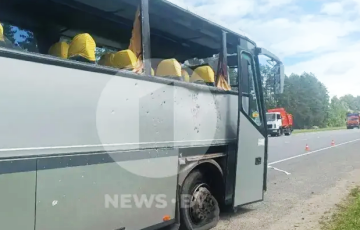
A detailed analysis of the incident in the Bryansk Region.
In the Bryansk Region of the Russian Federation, reported a drone strike on a bus carrying a children’s soccer team from the Gomel Region; however, the official account there are noticeable inconsistencies. The Ukrainian Armed Forces denied any involvement and stated that they did not use drones against targets in the Bryansk region during that period.
What is currently known about the bus incident? Can we say this was an actual drone strike, or does it look more like a planned provocation?
The website Charter97.org discussed this with Ukrainian military and political analyst Alexander Kovalenko of the “Information Resistance” group Alexander Kovalenko:
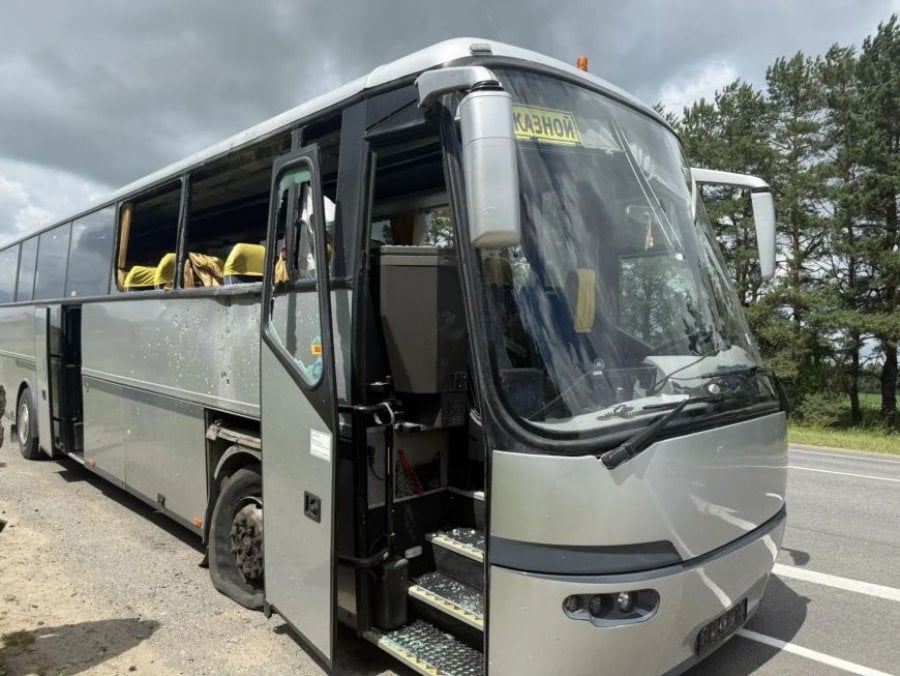
The question immediately arises: why are tourist buses carrying children still traveling through the territory of the Russian Federation? The Russian Federation is a country at war, and civilians from other countries who are in any part of it are putting themselves in danger.
The same applies to air travel, air transport, and travel by ship—for example, entering temporarily occupied waters—as well as movement within the territory of the Russian Federation itself.
Simply being in Russia is already dangerous. Therefore, I don’t understand what prompted the decision to send children on vacation to a country that is in a state of full-scale war and where things are constantly falling from the sky and exploding. This raises many questions about the judgment of the parents themselves who agreed to this.
As for the specific location where this happened: It can be said that the strike took place in the Bryansk region, in the area along the A-240 highway—specifically, the Pochepsky District, which is located approximately 60 kilometers from the border with Ukraine.
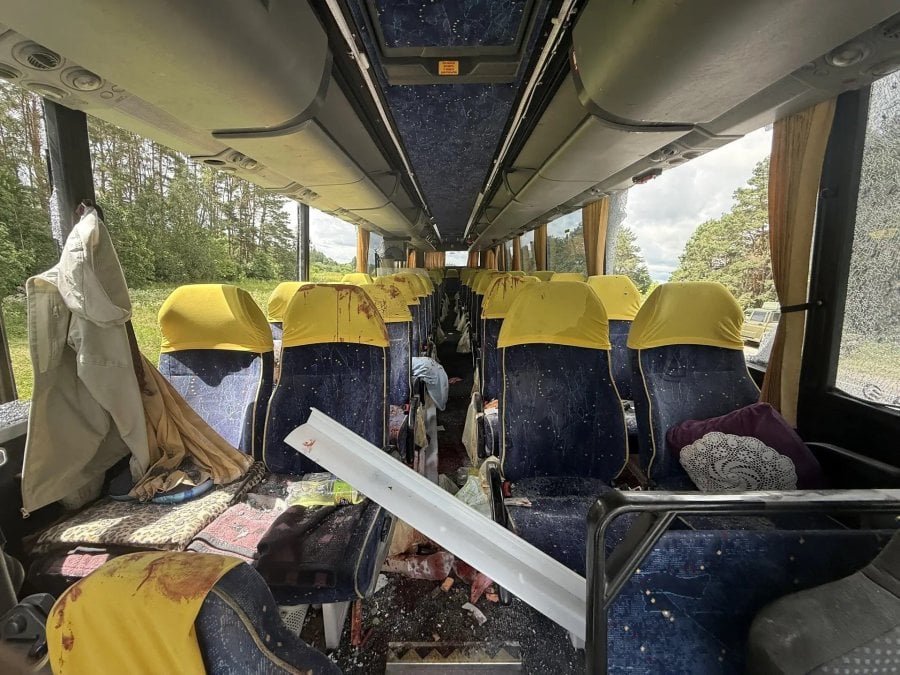
The photographs published by the Russian side show that the strike was carried out using a low-power weapon. In other words, it was an FPV drone, clearly not equipped with a cumulative warhead, but rather one using a warhead with a large number of fragmentation elements.
A standard FPV drone without fiber-optic transmission has a range of approximately 20 kilometers. With fiber-optic cable, the average flight range of an FPV drone is about 40 kilometers. However, if it had been launched from Ukrainian territory, the operator would have needed a safety zone. This is a standard set of safety requirements, averaging about 5 kilometers.
This raises the question: how could a drone with a range of 20–40 kilometers—depending on whether it has fiber-optic transmission or not—have flown, roughly speaking, 65 kilometers to strike a bus carrying children? Personally, I don’t have an answer to this question. Except for one assumption: this drone was launched from the territory of the Russian Federation.
Let’s suppose, however, that a Ukrainian sabotage and reconnaissance group enters the Bryansk Region, penetrates 20 kilometers to launch a drone via fiber-optic cable, or 40 kilometers to launch a conventional FPV drone without fiber-optic cable. For what purpose? To strike a bus carrying Belarusian children on Highway A-240 with a single drone? A truly phenomenal special operation, unparalleled anywhere in the world. Especially considering that this group would have had to travel 20–40 kilometers through territory that is constantly patrolled by Russia. There is currently a fairly substantial “Bryansk” military group stationed there, which controls the border zone. Plus, small and medium-sized electronic warfare systems are constantly operating there to jam tactical-level drones.
This raises the question: how could such an operation have been carried out? And what was its goal? To strike a bus carrying children? Not a fuel tanker, not an ammunition depot, not any oil facility, not a transit gas hub, and so on—but specifically a bus carrying children. That’s what makes it so interesting.
And here’s another very important point. Why am I talking about the drone’s low power? The fact is that Ukraine is currently carrying out a logistical lockdown both in the temporarily occupied territories and within the Russian Federation itself. Strikes are being carried out against trucks, freight vehicles, fuel tankers, and so on. But these strikes are being carried out by “middle strike” drones such as the “Hornet,” “Bulava,” Darts, RAM-2X, and others.
What sets these drones apart is that their warheads have an average explosive yield of 5 kilograms in TNT equivalent. Such drones can fly distances of 150–200 kilometers. They could easily have reached Highway A-240 and struck that bus.
But if a “Hornet”-type drone had struck that bus, the destruction and consequences would have been far worse and on a much larger scale. I think the bus would have been torn in two. Or at the very least, half the bus would have been blown out of the vehicle. There wouldn’t have been just some light shrapnel marks on its body.
So this was definitely not a “middle strike” drone. But if Ukraine were aiming to strike the A-240 highway with any kind of drone, it certainly wouldn’t have sent its sabotage team 40 kilometers from the border, risking its personnel just to launch an FPV drone. They would simply have launched a “Hornet,” RAM-2X, or Darts. And the destruction would have been much greater and more significant.
— What goal might Moscow and Minsk have been pursuing by accusing Ukraine of striking a bus carrying children?
— This is precisely a provocation on the part of the Russian Federation. Especially given that just the day before, Lukashenko had burst out with apologies to Zelenskyy and assured in an interview that he would not attack Ukraine. He understands perfectly well that Ukraine is not a country Belarus can attack, because the consequences for Belarus would be catastrophic.
Apparently, the Kremlin didn’t like this. So they decided to stir up Minsk in this way and set a precedent. On the one hand, this is a scenario for dragging Belarus into a war against Ukraine. On the other, it’s a demonstration that the Kremlin continues to keep Lukashenko on a tight leash.
Thus, first and foremost, this is a continuation of the policy that has remained unchanged since 2022: creating various kinds of provocative incidents linked to the Kremlin’s attempts to drag Belarus into a war against Ukraine and force it to do so.
Second, the Kremlin clearly did not like Lukashenko’s remarks about Zelenskyy, his apologies, and his assurances that no one would attack Ukraine from Belarusian territory again. Evidently, the Kremlin attempted to respond to Lukashenko’s remarks in this way.

Bank's name: Bank Millennium S.A.
Address: ul. Stanislawa Zaryna, 2A, 02-593, Warszawa
IBAN: PL97116022020000000216711123
SWIFT: BIGBPLPW
Name of the account holder: Fundacja “KARTA ‘97”
Purpose/title of payment: Donation for statuary aims
You can contact us by the e-mail [email protected]