
The Russian Offensive Has Choked: The Occupiers Lost 116 Square Kilometers In A Month
5- 3.05.2026, 8:22
- 3,588
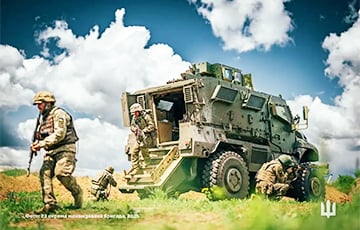
So many RF troops have not lost since 2024.
Russian occupation forces in April 2026 showed negative dynamics on the front. Instead of the expected seizures, the Russian army recorded a net loss of controlled territories.
This is reported by ISW (Institute for the Study of War).
According to the report, the occupiers lost control over 116 square kilometers within one month. This has not happened since August 2024, when the AFU launched an operation in Kursk region.
The pace of the enemy advance is falling and this process began as early as November 2025. The Ukrainian armed forces are conducting successful ground counterattacks. Precision strikes at medium range are knocking out logistics. The enemy is forced to defend where he planned to attack.
Communication and coordination: what broke down in the Russian army
The occupiers' problems have specific reasons. The RF military machine has begun to fail due to internal and external factors.
Key blows to the enemy's fighting ability:
Starlink: in February 2026, the blocking of terminals in the occupied territories became systemic.
Telegram: the Kremlin's restriction of messenger operations has destroyed horizontal communication between units.
Logistics: Ukrainian strikes on depots and headquarters have become more painful.
This has worsened the Russian army's already chronic problems. Without stable communications, coordinating an offensive has become nearly impossible, ISW said.
Weather Factor: Abnormal Winter and Crossroads
Nature has also played into the hands of Ukraine's defenders. This winter was harsher than the previous one, and temperatures in eastern Ukraine were lower. The amount of precipitation - much higher.
Now there is "roadlessness" on the front. Melting snow and spring rains have turned the soil into a trap for equipment. Mechanized RF units are simply bogged down in mud.
The ISW analysts note that the Russians usually try to regain activity in May, when the ground dries out. Whether they will have enough resources this time, however, is a big question.
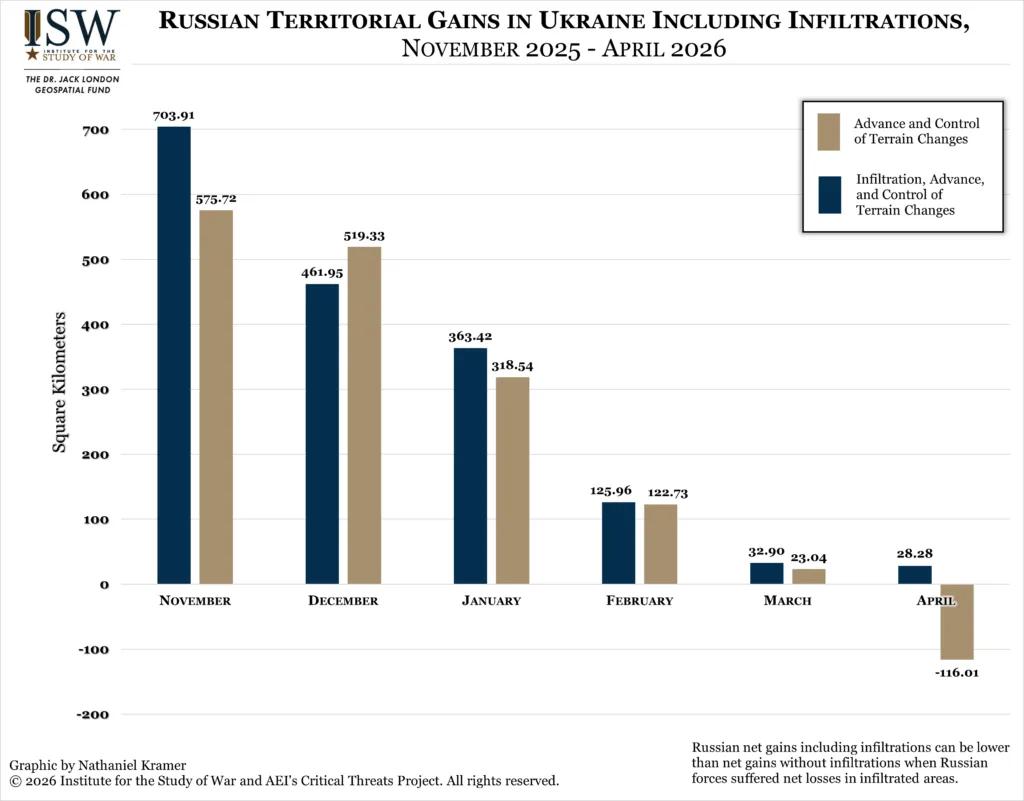
Kremlin is trying to hide the real state of affairs, analysts say. To do so, the aggressor is using "infiltration" tactics. Russian groups enter gray zones between Ukrainian positions. They do not control these areas, but propaganda passes it off as "taking control".
Comparative statistics of Russian advances:
November 2025-April 2026: 1,443 square kilometers captured.
The same period last year: 2,368 square kilometers captured.
Average speed in 2026: only 2.9 square kilometers per day (vs. 9.76 square kilometers in 2025).
The Russians are trying to create the illusion of continuous movement. In fact, the level of real control over the new areas is minimal. Most of the territories reported by the Russian Federation are disputed areas where the occupiers cannot gain a foothold, ISW concludes.
What are the current developments on the front
Ukraine has noticed "specific activity" on sections of the border with Belarus, Ukrainian President Vladimir Zelensky said. Small provocations are possible from that side, which will cost more to the Belarusian side, he said.
It also turned out that the occupants once again lied about their advancement in Sumy region. The settlement of Miropolye is under AFU control.
And Ukrainian heroes also hit the Iskander missile defense system, ammunition depots and control points of Russian drones. All the strikes were carried out on objects that were located on the VOT.

Bank's name: Bank Millennium S.A.
Address: ul. Stanislawa Zaryna, 2A, 02-593, Warszawa
IBAN: PL97116022020000000216711123
SWIFT: BIGBPLPW
Name of the account holder: Fundacja “KARTA ‘97”
Purpose/title of payment: Donation for statuary aims
You can contact us by the e-mail [email protected]