
"The Empire Will Collapse": Belarus Could Trigger Change Throughout The Region
9- 24.04.2026, 16:13
- 27,942
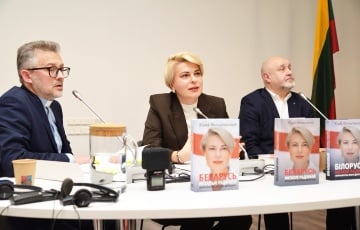
The book presentation for *Belarus by Natalya Radina* drew a full house in Vilnius.
In Vilnius—one of the hubs of the Belarusian diaspora since 2020—people have long been accustomed to opposition rallies, cultural and musical events, and meetings with politicians. It seemed that it would be difficult to surprise this audience anymore.
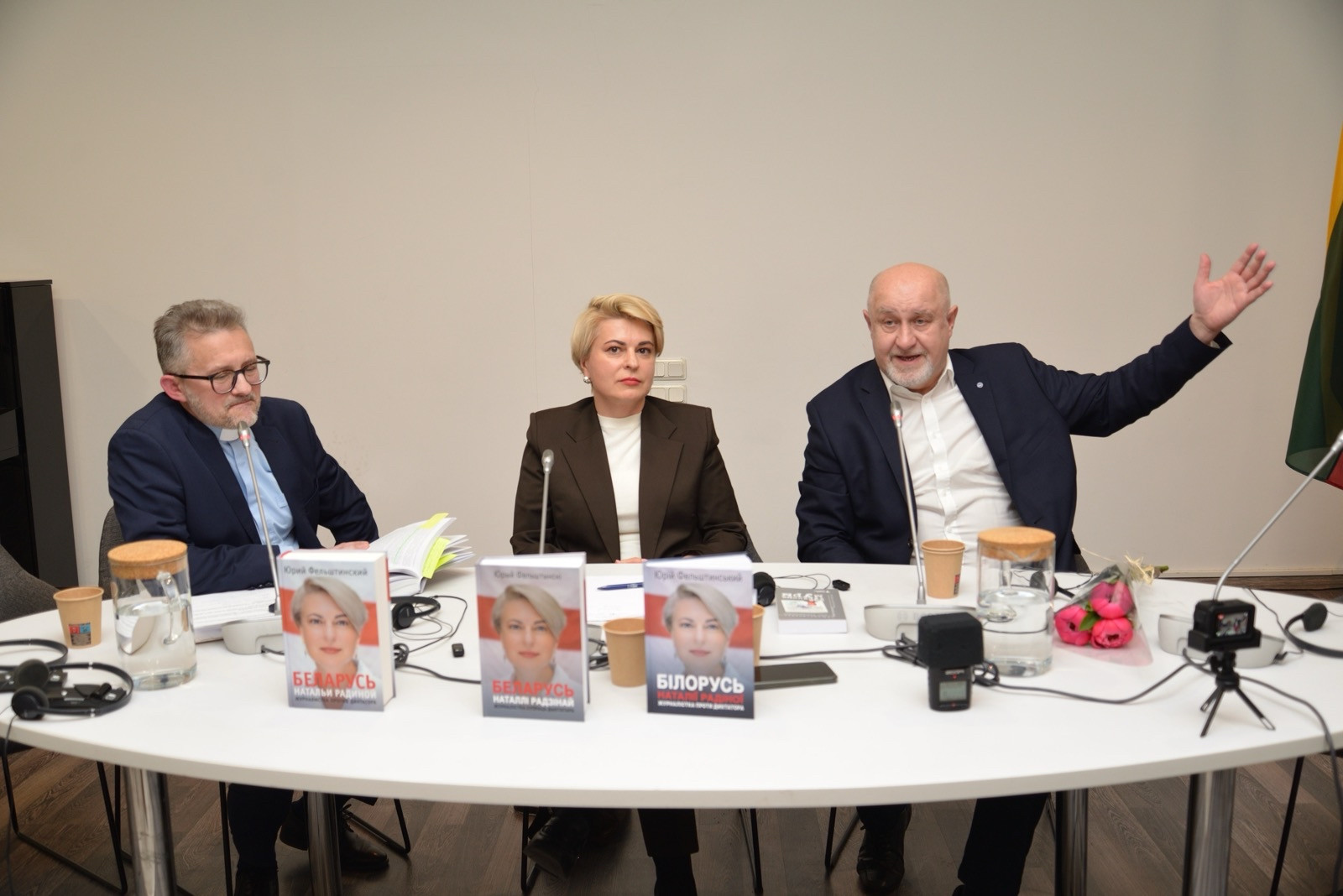
However, on the evening of a weekday—Wednesday, April 22—the Lithuanian Seimas Visitor Center was filled with people interested in Belarus. The occasion was the presentation of a new book by the renowned American historian Yuri Felshtinsky “Natalia Radina’s Belarus: A Journalist Against a Dictator.”
.jpg)
The event was attended by the editor-in-chief of the Charter97.org website, Natalia Radina, the coordinator of the “European Belarus” civic campaign, Dmitry Bondarenko, and the event was moderated by Father Vyacheslav Borok.
.jpg)
The event was attended by Lithuanian MP and leader of the “Friends of Belarus” group in the Seimas Ruslanas Baranavas, the Lithuanian Ministry of Foreign Affairs’ Special Envoy for Relations with Democratic Belarus Asta Andriauskienė, former political prisoner and leader of Belarusian Christian Democracy Pavel Severinets, renowned human rights activist and former prisoner of conscience Leonid Sudalenko, former political prisoner and journalist Oleg Gruzdilovich, former prisoners of conscience Alexander Bobko, Sergei Sparish, former fighter in the Kalinovsky Regiment Alexander Klochko, Belarusian Orthodox priest of the Patriarchate of Constantinople Georgy Roy, coordinators of the “European Belarus” civic campaign Maksim Vinyarsky, Andrei Sharendo, Andrei Voynich, blogger Andrei Pauk, and representatives of the Belarusian, Ukrainian, and Russian diasporas.
Blogger Dmitry Kozlov (“Gray Cat”) posted a video of the presentation on his YouTube channel.
“We all have a chance to finally get rid of this empire”
At the beginning of the meeting, Natalya Radina emphasized that Vilnius played a special role in the creation of Yuri Felshtinsky’s book:
— The idea for the book was born here, during the Free Russia Forum in 2023. I was invited as a speaker from Belarus, and I gave a very brief overview of our country’s history. It was then that I realized that many people simply don’t know anything about Belarus.
.jpg)
This was very strange, because we are located in the heart of Europe, and today so much in the region as a whole depends on our country. Yet people from Lithuania, Poland, and Russia don’t know who Belarusians are. There was great interest in our history in the audience, and it became clear that people know absolutely nothing about the Principality of Polotsk, the Grand Duchy of Lithuania, the Polish-Lithuanian Commonwealth, or the role Belarusians played in these political unions.
Afterward, Yuri Felštinsky, whom I’ve known for many years, came up to me and said, “Natalia, you need to write a book, because as a historian, I understand just how important your country is. After all, today, unfortunately, it has turned into a military springboard from which Russia threatens Lithuania, Latvia, Poland, and Ukraine. We need to write about Belarus so that people in the West understand that your country must be free.”
Yuri realized that it would be difficult to write this book without being a Belarusian historian. He suggested approaching it through the lens of my life. Of course, this seemed very strange to me: who was I to write a book about my own life? But my friends supported me and said, “No, come on, let’s write it.” And together with the leaders of “European Belarus” Andrei Sannikov, Dmitry Bondarenko, and Belarusian Olympic medalist Alexandra Gerasimenya, we began telling the story of our country and our struggle. I’ve been working as a freelance journalist since I was 18, and since 1996, when I arrived in Minsk, I’ve witnessed all the events that took place in Belarus almost immediately after Alexander Lukashenko came to power.
I hope the book turned out well and that it will convince people around the world that Belarus is worth fighting for, and that the Belarusian people—who have been fighting for their freedom for 32 years—need support.
Father Vyacheslav Borok quoted a passage from the book in which Natalya Radina talks about her ancestors. In their stories, many Belarusians recognize the histories of their own families—repression, exile, and life under occupation. However, the book also expresses hope that “new generations will manage to break out of this vicious cycle.” The host asked whether Natalya Radina had managed to do so:
— I think that Belarusians who are fighting for their country today have broken free from this vicious cycle. I hope I’ve managed to do so as well. After all, when I entered journalism at age 18, I immediately realized that I wouldn’t work in the state media. It was 1997, and even then it was clear where the country was headed—that Lukashenko was building a dictatorship, and that there was no freedom in the state media.
.jpg)
Initially, I planned to work in television, but I had to go into newspapers instead because television had already been taken over by Lukashenko, and strict censorship had been imposed on it.
As for the freedom of Belarusians and our country, it seems to me that we are all currently in the process of breaking these chains. Belarus has been under Russian occupation for hundreds of years, and now, as Russia wages this shameful and horrific war against Ukraine, we all have a chance to finally rid ourselves of this empire—so that it will finally collapse, and we will be free.
.jpg)
— At first, the security service officers really “grilled” us and put enormous pressure on us. But then we just talked, and I’m sure that much of what we discussed stuck with them. We explained that we aren’t fighting against Lukashenko, because today there’s one dictator, but tomorrow there might be someone else. We’re fighting for a free and Belarusian Belarus.
I told them: “Listen, if you were a national Belarusian dictatorship, I might not even fight—though I love freedom so much that I’m not sure about that. But you’re just kissing up to the Russians—you’re not officers of the Belarusian state, and you don’t care about our country’s security.”
Belarusian prison guards have portraits of Putin and Russian flags on their walls. Back in 2010–2012, when they were trying to recruit us, they cited Denikin, Kolchak, and the Russian philosopher Ilyin. I say: “I am a Belarusian patriot; you’re simply unfit for the job.” We have always fought for freedom and independence. We learned this from our neighbors, and above all, from the Lithuanians. That is why, for me, the main enemy is the Russian Empire.
“The time has come to teach the shared history of resistance”
Vyacheslav Borok referred to Natalya Radina’s biography and noted that she became editor-in-chief at a critical moment for “Charter ’97”—after the regime murdered the site’s founder Oleg Bebenin. The host asked if Natalya Radina was afraid at that moment. The journalist described how the events of 2010 affected her life:
— It was at “Charter” that I found friends and comrades-in-arms, people who always made it their mission to defeat Lukashenko.
When, in 2010, Andrei Sannikov, the head of the “European Belarus” civic campaign and one of the founders of the “Charter ’97” civic initiative, became a presidential candidate, we realized this was our chance to change the situation. We were ready to risk even our lives and set out with the intention of doing more than simply participating in the election campaign, as some political figures say today. We knew we were in it for the long haul. According to independent observers, Andrei Sannikov was beating Lukashenko in 2010; he was supposed to advance to the second round and could have become president of Belarus.
Unfortunately, three months before the election, Oleg Bebenin, the founder and editor-in-chief of *Charter*, was murdered. Of course, this came as a huge shock to me, because Oleg was not just a colleague—he had been a friend for many years. We started working with him back in 1997 at the newspaper *Ima*, which was a very popular publication in Belarus at the time. But it was clear that we couldn’t stop. No matter how difficult and frightening it was, I was convinced that we had to keep moving forward—we couldn’t be afraid.
.jpg)
After that election campaign, we all ended up in prison; we were arrested on Election Day in the square. But I’m very glad we didn’t stop then. I believe we set an example that Belarusians must fight for their freedom, risking their will and their lives—there is no other choice.
Ten years later, the people have regained their strength; they’ve taken to the streets again, and it’s become clear that as long as Lukashenko remains in power, we must keep fighting and protesting.
It is worth noting that the participants in the meeting in Vilnius, the former capital of the Grand Duchy of Lithuania, repeatedly referred to the shared history of Belarusians and Lithuanians. Dmitry Bondarenko, responding to a question about the experience of the Belarusian resistance, pointed to the shared history of the countries in our region.
— Belarus is not some kind of unique country. We are a state just like Poland, Hungary, or Czechoslovakia—or the Baltic states in the late 1980s. Belarusians are a little behind, but today we are fighting this “red dragon,” the Russian double-headed eagle, which has returned after centuries. In this sense, we are one of the countries in the region that continues the common struggle for our freedom and yours.
We learned from the example of dissidents from the Baltic states and from the Polish “Solidarity” movement. But after 2020, I spoke with many Polish veterans, heroes of the anti-communist resistance, and they said: “Listen, it wasn’t that harsh for us. Perhaps only during the first months of martial law in the People’s Republic of Poland. What’s happening in Belarus today is closer to Stalinism.”
I know there are various historical debates going on right now, but it seems to me that the time has come to teach a shared history of how our ancestors—Lithuanians, Belarusians, Poles, and Ukrainians—fought side by side in the battles at Blue Waters, on the Vorskla, near Žalgiris and Orsha, near Moscow and Vienna. This was a unique experience when our peoples, as part of a single state—the Grand Duchy of Lithuania and the Polish-Lithuanian Commonwealth—fought together. And they truly saved Europe—from the Tatars, from Moscow, and from the Ottoman Empire. It seems to me that this experience is needed again today. This is precisely what unites us.
“Perhaps Belarus will be the catalyst that brings about change in Russia”
.jpg)
Dmitry Bondarenko said he sees Belarus’s future in the EU and NATO, and also reflected on the future of the region:
— For hundreds of years, we lived alongside Lithuanians and Ukrainians in the same states, whether free or under oppression. Today, with Lithuania being a member of NATO and the European Union, it cannot be that people lived side by side for thousands of years and then a border suddenly appeared. That won’t happen; the border is temporary. And, of course, Belarus will become a member of NATO and the European Union—just like Poland, Lithuania, Latvia, Estonia, and neighboring Ukraine.
Of course, I wouldn’t want to exclude Russians either, even though we’ve all suffered greatly at the hands of Russia. However, I know, for example, that many fighters who voluntarily went to help Ukraine back in 2015 were Russians. There were thousands of them, while at that time there were only a few dozen Belarusians fighting for Ukraine. Today we know that many Russians are also fighting on Ukraine’s side.
The European part of Russia isn’t going anywhere; it will remain close by, we will still share borders, and we’ll have to do something about that. Perhaps Belarus will be the very catalyst that brings about change in Russia.
All of our countries already face a major shared problem—depopulation—and we will compete for labor. Belarusians might compete, for example, to attract the best Ukrainians and Russians to come work here. We Belarusians will have to create conditions to attract people from the West. Perhaps we should open several universities, or a branch of some prestigious American university in Belarus—or maybe a British one—or perhaps YSU will return to us from Lithuania in a new form.
.jpg)
Next, Georgy Roy, a Belarusian Orthodox priest of the Patriarchate of Constantinople, took the floor. In his speech in Lithuanian, he explained why the book *Belarus by Natalya Radina* is personally important to him:
— Dear Natalya, we are fellow countrymen. This book, which you gave me as a gift, contains a lot of interesting information. I’ll mention right away that my son—a student at the University of Gdańsk majoring in political science—has taken this book from me. He’s very interested in what happened in Belarus. I’m simply amazed at how differently young people view history.
I read the first chapters of this book—which are about your childhood and our native Kobrin region—with great interest. It was interesting to compare how we grew up—we lived in the same city, in the same place. I think you’ve truly done something very important—this applies to all those years of struggle. It’s good that this book exists—it’s a necessary retrospective: what happened to us, where we are now. It helps us move forward.
.jpg)
“You have no other future than a free Belarus”
Lithuanian MP Ruslanas Baranavas, who helped organize the book presentation in Vilnius, shared what surprises him about Belarusians, using the example of former political prisoners who were forcibly deported to Lithuania:
— It seems a man spent five years in prison and fought for 20–30 years. You’d think that once he was brought to Lithuania, it would be understandable if he said: “That’s it, enough—I’ll live peacefully in Europe.”
But the people we met were saying that very same day: “What are we going to do next? How are we going to keep fighting?” That’s really impressive.
Not a single one said, “I want to take a break; enough is enough.” No, everyone is determined to keep fighting. I think that with this spirit, you have no other future than a free Belarus.
.jpg)
.jpg)
Renowned Lithuanian journalist Vitautas Bruveris asked a question about the policies of U.S. President Donald Trump, who has begun negotiations with the Lukashenko regime, as well as about possible aggression originating from Belarusian territory. Natalia Radina noted that she has always advocated for putting pressure on the Belarusian leader:
— I see that these negotiations with the U.S. are saving people, not the dictatorship. The sanctions that the Americans are lifting do not have a very strong impact on the economic situation. Therefore, it is important for Lukashenko that restrictive measures be lifted specifically by European Union countries.
And here it’s very good that Europe and Lithuania are standing firm on principle and saying they demand systemic changes: to stop the repression and withdraw from the war that Lukashenko’s regime, together with Putin, is currently waging against Ukraine. Only then can we begin to discuss lifting the economic sanctions.
As for Lukashenko’s threats… What if he’s actually warning us? Perhaps there really is a threat of an attack. We understand that Belarus today is a Russian military springboard. And as long as Russia maintains such a large presence in Belarus, the threat to Ukraine and the Baltic states will remain. Therefore, I do not rule out various scenarios. We understand that Russia currently lacks the resources to wage war on two fronts, but I wouldn’t rule out any scenario.
“Belarusian independent journalists are defending the entire region”
Responding to a question about what the Belarusian diaspora can do today, Natalya Radina called for focusing on specific goals rather than spending funds on creating obscure organizations:
.jpg)
— The most important thing right now is to conduct information campaigns targeting Belarus. It is very important to support independent Belarusian media. Unfortunately, there are problems with this.
“Charter ’97” is the most popular Belarusian website according to statistics, but it doesn’t receive enough support. I don’t even know how we’ll manage next year—we receive very little assistance from Western foundations. We need to emphasize that without independent media, Belarus will not become free, because we must counter the propaganda coming from Russia and Lukashenko’s media.
We, as independent journalists, also help ensure security in the region. Why didn’t the Belarusian army invade Ukraine? That, too, is thanks to the independent media, which people in Belarus read and listen to more than Lukashenko’s propaganda.
Second, of course, the work of human rights organizations is important. We need to support former political prisoners who come to the West. It’s important to help the families of those who have been repressed inside Belarus—no matter how difficult it may be—to find ways to ensure that this aid reaches them.
Diplomatic efforts are also important: engaging with Western politicians to convey the truth about what is happening inside the country and to influence the formation of Western policy toward Belarus. But that is all we can do. I see no point in any pseudo- or quasi-governmental structures created in exile. I believe this is a waste of resources.
.jpg)
One of the questions from the audience concerned the 2020 revolution. Why didn’t the security forces side with the Belarusian protesters? Dmitry Bondarenko, coordinator of “European Belarus,” pointed out that those who called themselves leaders did not appeal to the military:
— Recently, former political prisoner, lawyer Maksim Znak spoke about how, together with Maria Kolesnikova and Svetlana Tikhanovskaya, they filed a complaint with the Central Election Commission against “the soup cook” Yermoshina. They didn’t consider turning to the military; instead, for some reason, they filed their complaint with an official who was subject to all international sanctions.
The generals didn’t listen to anyone about whose side to take.
However, I’ll note that a split among the elites occurred at that time. We spoke with friends from “European Belarus” who were serving time in penal colonies. There is another category of prisoners in Belarus—they are true heroes. And they are typically charged with “treason against the motherland.” These are judges, prosecutors, officials, military personnel, police officers, and special forces members who refused to carry out orders. And there are, they say, hundreds of them. They are not classified as political prisoners. This was the split among the elites, when many refused to follow orders.
Unfortunately, leaders who could have made a real difference—such as Nikolai Statkevich, Pavel Severinets, Sergei Tikhanovsky, who acted very boldly, and a number of others, had already been arrested by that point. And I didn’t understand at the time why the so-called leaders didn’t call on the protesters to go on television and appeal to the military to side with the people. Journalists were leaving the television stations, and, most importantly, so was the technical staff.
But here, it was necessary to draw on the experience of the Belarusian Popular Front, which, to put pressure on the authorities, called on people to come to the TV stations, and they were given the opportunity to speak. In 2020, this was not done.
Natalia Radina also mentioned that the book will be published in English soon, and following the presentation, which took place in Tallinn, a proposal was made to translate it into Estonian. The book is also set to be published in Polish and Lithuanian.
When asked about her plans for the future, Natalya Radina said that the most important thing for her right now is “returning to a free Belarus.”
.jpg)
— I hope this gathering has given us some hope that we will see a better future. And I appeal to each of you: write the story of your life. If you are Belarusian—write about your Belarus, dream and think about it, and work for the good of Belarus. Write the story of the nation to which you have the honor of belonging. If the narratives of these stories leave no room for even one percent of collaboration with evil, if we remain uncompromising toward evil, yet at the same time are able to reach agreements with others, we will be able to write a unique book about a free and European Belarus—and, together, about a peaceful Europe.
However, let’s not succumb to the illusion that we can reach an agreement with those who have once tasted human blood. You can’t negotiate with them using “flowers.” Let’s save the flowers for their funerals.
I’m especially hopeful that we’ll have a book launch for this book in Minsk. Thank you all very much.

Bank's name: Bank Millennium S.A.
Address: ul. Stanislawa Zaryna, 2A, 02-593, Warszawa
IBAN: PL97116022020000000216711123
SWIFT: BIGBPLPW
Name of the account holder: Fundacja “KARTA ‘97”
Purpose/title of payment: Donation for statuary aims
You can contact us by the e-mail [email protected]