

Why Did Macron Call Lukashenko?
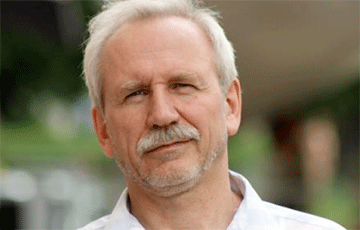
- Valery Karbalevich
- 25.05.2026, 14:32
- 2,286
The question is what conclusions the dictator will draw from this event.
On Sunday, May 24, French President Emmanuel Macron called Alexander Lukashenko. The event is unexpected and unusual. After all, Western leaders talk to Lukashenko very rarely after 2020. In 2021, Angela Merkel called him, a year later - the same Emmanuel Macron, and last year - Donald Trump.
Since the EU countries do not recognize Lukashenko as the legitimate president of Belarus and refrain from contacts with him, high-level communications are extremely important for official Minsk. To force Lithuania to hold talks at the level of the foreign minister or at least his deputy, Minsk is putting hard pressure on the Lithuanian side (balloons, migrants, etc.). The Belarusian authorities persistently hinted to Warsaw that they were ready to release Andrzej Poczobut in exchange for the visit of Polish Foreign Minister Radoslaw Sikorski to the Belarusian capital.
With this background, Macron's call looks almost sensational.
Here it is worth paying attention to the personality of Emmanuel Macron. The French president is trying to assume the role of the main figure of European politics. He seeks to speak on behalf of Europe. This role increases in times of acute international crisis.
And here it is worth drawing parallels with the events of four years ago, when Macron called Lukashenko twice: on February 20, 2022 (before the Russian invasion of Ukraine) and February 26 (on the third day of the war). In those days, there was serious anxiety in the West that Lukashenko, under pressure from the Kremlin, would decide to directly engage the Belarusian army in the war and openly invade Ukraine together with Russian forces. And the French president's call to Minsk was a stern warning about the negative consequences for Belarus in case of such a development.
And now Macron is again acting as a crisis manager. This time his call is caused by the crisis in Belarusian-Ukrainian relations. We can say that in a certain sense it has become a success of Ukraine's diplomacy.
For a month now, official Kiev has been waging a political, diplomatic, and psychological attack against Lukashenko's regime. Ukrainian President Vladimir Zelensky and other Ukrainian officials almost every day say that, say, Russia is dragging Belarus into war, that an attack from the Belarusian territory is being prepared. At the same time, Kiev appeals to the West, urging it to put pressure on Minsk.
But so far, these measures have not had much effect, as there have been no new facts of Belarus' participation in the war or additional threats from it to Europe. But recently such facts have appeared. These are joint Belarusian-Russian exercises on the use of nuclear weapons. Then there was one of the largest-scale shelling of Ukraine with drones and missiles, including Oreshnik. Recall that Lukashenko brags that this missile system is located on Belarusian territory.
Before calling Minsk, Emmanuel Macron had a conversation with Vladimir Zelensky. It seems that the president of Ukraine convinced his interlocutor in the reality of the threat from Belarus. And the latter joined the Ukrainian pressure on Lukashenko.
The AFP news agency, citing a source in Emmanuel Macron's entourage, revealed the content of the current telephone conversation between Paris and Minsk. The French President warned Lukashenko against any demand to drag Belarus into the war against Ukraine on the side of Russia, emphasizing the risks for Belarus in such a case. French sources note the very serious and tense nature of the conversation. Maybe for this reason, the Belarusian state media have not yet launched a full-fledged propaganda campaign around this call.
The question is what conclusions Lukashenko will draw from this event. For example, he may come to believe that European politicians only talk to him when his regime poses a serious security problem for his neighbors. Merkel called him in 2021 at the peak of the migrant crisis. Macron both in 2022 and now calls on Minsk when the military crisis is escalating. In other words, Europe notices Lukashenko when he creates a big problem.
But the main question lies in another plane: does Lukashenko still have freedom of choice and room for maneuver?
Valery Karbalevich, "Radio Svaboda"

Bank's name: Bank Millennium S.A.
Address: ul. Stanislawa Zaryna, 2A, 02-593, Warszawa
IBAN: PL97116022020000000216711123
SWIFT: BIGBPLPW
Name of the account holder: Fundacja “KARTA ‘97”
Purpose/title of payment: Donation for statuary aims
You can contact us by the e-mail [email protected]