

Lukashenko Is Becoming Too Weak
2- 24.10.2026, 12:32

Will Baron Vorobey start a feudal feud?
Businesses often have to clean up the messes made by the Belarusian authorities. But now, it seems, relations between the government and the business community are reaching a fundamentally new level. Lukashenko has begun distribute land in the Vitebsk Region as fiefs to Belarusian businessmen, just like in the good old feudal days.
The ill-fated region
“The Vitebsk region is a case in point. For as long as I’ve been working alongside the head of state, the question has been raised about how to raise this region to a level at least slightly above that of the perpetually lagging ones,” said Igor Tur, host of the “Propaganda” program on Belarusian television.
I’m not sure Igor Tur realized what he actually said. Because he effectively accused his boss of complete managerial impotence. No matter how many years a person tries, things only get worse. All the long-standing attempts to save the Vitebsk Region, according to the state propagandist himself, have apparently failed miserably.
It gets even worse when you ask yourself who actually brought the region to such a sorry state. Because in the late ’80s, the region was one of the three main financial contributors to the Byelorussian Soviet Socialist Republic.
In the ’90s, it went into decline. But everything went into decline in the ’90s. In the 2000s, however, when Lukashenko latched onto Russia’s oil windfalls, the region performed economic miracles. Then Russia started to rein in its spending a bit, and the miracles came to an end.
And after that, in the 2010s, Lukashenko decided to save the Orsha District. But while they were busy saving the Orsha District, they let everything else fall apart. The Orsha District, by the way, wasn’t saved either.
I’ll Put It in Good Hands
And now, after thirty years of Lukashenko’s rule, the authorities no longer know what to do with the Vitebsk Region. So they’re looking for someone who could fix their mess. That’s why Lukashenko didn’t just happen to visit the Vitebsk Region last week. He went there to personally transfer the lands of the Vitebsk Region to the fiefdom of businessman Nikolai Vorobey.
“I’m ready to transfer Osveya, Kokhanovichi, and the forest and land to your private ownership. Something needs to be done here—and drastically,” said Lukashenko.
A year ago, Lukashenko had already tried to lease the region en masse to Omani sheikhs. But he was unable to persuade the sheikhs. So now the region is being handed out to Belarusian businessmen on a smaller scale. And Nikolai Vorobey isn’t the first to receive a piece of the pie.
The company “Servolux” received ten organizations in the Dubrovno District and the Vitebsk Bacon enterprise. They decided to assign agricultural organizations in the Orsha District to “Savushkin Product.” And now Lukashenko has granted land to Nikolai Vorobey.
“I asked him to take control of the entire north, with the center in Osveya,” said Lukashenko.
And this isn’t simply privatization or the transfer of state assets to private business. It’s not a shift from so-called socialism to so-called capitalism. From advanced socialist practices, we’ve turned back toward the past—toward even more “advanced” practices of not-so-developed feudalism.
The Baron and His Army
When the king became too weak to manage distant and less accessible regions, he granted these regions as fiefs to his barons. Granting them broad powers to govern the population under their jurisdiction. This is exactly what we’re seeing now in the Vitebsk Region.
“Make sure the people here live decently. But they must work day and night,” Lukashenko instructed.
And since serfdom has already begun to be revived here—albeit on a limited scale for now—the emergence of marquises and dukes is precisely the next logical step. We will now have Baron Vorobey-Osveysky and Count Moshensky in the Vitebsk Region.
And if this cutting-edge feudal experiment takes root within a single region, it can be extended to all the others.
And every self-respecting feudal lord needs, of course, his own army. Otherwise, Count Orshansky might suddenly decide that his Orshansky District isn’t enough, and he’ll want to grab a piece of the Verkhnedvinsky District for himself.
And so, in the Vitebsk region, we witnessed yet another pilot project: a project to create a feudal militia.
Lukashenko devoted the second day of his visit to security issues. More specifically—the creation of a people’s militia. But a unique militia.
“An interesting and important example is the organization of a militia within a private entity,” Lukashenko’s press service wrote.
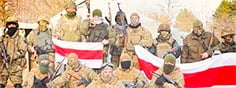
The unit is made up of employees of a hunting estate owned by Vorobey. The businessman purchased the uniforms, body armor, and weapons—which include not only assault rifles but also machine guns and combat drones—with his own money.
He also funds the unit, which is commanded by a former professional soldier. So, compared to the “combat tractor drivers” whom Lukashenko ordered to be drafted into the army, this platoon led by Nikolai Vorobey looks quite impressive.
Lukashenko liked the experiment. He said that this pioneering initiative should be scaled up nationwide. So it’s quite possible that Belarusian barons will soon have their own feudal militias.
Felix Mirsky, “Belarusians and the Market”

Bank's name: Bank Millennium S.A.
Address: ul. Stanislawa Zaryna, 2A, 02-593, Warszawa
IBAN: PL97116022020000000216711123
SWIFT: BIGBPLPW
Name of the account holder: Fundacja “KARTA ‘97”
Purpose/title of payment: Donation for statuary aims
You can contact us by the e-mail [email protected]