Don't Fall Asleep, Rygorych
- Irina Khalip
- 16.10.2026, 12:11
- 4,198
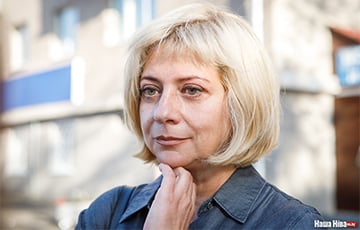
Photo: “Nasha Niva”
Revolutions are contagious.
Ilham Aliyev yesterday accepted congratulations from the working masses on the occasion of his 23 years as president of Azerbaijan. At the same time, in various cities and villages across the country, people threw stones at school windows, set fires, and chanted “Freedom for the hijab!”
Spontaneous protests, which began in late September due to a ban on wearing hijabs and headscarves in Azerbaijani schools, have already spilled beyond school grounds. Recently, for example, Azerbaijani propaganda outlets reported that 200 protesters had been detained in Baku near the “May 28” metro station. As usual, however, nothing was reported about the protest itself—it was simply stated that two hundred public order violators, who had coincidentally gathered in one place, were detained, and criminal cases were opened against half of them. At the same time, photos and videos were shown from schools where children, all dressed and groomed identically, stood in formation, just like their peers in North Korea.
I won’t get into whether it’s right to ban headscarves and hijabs for female students and teachers—that’s not my point. Azerbaijan is a country glistening with prosperity. Of course, there have been political protests there in various years following elections, but they were not massive. The opposition took to the streets for those protests, just as they once did in Belarus. But not hundreds of thousands of citizens dissatisfied with the government. So stability is precisely what the Azerbaijani regime could boast about: stability and the well-being of its citizens. Imagine Belarus in the 2000s, only rich and with oil—you’d get something almost like Azerbaijan. And for the past six years, Ilham Aliyev—unlike Lukashenko—has been a national hero following a small, victorious war in Nagorno-Karabakh. It was time to relax.
Nevertheless, all of a sudden, schoolchildren, parents, and teachers began protesting across the country. Not the opposition, but simply children and adults. Without coordinating anything, gathering spontaneously, recording indignant video messages, making demands, and expressing outrage. So the phrase “nothing foreshadowed it,” as history shows and proves, is just empty words. In no country in the world—whether a dictatorship or a democracy—can those in power be certain that tomorrow people won’t take to the streets to protest an issue that was never even considered a possible cause of public outrage. In Belarus, such mass protests in 2020 had it not been for Lukashenko’s boorish behavior during the COVID-19 pandemic. In Azerbaijan, the banned hijab played the role of COVID.
And here’s another important feature of global development: revolutions are contagious. Once, the Chinese writer Liao Yi, who served four years in prison for his poem “The Long-Page Massacre,” dedicated to the heroes of the events at Tiananmen Square, said that without that square, the Berlin Wall would not have fallen. He spoke of the connection between the events at Tiananmen Square and the fall of communist regimes in Central and Eastern Europe. Ironically, on the day Chinese protesters were shot and crushed by tanks—June 4, 1989—Poland held its first free elections to the Sejm. Next came Hungary, the GDR, Czechoslovakia, and Romania.
The Belarusian protests of December 2010 were followed by the “Arab Spring.” “Red May” of 1968 in France culminated in mass protests in Czechoslovakia and even the famous march of Soviet dissidents onto Red Square in Moscow. The hijab protests in Azerbaijan could not have arisen without the school protests in France that began a little earlier. So no one knows at which point on the planet protests that erupted in one country will suddenly catch on. But they will certainly flare up. Revolution—like COVID—spreads quickly. It seems to start somewhere in China, and then suddenly it’s on the streets of Minsk, with security forces scratching their heads, stumbling over their words and blushing before a boss who’s just as terrified and hysterical: “We were monitoring every Belarusian—we have three KGB agents and wiretaps with surveillance cameras on every citizen—nothing foreshadowed this; everyone was happy with their lives, getting ready to head to their dachas or the seaside.” Why did they suddenly take to the streets to protest? Hell if we know—it’s not our fault. To this day, they still can’t cope with the aftermath of the protests and dream of one day waking up in a country where 2020 never happened.
So don’t sleep, Rygorych—you’ll sleep through the revolution. Annushka has already put on a hijab.
Irina Khalip, exclusively for Charter97.org

Bank's name: Bank Millennium S.A.
Address: ul. Stanislawa Zaryna, 2A, 02-593, Warszawa
IBAN: PL97116022020000000216711123
SWIFT: BIGBPLPW
Name of the account holder: Fundacja “KARTA ‘97”
Purpose/title of payment: Donation for statuary aims
You can contact us by the e-mail [email protected]