


"The Explosion Was Really Serious": What Happened During The Russian Pacific Fleet's Exercises
18- 27.08.2026, 22:39
- 50,046
Main Versions.
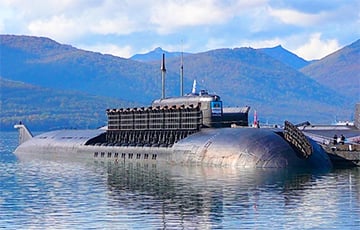
On August 26, in Peter the Great Bay in Russia's Far East powerful explosions rocked the area. Ships of the Pacific Fleet were nearby, and shortly before that, military exercises involving the nuclear submarine Omsk had taken place in the area. A theory has emerged that an “Oreshnik” missile may have detonated.
What could have happened on the Russian submarine? Could a missile or other munition have actually detonated there?
The website Charter97.org spoke with Colonel (Res.) of the Ukrainian Armed Forces, military expert, and flight instructor Roman Svitan about this:
— The explosion was indeed serious; there is video and photographic evidence. The question is what exactly caused it and where it occurred.
This is an area where the Russian Navy operates. Therefore, the incident could be linked to either a submarine or surface ships. We can also factor in the operations of unmanned boats (unmanned surface vessels—ed.).
Could a missile have exploded upon launch? Yes, it could have. But in this area—it’s unlikely. It’s too close. It’s unlikely the Russians would have launched a missile there.
If the missile itself simply exploded for no reason at all, that’s a major problem. The explosion could have occurred while the missile was being loaded or unloaded. That’s also possible. We can’t rule out the use of underwater vehicles either.
We could spend several hours discussing the possible causes and the likelihood of one explosion or another. In military affairs, especially on complex platforms like submarines, anything can explode—including support systems.
As for the “Oreshnik,” it’s unlikely that was the one. There are several reasons for this. This missile is still too unproven to be used at other sites. That’s practically impossible. Therefore, I think that if a missile did explode, it was some other type. It’s unlikely it was the “Oreshnik.”
— What can you tell us about the "Oreshnik" missile itself? Could it turn out that the whole story surrounding this Russian “superweapon” is largely is largely a myth and propaganda?
— The “Oreshnik” missile is a simplified version of the “Yars” and a rather capable series of missiles—the “Topol” and “Topol-M.” By and large, this missile was created by removing one of the Yars missile’s booster stages.
In other words, they took a decent intercontinental ballistic missile and reduced its range to that of a medium-range missile. From an intercontinental missile capable of traveling more than 5,000 kilometers, they created a missile capable of flying only up to 5,000 kilometers. From a practical standpoint, this is a completely pointless endeavor. There was absolutely no point in developing this missile at all, given that the “Topol” and “Yars” were already available. Most likely, this was an attempt to siphon off funds somewhere: to carve out and allocate funding, and then funnel it elsewhere.
From a military standpoint, this is simply a senseless modification when intercontinental ballistic missiles already exist. It’s like having a pistol and suggesting, “Let’s make a slingshot.” Why would you need a slingshot if you already have a pistol? It’s the same story here. It’s just that you can allocate funds for a slingshot. Or, on the other hand, you can use the creation of something “new” for PR purposes.
Although this isn’t really such a new weapon. It’s something that already existed—and was mostly developed back in the Soviet Union. The “Topol” series was developed by the USSR back in the day. So all of this looks more like a PR stunt—and one with a corrupt slant, at that. And now they have to keep playing up this theme somehow. The Russians are running around with the “Oreshnik” as if it were a worthless piece of junk.
The effectiveness of this missile is far too low. It’s much lower than that of the “Topol” and “Yars” missiles.

Bank's name: Bank Millennium S.A.
Address: ul. Stanislawa Zaryna, 2A, 02-593, Warszawa
IBAN: PL97116022020000000216711123
SWIFT: BIGBPLPW
Name of the account holder: Fundacja “KARTA ‘97”
Purpose/title of payment: Donation for statuary aims
You can contact us by the e-mail [email protected]