
The Ukrainian Armed Forces' Secret Offensive: Russia's Plan Thwarted
1- 28.07.2026, 11:04
- 3,370
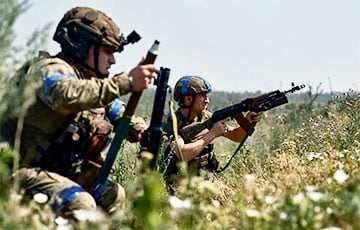
Very little is known about this operation.
Over the past six months, the Ukrainian army has been conducting an offensive along a section of the front approximately 50 kilometers wide, gradually regaining control of settlements lost a year earlier.
This is reported by influential OSINT expert Clement Molin, as reported by "Dialog".
Due to the lack of official statements and the extremely limited amount of video footage, very little is known about this operation, so I have compiled all available information to make sense of what is happening.
In 2025, the Russian army doubled the pace of its advance compared to 2024, but its most notable successes were not achieved in the Donbas. Early in the year, the Russians captured Velyka Novoselka, after which they launched an offensive north toward Komar and west toward Huliaipole. By the end of the year, Ukraine’s situation had become critical: its south-facing defensive lines had been breached from the east, and Russian troops were gradually closing in on Zaporizhzhia—a city with a population of about 800,000.
After the capture of Huliaipole, many expected the fall of Pokrovsk, Ternovate (where the Russians had already penetrated by that point), and then Orekhov. It was assumed that by the end of the year, the Russian army would reach the outskirts of Zaporizhzhia; however, seven months later, the situation had hardly changed: Russian troops remain pinned down west of Huliaipole. Moreover, further north they lost significant territory, which effectively halted this offensive. Although it was considered secondary compared to the main campaign in the Donbas, it involved enormous forces—five combined-arms armies and one army corps.
What Happened
It all began in February, when several airborne assault brigades were deployed to the area. Under cover of thick fog, they launched a mechanized attack, landing infantry in disputed settlements—often already behind the positions of the first Russian groups that had penetrated the villages. The settlements were then systematically cleared, and Ukrainian units themselves began to gradually push further south. By March, they had established a foothold east and west of Uspenivka, cutting off Russian forces’ ability to advance toward Pokrovske and Ternovate.
In response, Russia redeployed several Marine brigades and divisions to this sector, as well as units from the 68th Army Corps.
Starting in April, airborne assault brigades were redeployed northward with the task of advancing on Komar. The purpose of this redeployment was to prevent the 90th Tank Division from shifting its forces toward Dobropillya.
This time, there was no large-scale mechanized offensive: the terrain, crisscrossed by several rivers—most notably the Volchya—made such an offensive virtually impossible. Instead, small Ukrainian infantry groups gradually advanced, moving toward the next natural defensive line—the Mokrye Yaly River.
It is important to understand that, despite their eight-month presence in the area, Russian forces were never able to establish a secure foothold. The extensive network of rivers complicated logistics, and the small size of the settlements made it impossible to concentrate significant forces.
As a result, Ukrainian units managed to move relatively covertly behind Russian lines and reach the Mokrye Yaly River.
A strict media blackout was imposed in the area of operations. With the exception of a single video clip (later deleted) showing Ukrainian soldiers raising a flag over a liberated village, the Ukrainian side published virtually no material about the operation, which by that point had already been underway for three months.
The Russian side also continued to conceal the actual situation. The “Vostok” group published only videos that were difficult to geolocate and continued to send out so-called “flag-planting” teams, which were effectively carrying out suicide missions: they would reach Iskra, raise the Russian flag, and thereby create the illusion of control over the territory.
On the map, I have roughly depicted the situation that has developed over the past few weeks. It is based primarily on several geolocated video recordings, satellite images documenting airstrikes and artillery strikes, as well as scattered posts on social media.
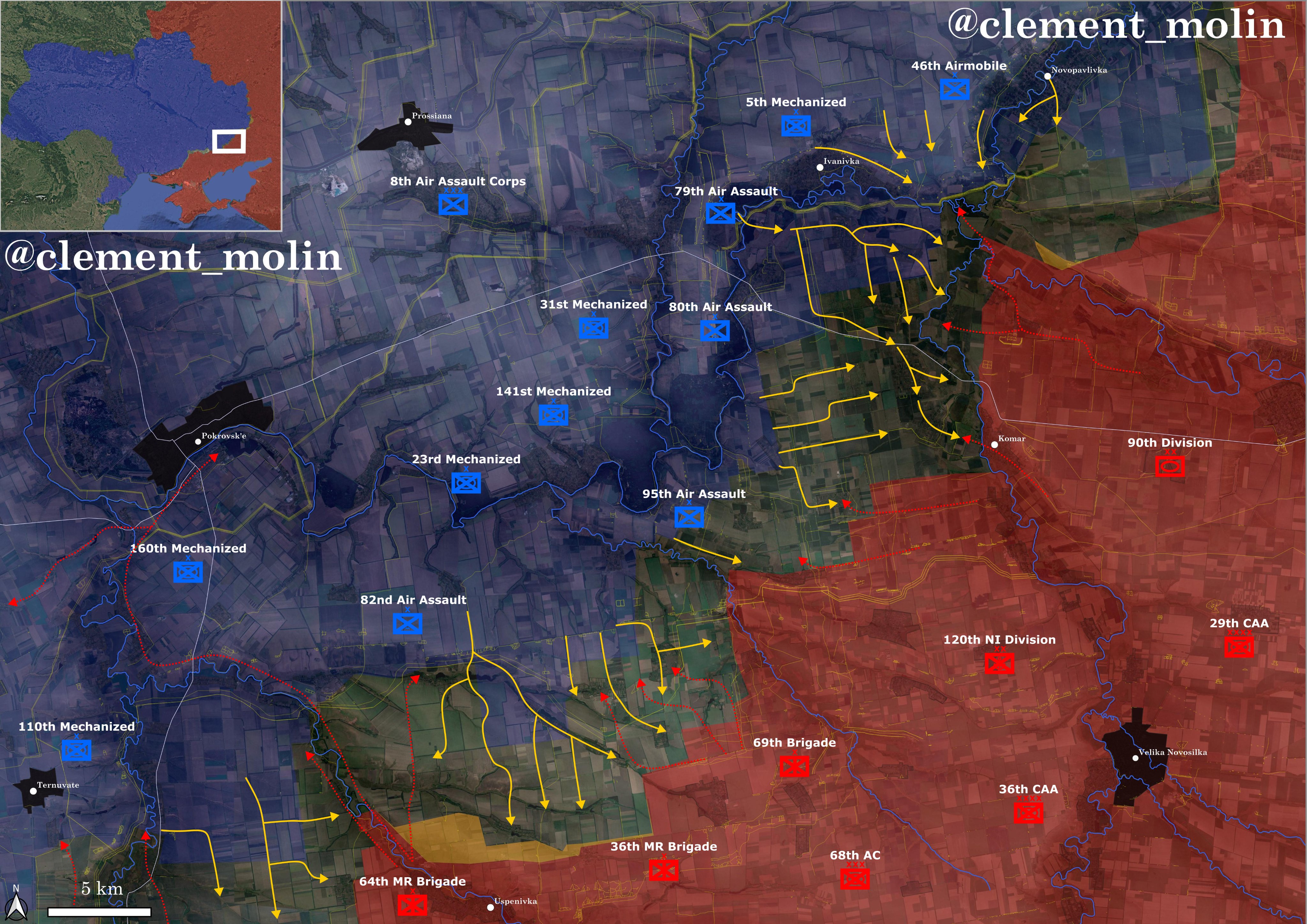
In other words, little is known about the actual state of affairs, but it can be said that Ukrainian forces have advanced to the outskirts of Komar, forcing the 90th Tank Division to commit about half of its forces to that sector.
I am virtually certain that all Russian units located north of the Volchya River (near Ivanivka) or the Solona River (near Novopavlivka) were either destroyed or taken prisoner. This conclusion can be drawn based on the scale of Russian airstrikes (at least a hundred) carried out in these areas.
Thus, the section of the so-called “New Donbas Line” has been held for the tenth consecutive month. It is also highly likely that Ukraine has regained control of several settlements further south, as confirmed by the nature of the airstrikes in that area.
While the operation is ongoing, I am deliberately withholding additional details in accordance with Ukrainian operational security (OPSEC) requirements until new confirmation becomes available.
How This Operation Is Structured
Ukrainian forces are actively using drones to create a wide zone that is inaccessible to the enemy. This is particularly true of the area along the river all the way to Velyka Novoselka.
The offensive is developing gradually: small infantry groups are slowly advancing, supported by artillery positioned in the forests to the west, as well as periodic airstrikes on the positions of Russian drone operators in the Komar area.
Overall, it is important to understand that this operation was made possible because the Russian army is experiencing serious difficulties in deploying reinforcements to the front lines. In addition, anti-tank trenches are hindering mechanized or motorized attacks that could deliver reinforcements.
The nature of the airstrikes also speaks to the problems facing the Russian command. Strikes are carried out daily far behind the front lines—as far as Prosyana and Chaplyne, located 35–40 kilometers from the front line. Although the official objective is to disrupt Ukrainian forces’ operations, such strikes are more likely indicative of the insufficient effectiveness of Russian unmanned aerial vehicles in this sector, particularly the “Molniya” family of drones.
Conclusion
As a result of this operation, Ukraine not only gained time to further strengthen its defenses in the Pavlograd sector but also dealt a significant blow to the Russian force in this section of the front. If the current momentum continues, the offensive may continue into the summer and then into the fall.

Bank's name: Bank Millennium S.A.
Address: ul. Stanislawa Zaryna, 2A, 02-593, Warszawa
IBAN: PL97116022020000000216711123
SWIFT: BIGBPLPW
Name of the account holder: Fundacja “KARTA ‘97”
Purpose/title of payment: Donation for statuary aims
You can contact us by the e-mail [email protected]