

Defense News: Ukraine Has Developed A Missile That The Wind Carries Into Russia
12- 26.06.2026, 18:08
- 18,132
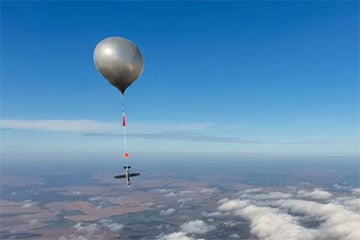
It is launched from a balloon at the edge of the stratosphere.
Ukraine has developed a missile that is launched from a balloon at the edge of the stratosphere and is capable of overcoming Russian electronic warfare systems.
The American publication Defense News.
According to the publication, this is one of the newest types of weapons that Ukraine is using as part of its campaign of medium-range strikes against Russian territory. Its goal is to force the Kremlin to withdraw its troops and return to the negotiating table.
The DART missile, launched from a balloon, descends from an altitude of approximately 7–11 miles (11–18 km) and is guided by satellite until it reaches an altitude of about 4 miles (6.5 km). After that, the navigation system shuts down, and a solid-fuel engine guides the missile along a predetermined trajectory, according to developers from the Ukrainian company Center for Innovative Technologies.
Once the navigation system is turned off, Russian electronic warfare systems can no longer knock the missile off course.
The company developed DART to be launched from a balloon, rather than from an aircraft or a ground-based launcher. According to the developers’ concept, this is a low-cost, stealthy, and electronic-warfare-resistant delivery vehicle designed to deliver guided munitions deep into Russian territory.
According to the publication Military, the missile’s warhead, weighing about 13 kg, disperses conductive graphite threads designed to short-circuit Russian power grids. At the same time, the system has not yet been incorporated into the Ukrainian military codification.
“Balloons are actively used by the Armed Forces of Ukraine primarily as support platforms and means for delivering medium- and long-range strikes,” retired Colonel Viktor Kevlyuk told Euromaidan Press last month. Kevlyuk served in the Armed Forces of Ukraine for 35 years and now works at the Center for Defense Strategies in Kyiv.
“They are inexpensive, invisible to radar, can remain airborne for long periods, and can carry a payload,” Kevlyuk noted.
According to him, Ukraine has already launched more than 1,000 such balloons toward Russia.
Kyiv is currently using these balloons to launch guided missiles. Carried by prevailing westerly winds, they penetrate deep into Russian territory and can even reach Moscow. During an attack last September, Russian air defense systems detected them at an altitude of about 6 miles (9.7 km).
The balloons can drift with the wind for more than a hundred miles before dropping a payload and then passing the baton to a drone or missile that will travel hundreds more miles.
The Ukrainian Armed Forces have already used military balloons, most often for surveillance or as decoys.
These inexpensive, wind-drifting balloons force Russian air defense systems to launch S-300 and S-400 interceptor missiles, which cost millions of dollars. Each balloon costs about $200.
In September, during a nighttime combined strike, Ukraine launched several balloons over Moscow and Tatarstan. According to analysts, this strategy was intended to confuse Russian air defense systems.
Another side of the story came to light in May, when a video appeared online showing an American strike drone falling from a Ukrainian balloon over the front line. The video, shared by Ukrainian military channels, was the first public evidence that Kyiv is using airships in combination with precision-guided weapons.
The drone, called the Hornet, is an attack UAV approximately seven feet (2.13 m) long, controlled by artificial intelligence, and developed by the American company Perennial Autonomy. It is already being used by the Ukrainian military to target Russian supply lines.
According to Euromaidan Press, the Ukrainian military launched it from a balloon that carried the drone dozens of miles and released it at an altitude of over 26,000 feet (7.9 km). During the flight, the drone consumed only a small portion of its battery charge.
According to The Defense Blog, Ukrainian drone operators claim that this “head start” roughly doubles the Hornet’s flight range.
Perennial Autonomy, the company that manufactures the Hornet drone, was founded by former Google CEO Eric Schmidt based on his previous unmanned aerial vehicle projects, White Stork and Swift Beat, in Ukraine. According to media reports, these initiatives won the largest counter-drone contract in the history of the U.S. Armed Forces last month—worth up to $500 million.
Russia also learned of this idea—but didn’t have the wind at its back.
Winds along the front line blow from west to east, so Russian balloons launched toward Ukraine usually drift back over Russian territory.
This geographical feature plays into Kyiv’s hands, the publication notes.

Bank's name: Bank Millennium S.A.
Address: ul. Stanislawa Zaryna, 2A, 02-593, Warszawa
IBAN: PL97116022020000000216711123
SWIFT: BIGBPLPW
Name of the account holder: Fundacja “KARTA ‘97”
Purpose/title of payment: Donation for statuary aims
You can contact us by the e-mail [email protected]