

Germany Has Returned To Poland Cultural Artifacts Looted By The Nazis
1- 17.06.2026, 19:10
- 3,050
Among the artifacts on loan are a medieval manuscript, a gold ring, and miniature models from a museum in Warsaw.
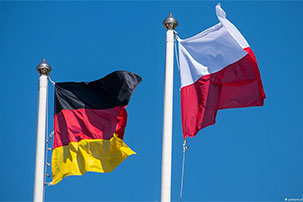
The German government has returned to Poland several cultural artifacts looted during the German occupation in World War II. The handover of these cultural artifacts, timed to coincide with the 35th anniversary of the Treaty of Good Neighborliness, is “an expression of mutual respect, Germany’s enduring responsibility, and a partnership based on trust,” said German Foreign Minister Johann Wadephul at the German-Polish Forum in Berlin, reports DW.
This event “further strengthens the solid ties between our countries,” he said. “Remembering the past, taking responsibility for the future, and reconciliation as a task for many generations continue to guide our actions today,” Wadeful emphasized.
Among the returned artifacts is a medieval manuscript containing a fragment of the hymn “Gaude Mater Polonia” and dating from the late 14th century. The manuscript, consisting of six parchment leaves, found its way to the Berlin State Library through unknown circumstances and was stored there as an item not belonging to the library’s collection. It had previously been part of the collection of a seminary in Płock, Poland, which was looted and largely destroyed during World War II.
Germany’s State Minister for Culture and Media Wolfram Weimer called the manuscript “one of the oldest examples of religious poetry” in Poland. “Today’s act of restitution is an important gesture acknowledging historical injustice,” he said. “In doing so, we are writing a new chapter in the culture of remembrance of our countries.”
In addition, a gold ring from the first half of the 16th century, believed to have belonged to Polish King Sigismund I, was returned to Poland. In all likelihood, the diamond-encrusted ring was looted by German troops from a Polish collection in September 1939. It subsequently ended up in Germany and had been kept at the Museum of Jewelry Art in Pforzheim since 1963.
The German Ministry of Transport has transferred 11 items from the holdings of the Federal Office for the Management of Railway Property to Warsaw; these items were previously part of the collection of the Transport Museum in Warsaw. These are miniature models of railway equipment.
The German Foreign Ministry noted that the return of cultural property that ended up in Germany during World War II has “significantly intensified” following German-Polish intergovernmental consultations in December 2025. Currently, a joint German-Polish working group led by the German Foreign Ministry, in cooperation with the Polish Ministry of Culture, is handling the return of additional cultural assets.
In a joint statement by Wadelful and Polish Foreign Minister Radosław Sikorski, the Treaty on Good-Neighborliness and Friendly Cooperation is described as a turning point in relations between the two countries. “This treaty has become not only an important element in the process of Polish-German reconciliation after long periods of estrangement and mistrust, but also a starting point for deep, trusting cooperation at all levels of our societies,” the ministers noted.
The statement also points to the radical changes in the geopolitical landscape over the past decades, particularly in light of Russia’s full-scale war against Ukraine. “Mindful of the tragic history of the 20th century, we bear a special responsibility for our region and our continent—as NATO allies and EU partners. Russia’s aggression against Ukraine has confronted us with new political realities. Our response to it has become a measure of our responsibility and our ability to act,” the statement continues.
According to the ministers, Russian aggression—particularly hybrid operations and disinformation—is also directed against Germany and Poland. “Their goal is to divide our societies, destroy public order, and undermine trust in the state and its institutions. We will not be intimidated. We will successfully strengthen our resilience and educate our societies,” the authors of the statement emphasized.
They identified their primary goal as “defending European values, including the rule of law and free elections, and ultimately achieving a lasting and just peace in Ukraine that strengthens Europe’s security.” “We take the lessons of history seriously. Preventing a new war is not just empty words, but a commitment to future generations,” stated Wadepul and Sikorski.
German-Polish Award Presented to Former Ambassador and Border Cooperation Center
During the forum, both foreign ministers presented the German-Polish Award to Polish diplomat Janusz Reiter, who headed the Polish Embassy in Berlin in the 1990s, and to the Frankfurt-Słubice Cooperation Center. The award was presented in recognition of their long-standing contributions to the development of German-Polish relations.
“The German-Polish Treaty on Good Neighborly Relations serves as the foundation of our relations and of Poland’s success story in the EU and NATO. In Janusz Reiter, we are honoring one of the key architects of this treaty. By honoring the Frankfurt-Słubice Cooperation Center, we are paying tribute to an organization that demonstrates exceptional dedication and an innovative approach to advancing German-Polish cooperation in the border region,” said Knut Abraham , a member of the Bundestag and co-chair of the jury for the German-Polish Award.

Bank's name: Bank Millennium S.A.
Address: ul. Stanislawa Zaryna, 2A, 02-593, Warszawa
IBAN: PL97116022020000000216711123
SWIFT: BIGBPLPW
Name of the account holder: Fundacja “KARTA ‘97”
Purpose/title of payment: Donation for statuary aims
You can contact us by the e-mail [email protected]