
The Telegraph: Russia Is Waiting For 1917
4- 25.05.2026, 8:00
- 6,184
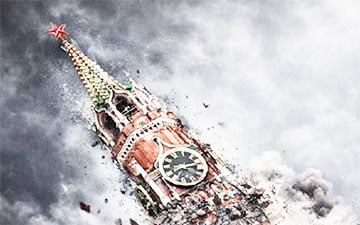
Putin is following in the footsteps of Nicholas II.
British historian and Russia researcher Robert Service believes that the war against Ukraine is increasingly undermining not only the Russian economy but also Putin's political image.
In his column for The Telegraph, Service notes that in the Russian political tradition, the legitimacy of power is closely linked to military victories. He recalls that the Russian Empire's defeat in the war with Japan in 1905 and failures in World War I were factors that led to political upheaval and the fall of the monarchy.
The historian believes that the Kremlin's previous military campaigns were relatively easy for Putin: the annexation of Crimea in 2014 went virtually unopposed, and the operation in Syria was limited mainly to airstrikes. However, a full-scale war against Ukraine proved to be a very different challenge.
Service points out that the 2026 Victory Parade in Red Square was held for the first time without tanks and the latest military equipment due to fears of Ukrainian drone attacks. At the same time, strikes on Russian territory have become regular even deep behind the lines.
He says the Kremlin expected to complete the invasion in a matter of days. To prove it, he cites reports that some Russian tank crews carried parade uniforms at the beginning of the war, expecting to participate in a parade in the center of Kiev.
Instead of a quick victory, the war is now in its fifth year, and Russia's economy is losing stability under the pressure of huge military expenditures and sanctions. In addition, the Kremlin is finding it increasingly difficult to make up for personnel losses, which, according to the author's estimates, reach at least 30,000 dead and wounded every month.
The historian also emphasizes that the expansion of mobilization mechanisms increases internal tensions. He recalls that even the partial mobilization in the fall of 2022 caused noticeable discontent in society, and now the authorities are actually moving to a permanent draft.
Service pays separate attention to the strengthening of control over the information space. According to him, the Russian authorities are restricting the work of the Telegram messenger and promoting state-controlled alternatives available to the intelligence services.
Despite the repressive apparatus and tight control over the media, the historian believes that Putin's image is gradually eroding, which poses a threat to the stability of the regime itself.
At the same time, even the possible end of the war on the Kremlin's terms, according to Service, will no longer allow Russia to regain its former geopolitical influence. He notes that so far Russian elites have not shown a willingness to openly oppose Putin, but the political situation could change as suddenly as it did during the fall of the Romanov dynasty in 1917.
"This war was a gigantic geopolitical mistake. Putin is unlikely to leave without serious upheaval, and no one can guarantee that his successor will be better. But without him, Russia at least has a chance to return to a softer domestic and foreign policy," the columnist concludes.

Bank's name: Bank Millennium S.A.
Address: ul. Stanislawa Zaryna, 2A, 02-593, Warszawa
IBAN: PL97116022020000000216711123
SWIFT: BIGBPLPW
Name of the account holder: Fundacja “KARTA ‘97”
Purpose/title of payment: Donation for statuary aims
You can contact us by the e-mail [email protected]