
Russia's Civilian Economy Has Come To A Standstill
- 7.10.2026, 19:01
- 2,346
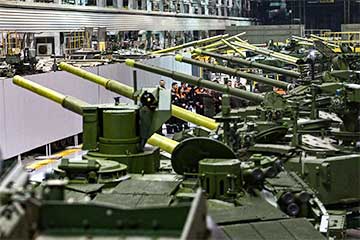
All growth since 2022 has occurred in war-related industries.
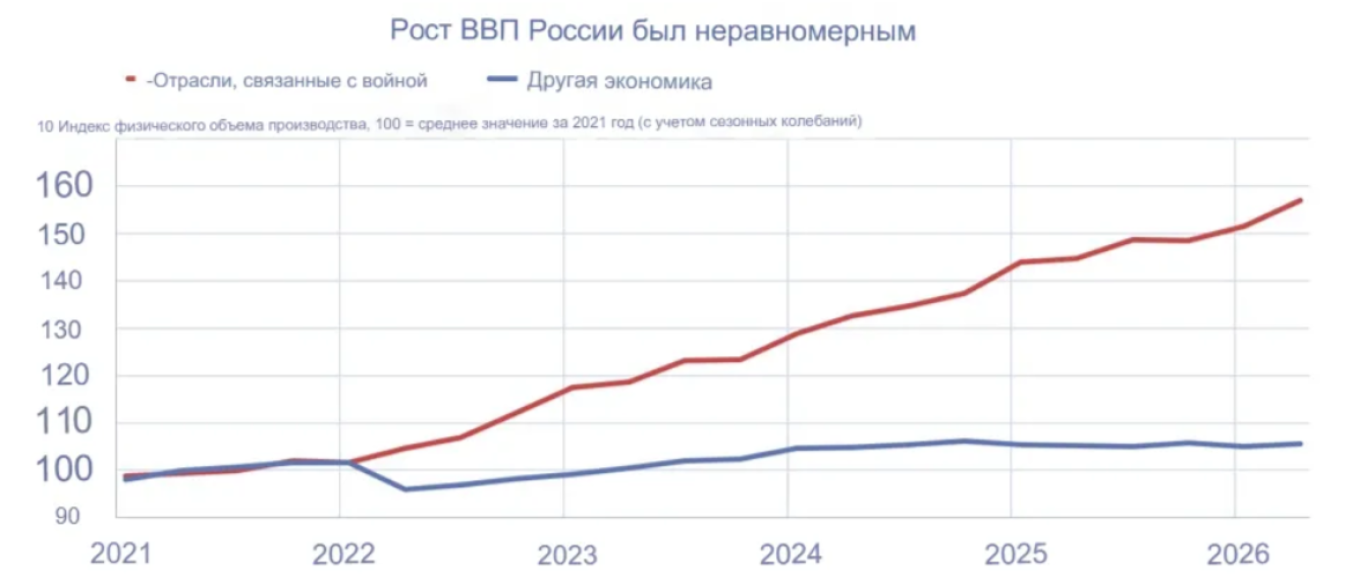
Economic growth—despite the sanctions, which the Russian authorities take pride in—has turned out to be almost entirely concentrated in war-related industries, according to calculations by analysts at the Bank of Finland. Thanks to a significant increase in military spending, three sectors—including defense industry products (the production of “finished metal products,” “other transportation vehicles,” and “computers and optical products”), as well as “public administration and defense,” have grown by more than 40% since the beginning of 2022. However, sectors outside of these four have, on the whole, shown almost no growth over the past five years, writes The Moscow Times.
Analysts at Raiffeisenbank also noted the growing gap between the public sector and other industries. Excluding the manufacturing sector—which includes the military-industrial complex—and the public sector, other sectors did not grow over the year starting in the first quarter of 2025.
“Russia’s civilian economy has come to a standstill—that’s already a medical fact,” says Moscow State University professor Natalia Zubarevich. “If we look at output in metric tons and units, all construction materials are down; chemicals are down; and the civilian machinery sector is experiencing a serious decline—there’s nothing you can point to and say, ‘This is growing.’” Most industries outside the military-industrial complex have been in a state of “near-stagnation” since mid-2023 and have been in decline since the second half of 2024, noted the Kremlin-aligned think tank TsMAKP.
According to Rosstat data, over the first eight months, production of most types of clothing fell by 5–9% in terms of both tonnage and units; footwear production remained at last year’s level; and wood processing, paper products, and most chemicals saw slight declines. Tire production fell by 12.5%, concrete and building materials by about 10%, and most types of metallurgical products by 5–15%. Refrigerator production remained at last year’s level, while washing machine production fell by 9%.
One of the few sectors showing steady growth is the pharmaceutical industry. Passenger car production rose by 13%, but assembly projects for Chinese brands cannot compensate for the departure of Western ones: 507,000 cars were produced in the first eight months, compared to 916,000 in January–August 2021
Capital goods are not finding buyers because investment is falling, Zubarevich noted. Investment in fixed assets decreased by 2.3% last year and by 9.9% in the first half of the year, according to Rosstat. Not even the government expects them to grow: it forecasts that by 2029, investment will only return to 2025 levels.
Three years of declining investment carry the risk of losing the market-driven potential of the economy and could lead to a loss of production capacity and slow long-term economic growth, warns Grigory Zhirnov of the Higher School of Economics. We’ve already had a three-year investment lull, to put it mildly—where is economic growth supposed to come from? asks Anton Tabakh, chief economist at Expert RA, rhetorically.
Analysts at the Bank of Finland forecast that the Russian economy will grow by 1% this year and by 0.5% over the next two years. They believe Russia still has the industrial and financial capacity to wage an aggressive war, but warn that such a policy leads to a crisis.
Soon, the authorities will face a difficult choice. If spending is increased too much, the imbalances that have built up in the economy will worsen, and this could ultimately lead to a serious economic crisis. But if spending is cut, the economy could slip into a recession as government support weakens.
Data on the Russian economy do not inspire optimism, writes Alexei Klimyuk of Alfa Capital, urging recognition of a sustained trend toward a slowdown in business activity—a trend that cannot be reversed by fiscal stimulus or a cut in the key interest rate. Therefore, his expectations for next year are “bleak”: GDP growth “around zero, or even lower.”

Bank's name: Bank Millennium S.A.
Address: ul. Stanislawa Zaryna, 2A, 02-593, Warszawa
IBAN: PL97116022020000000216711123
SWIFT: BIGBPLPW
Name of the account holder: Fundacja “KARTA ‘97”
Purpose/title of payment: Donation for statuary aims
You can contact us by the e-mail [email protected]