

In Anticipation Of Further Unrest, Paris Has Extended Its Curfew
- 23.10.2026, 9:29
Meanwhile, protests have been banned in Marseille and Lyon.
French authorities have extended the curfew imposed in several districts of central Paris until Monday and have banned all protests in Marseille and Lyon this coming weekend, according to BBC.
On Saturday, when new demonstrations are expected, the Louvre, the Orsay Museum, and the Picasso Museum will also be closed in the French capital.
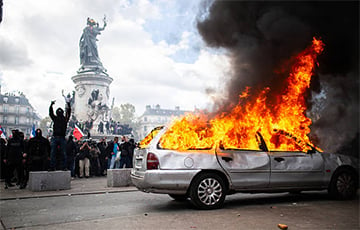
France has still not recovered from large-scale riots that took place last weekend, when mass protests against the high cost of living and school conditions were overshadowed by riots and looting, which resulted in the destruction of commercial and historic buildings.
In other parts of the country, where protests are not completely banned, only pre-approved labor union demonstrations will be permitted on Saturday, President Emmanuel Macron announced.
Deputy Interior Minister Jean-Didier Bergère stated that the number of police officers deployed to maintain order would be increased by 20% compared to last weekend. The government had previously been accused of being caught off guard by the scale of the unrest.
On Thursday, French Minister of Justice Gérald Darmanin reported that, following expedited court proceedings, 217 people were sentenced to prison for participating in the riots last weekend. That number is expected to rise.
According to Darmanin, 2,700 people were arrested across France, and more than a thousand of them have already appeared in court.
According to the newspaper Le Figaro, the minister noted that half of those detained had no prior criminal records.
Paris police announced the extension of the curfew until Monday at Place de la République, where protesters gathered last weekend, as well as in the vicinity of the Les Halles shopping center and transportation hub.
According to the prefecture of the French capital, movement in both of these areas will be prohibited from 11:00 p.m. to 6:00 a.m. local time (9:00 p.m.–4:00 a.m. GMT; and from October 25, after the switch to standard time, 10:00 p.m.–5:00 a.m. GMT). The decision was made by order of Interior Minister Laurent Nunez and Prime Minister Sébastien Lecornu.
On Saturday, public transportation in Marseille will be suspended to prevent a recurrence of the riots.
Last weekend, the city witnessed some of the most violent clashes of the current wave of unrest. More than 500 businesses sustained damage.
The prefecture of the Bouches-du-Rhône department, to which Marseille belongs, announced that the curfew previously imposed on minors will be extended to the entire population on the night of October 24. The restrictions will be in effect from 11:00 p.m. to 5:00 a.m. French time.
Similar measures have been announced in Nice in the south of the country, in Toulon on the Mediterranean coast, in Rouen in the northwest, and in Grenoble in eastern France.
On Thursday, Macron held a meeting with intelligence officials and ministers to discuss preparations for the next nationwide day of protests, scheduled for Saturday.
“The general recommendation is that demonstrations not take place. For those who wish to continue protesting within the framework of labor unions, prefects will offer alternative routes,” the French president stated. “However, if the protests are not organized by labor unions, such demonstrations will be banned wherever possible.”
Macron also condemned what he called “political and even insurrectionary actions organized by far-left groups seeking to overthrow the Republic.”
The “Yellow Vests” (gilets jaunes) movement was behind many of the protests last weekend. Paris authorities reported that several marches planned by the movement had been banned.
Throughout the week, a partial curfew—imposing various restrictions on the movement of young people and on mass gatherings—was in effect in a number of cities, including Marseille, Bordeaux, Nice, Lyon, and Lille.
Prime Minister Sébastien Lecornu promised this week a “large-scale” deployment of police forces to prevent possible unrest this coming weekend. However, some police officers told French media that they had not received training to handle large crowds.
Vandalism and Riots
About 550,000 people took part in demonstrations on October 17, protesting rising fuel prices and the cost of living. The protests gained momentum after several weeks of demonstrations by schoolchildren.
During the protests last weekend, demonstrators set fire to the Lyon tourist office building.
In Limoges on Saturday, a fire engulfed the clock tower and part of the roof of the ornate city hall building, causing them to collapse.
On Thursday, a second suspect in the arson—a 66-year-old man—was arrested. Earlier, police had detained a man in his 30s on suspicion of attempted murder of police officers who were inside City Hall when the fire broke out.
In Paris, vandals damaged the famous Place de la République. Groups of rioters took over certain areas of the capital, carrying out acts of vandalism there.
The riots have been taking place in the final months of Emmanuel Macron’s presidency. The presidential election in France will be held in two rounds on April 18 and May 1 of next year.

Bank's name: Bank Millennium S.A.
Address: ul. Stanislawa Zaryna, 2A, 02-593, Warszawa
IBAN: PL97116022020000000216711123
SWIFT: BIGBPLPW
Name of the account holder: Fundacja “KARTA ‘97”
Purpose/title of payment: Donation for statuary aims
You can contact us by the e-mail [email protected]