


The Bundeswehr Has Deployed A Special Electronic Warfare Unit Near The Belarusian Border
2- 3.08.2026, 21:30
- 3,232
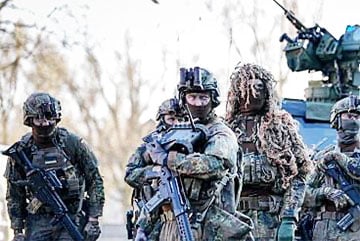
The group is located about two kilometers from the Belarusian border.
The Bundeswehr has deployed a special electronic warfare unit near the border between Belarus and Lithuania to wage an “invisible electronic war,” according to Euronews. It is specified that the soldiers are monitoring the electromagnetic spectrum, intercepting radio communications and signals from enemy radar systems.
The unit is located approximately two kilometers from the Belarusian border. The squad leader of the EloKa (electronic warfare) unit, Christian (name changed), told Euronews that his mission is surveillance and reconnaissance.
His unit can not only conduct reconnaissance but also disrupt the networks of a potential adversary using electronic countermeasures, including blocking communications at critical moments.
In addition to stationary posts, Euronews notes, the Bundeswehr has mobile teams equipped with 30-kilogram backpacks containing all the necessary equipment to deploy their own communications network.
As Euronews notes, data and the paths by which it is transmitted through the electromagnetic field are “the new invisible currency of the modern battlefield.” The Bundeswehr deployed EloKa units along the Lithuanian border to gather intelligence, including during the recent six-week Freedom Shield exercises.
In late July, the Lithuanian Armed Forces reported that a Bundeswehr armored battalion had been deployed to the country from Germany overnight.
This came amid reports in early July by Politico, citing sources, that NATO was hastily strengthening its eastern flank in the face of a potential threat from Russia and reduced support from the United States. As a result, the Baltic states are independently building the Baltic Defense Line, complete with anti-tank trenches, bunkers, “dragon’s teeth,” and minefields. Meanwhile, approximately 3,000 NATO troops are stationed in Lithuania, and a German brigade—expected to arrive by the end of 2027—will serve as a key element of the defense.

Bank's name: Bank Millennium S.A.
Address: ul. Stanislawa Zaryna, 2A, 02-593, Warszawa
IBAN: PL97116022020000000216711123
SWIFT: BIGBPLPW
Name of the account holder: Fundacja “KARTA ‘97”
Purpose/title of payment: Donation for statuary aims
You can contact us by the e-mail [email protected]