


A Metric Ton Of Old Cell Phones May Contain More Gold Than A Metric Ton Of Gold Ore
2- 17.08.2026, 15:51
- 3,372
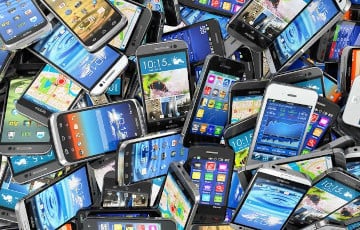
In almost every home, there's a box that has accumulated unused electronic devices over the years.
An old phone that hasn’t been turned on in five years, tangled charging cables, a tablet with a cracked screen, a forgotten camera, or wireless earbuds whose battery barely holds a charge anymore. Taken individually, none of these items seems particularly valuable. But taken together, the picture is quite different.
One kilogram of electronic waste can contain gold in a much higher concentration than the ore mined at an active gold mine, writes Startlap.
This is where the term “urban mining” comes from: in this case, valuable raw materials are extracted not from the earth’s depths, but from discarded electronic devices.
In the mining industry, one of the most important indicators is ore quality—that is, the amount of the target metal contained in a metric ton of mined rock.
According to a 2019 report prepared jointly by the United Nations Environment Programme, the World Economic Forum, and members of the UN E-Waste Coalition, a single metric ton of discarded electronic waste—for example, cell phones, laptops, tablets, and monitors—may contain roughly 100 times more gold than a metric ton of average ore from a gold mine.
According to the report’s estimates, about 7 percent of the world’s gold reserves are currently contained in discarded electronic devices.
This, of course, does not mean that an impressive amount of gold can be extracted from an old cell phone. A modern cell phone typically contains only 25–50 milligrams of gold. In addition, it contains small amounts of silver, palladium, and platinum, as well as significantly more copper.
Gold is found primarily on printed circuit boards, as it is a good conductor of electricity and is not prone to corrosion.
The value of the gold in a single phone may amount to just a few dollars, so it would be completely pointless to try to extract it at home.
The difference becomes clear when you consider that the cost of gold in a single phone may amount to just a few dollars, so it would be completely pointless to try to extract it at home.
The difference becomes clear when you consider that the cost of gold in a single phone may amount to just a few dollars, so it would be completely pointless to try to extract it at home.
The difference becomes clear when you consider that the cost of gold in a single phone may amount to just a few dollars, so it would be completely pointless to try to extract it at home.
The difference becomes clear when you consider that the cost of gold in a single phone may amount to just a few dollars, so it would be completely pointless to try to extract it at home.
The difference becomes clear when you consider that the cost of gold in a single phone may amount to just a few dollars, so it would be completely pointless to try to extract it at home.
The difference becomes clear when you consider that the cost of gold in a single phone may amount to just a few dollars, so it would be completely pointless to try to extract it at home.
The difference becomes clear The value of the gold in a single phone may amount to just a few dollars, so it would be completely pointless to try to extract it at home.
The difference becomes clear when devices are considered not individually, but by the ton.
A ton of old cell phones can contain up to 140 grams of gold
A ton of old cell phones can contain up to 140 grams of gold
A ton of old cell phones can contain up to 140 grams of gold
A ton of old cell phones can contain up to 140 grams of gold
A ton of old cell phones can contain up to 140 grams of gold
A ton of old cell phones can contain up to 140 grams of gold
A ton of old cell phones can contain up to 140 grams of gold
A ton of old cell phones can contain up to 140 grams of gold
A ton of old cell phones can contain up to 140 grams of gold
A ton of old
A metric ton of old cell phones can contain up to 140 grams of gold
A metric ton of ore mined at active gold mines typically contains about 5–20 grams of gold. Even a concentration of about 5 grams can be considered economically viable for mining a deposit. In contrast, according to data from modern recycling facilities, a metric ton of discarded cell phones can contain about 140 grams of gold.
This explains why people are increasingly talking about “urban mining” rather than simply “recycling.” Companies specializing in this essentially do the same thing as a mine: they process material to extract valuable metals. The only difference is that the “deposit” isn’t located several hundred meters underground, but rather, for example, in a Belgian warehouse or at a Swedish waste sorting facility.
There are billions of dollars in discarded electronic devices
According to the 2024 Global E-Waste Monitor, approximately 62 million metric tons of electronic waste were generated worldwide in 2022.
The value of the metals contained in it was estimated at approximately $91 billion at prices at that time. Of that amount, about $15 billion was in gold, $19 billion in copper, and $16 billion in iron.
In other words, a vast wealth of minerals is accumulating in homes, warehouses, and landfills around the world. The problem is that a significant portion of it never re-enters the economy.
The same report concluded that only about 22 percent of the world’s electronic waste is collected and recycled through formal channels. The remaining 78 percent may end up in landfills, incinerators, or informal recycling facilities; some is smuggled out of the country; and many devices simply continue to gather dust in people’s homes.
The value of natural resources in e-waste generated in 2022 that have not been recovered but are theoretically usable has been estimated at approximately $62 billion.
Why not just collect all the old phones
The first problem is the collection itself. When a mining company discovers a gold deposit, the ore is located in one specific place.
E-waste, on the other hand, is scattered across several billion households, and we’re talking about tens of thousands of different device models. In order to extract valuable metals from an old phone, it must first be sent to a suitable recycling facility.
This requires collection points, transportation, sorting, and processing—and, of course, the owner actually deciding to turn in the device. A gold mine doesn’t need to convince the ore to make its way to the processing plant.
Processing requires a substantial industrial infrastructure
Another obstacle is the technology itself. The chemical processes for extracting gold from electronic devices are well known, but large, specialized facilities are needed to apply them economically and safely.
The most significant urban mining facilities are currently concentrated in several countries, including Belgium, Germany, Sweden, and Japan. Well-known players in the industry include, for example, Umicore, Aurubis, and Boliden.
However, these facilities are capable of processing only a small fraction of the electronic waste generated worldwide each year.
As a result, some of the waste ends up at informal recycling sites in West Africa and South Asia. In many cases, attempts are made there to extract metals using acid solutions or open-air burning, which can cause serious harm to health and the environment.
Technology exists to recover gold, copper, and other valuable metals. An industry specializing in this field is operational and capable of recycling electronic waste in a cost-effective manner, but its capacity is still far from sufficient. Meanwhile, year after year, we buy new phones, laptops, tablets, and other electronic devices, while the old ones often end up going nowhere at all.

Bank's name: Bank Millennium S.A.
Address: ul. Stanislawa Zaryna, 2A, 02-593, Warszawa
IBAN: PL97116022020000000216711123
SWIFT: BIGBPLPW
Name of the account holder: Fundacja “KARTA ‘97”
Purpose/title of payment: Donation for statuary aims
You can contact us by the e-mail [email protected]