
Erfan Kudosov: The Kremlin May Abandon Its Army In Crimea
2- 25.11.2026, 16:07
- 1,238

Photo: Charter97.org
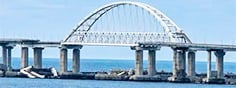
The Ukrainian Armed Forces' strikes on the Kerch Bridge have raised hopes for the liberation of the peninsula.
As a result of strikes by Ukrainian forces one of the arches of the road section of the Crimean Bridge collapsed, and the railway section also sustained serious damage. It is possible that the bridge will be completely put out of commission in the near future.
Erfan Kudusov, a well-known civil activist and one of the leaders of the Crimean Tatar people, spoke to the website Charter97.org about how the bridge’s destruction has affected life in occupied Crimea.
— Please tell us, what is happening right now in occupied Crimea? According to your information, how did local residents react to the destruction of the Crimean Bridge?
— One arch of the road bridge has been destroyed. It was a large, connecting arch, over 220 meters long. Not all the spans have been destroyed, of course, but the 5,000-metric-ton arch has effectively fallen from its supports. The asphalt-paved section on the reinforced concrete foundation has also collapsed and is blocking the shipping lane. It is currently impossible for large-tonnage vessels with a draft of more than eight meters to exit the Sea of Azov. The railway section is still standing, but it is damaged. The Russians are still attempting to run passenger trains across it at their own risk.
In principle, this railway span could also be destroyed. Ukraine has all the means to do so. I think the political and military leadership is simply waiting for the right moment. I don’t think there’s any point in allowing the occupiers to make the situation easier for themselves. If they attempt to begin any work to clear the shipping channel, the railway section of the bridge could be attacked along with the barges, ships, and technical equipment. The Russians already realize that they are unlikely to be able to restore this bridge before the end of the war.
Crimean Tatars await the liberation of the peninsula
I would tentatively divide the Crimean population into two parts—or even two and a half. Why? Because there are citizens of Ukraine who found themselves under occupation in 2014, and there are citizens of the Russian Federation and other countries who arrived after 2014 and are, in fact, residing in Crimea illegally. There are many such people. Their attitudes toward what is happening—toward the war and the actual destruction of the Kerch Bridge—vary. Even among Ukrainian citizens, one can roughly distinguish between those who have remained loyal to Ukraine—which is the majority of the Crimean Tatar people—and those who have come to enjoy living under occupation. Although this is also a very rough distinction.
As for our people, I can say that Crimean Tatars generally view what is happening as a positive sign: Ukraine is fighting for Crimea, and the peninsula will be liberated in the near future. When I get in touch with Crimeans—with relatives and acquaintances—I see that they are very optimistic and are looking forward to the continued expulsion of the Russian occupiers.
People are stocking up on essential goods
But those who thought that life under Russia would be heaven on earth are now deeply despondent. There is already a certain amount of panic. Well, not terrible, to be honest, but there is panic. People are stocking up on essential goods. I can say that on the Southern Coast of Crimea, sales of sugar, buckwheat, and other grains began to be restricted about ten days ago. That is, two kilograms of this, one kilogram of that. Now such restrictions are in effect practically throughout all of Crimea.
Problems with supplies and logistics have begun. Anyone taking a detour is taking a risk. Long-haul truckers are refusing to drive. Freight rates have risen by about three, five, or seven times. There, every fifth or sixth vehicle fails to reach its destination because Russian occupation forces are attempting to deliver military cargo, fuel, and so on to their armed forces under the guise of civilian transport. Naturally, the Armed Forces of Ukraine aren’t going to just stand by and watch this happen. All of this is within their reach.
A third of the gas stations are practically out of fuel
As for fuel in Crimea, there is still some available, but, as they say, the devil is in the details. Prices have already risen to 150 rubles and higher per liter for regular—and, moreover, low-quality—gas. That’s what I’m hearing from local residents. At the “TES” and “ATAN” gas stations—these are large chains that used to be operated by TNK, Lukoil, and so on—people, of course, fill up with gasoline and diesel, but the fuel quality is terrible. Clearly, no standards are being met.
How did people get around this problem in the past? People used to drive across the Crimean Bridge, bringing in 100–200 liters privately and selling fairly high-quality fuel to one another. That doesn’t happen anymore. A third of the gas stations have practically run out of fuel. Two-thirds of the gas stations are still operating, but how? They sell three to five metric tons in the morning or as soon as fuel arrives, and then they close. In other words, it’s no longer possible in Crimea to pull up and fill up at any time of day, as happens in a normal country—or even in war-torn Ukraine.
Nine districts of Crimea are without electricity
All of this creates problems not only with logistics but also with everyday life. Water supply has become more difficult. Water is no longer available everywhere. Northern Crimea is suffering greatly from this. In the south, the situation isn’t quite as dire yet. There, water still flows by gravity to the Southern Coast from the Bakhchysarai District.
As for electricity, there is no power from morning until midnight—throughout the entire daylight hours and the entire evening. The occupying authorities promise that, within the next ten days, electricity will be supplied continuously at night. But this is all, as they say, fairy tales from the Vienna Woods. In fact, out of Crimea’s 14 districts, nine are completely without electricity. In addition, cities such as Sudak, Dzhankoy, Yalta, Alushta, and so on remain without electricity. Of the major cities, only Simferopol—and to a limited extent Sevastopol—occasionally have electricity.
Overall, the situation with electricity throughout Crimea is very dire. And the occupying authorities don’t have many options to fix it, because the attacks haven’t stopped. The collapse of the Crimean Bridge has caused more than just logistical problems. A power cable from the Kuban also runs along the bridge. Apparently, it was also damaged. So the likelihood that the situation will improve anytime soon is very low.
— What is the current status of the Russian occupation army in Crimea? What consequences might a continued blockade of the peninsula have for it?
— You know, the fact is that the occupation regime will prioritize supporting the army over the civilian population. If fuel runs out, the military will be the last to run out of it. In a normal country, the civilian population is supported first and foremost. But not in Russia, and certainly not in occupied Crimea. They’ll take care of the population last. People, in principle, have already been left to fend for themselves.
The army there has certain reserves. But if this situation continues for quite a long time—and it will—say, two, three, or four months—then logistical problems will catch up with the army as well. While the civilian population can stay at home, the military cannot. They consume large amounts of diesel fuel and so on. This will cause problems. There aren’t any major problems yet, but supplies will begin to dwindle in the coming weeks.
The Kremlin may simply abandon its army in Crimea
The Kremlin will not allow the occupying army to retreat. Just as it did during World War II—in the worst-case scenario for them, but the best-case scenario for us—it will simply abandon that army in Crimea. And they’ll either hold out there as a garrison or surrender; I don’t know.
But, let’s put it this way: we don’t care about the occupying army. We’re more concerned about our Ukrainian citizens who find themselves in such a difficult situation that we—and by “we” I mean Ukraine—are forced to take military action. And this entails major problems.
According to all international norms, the occupying regime is obligated to ensure the functioning of the occupied territory and to care for the civilian population. But I think it will not do so. Instead, it will shout ever louder through its propaganda media—the media it controls in Europe and the West in general—that we are causing a humanitarian catastrophe.
I think Ukraine should expect this, but we are, generally speaking, prepared for it. Ukraine is ready to assist the civilian population after the Russian army withdraws from Crimea.

Bank's name: Bank Millennium S.A.
Address: ul. Stanislawa Zaryna, 2A, 02-593, Warszawa
IBAN: PL97116022020000000216711123
SWIFT: BIGBPLPW
Name of the account holder: Fundacja “KARTA ‘97”
Purpose/title of payment: Donation for statuary aims
You can contact us by the e-mail [email protected]