

Lukashenko Let The Cat Out Of The Bag
9- 19.10.2026, 13:22
- 19,246
The private agribusiness sector is outperforming the public sector.
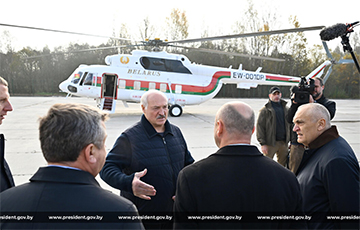
In the Verkhnedvinsk District, the government once again held up a private agribusiness as a model for its officials. This time, serving as a case study for Minister of Agriculture Yuri Gorlov, Deputy Prime Minister Yuri Shuleiko, and Vitebsk Region Governor Alexander Rogozhnik was Nikolai Vorobey, owner of the “Krasny Bor Agro” livestock farm, writes "Solidarnast" .
It’s clear that there should be no false hopes here—a businessman close to the regime, who is called one of Lukashenko’s “moneybags,” doesn’t fit the role of an ordinary private entrepreneur.
Nor should one be misled regarding the farmers Vladimir Malinovsky and Mikhail Shrub, whose experience the government also suggested emulating. At the very least, they have been provided with “greenhouse” conditions for farming—ranging from the allocation of land plots to freedom of action in choosing equipment, crop rotation, and sales markets.
This does not negate an important fact: setting aside Lukashenko’s special treatment of these individuals, their personal example eloquently demonstrates the clear superiority of private farming over that surrogate Soviet collective farm that Lukashenko brought back into use three decades ago.
Moreover, he publicly acknowledges this time and again—both by holding up private farmers as examples to his own officials and by stating that, despite all the financial injections into the remaining collective farms, they should perform at least as well as private farmers, but… Machinery left idle, drunkenness, a lack of discipline, and livestock mortality on a historic scale.
An obvious yet important conclusion emerges from this story. For thirty years, two parallel realities have existed in the country’s agricultural sector: private farmers who enjoy the ruler’s favor and hundreds of surviving collective farms.
The former are a clear example of a distinct advantage over the public sector in terms of efficiency. This is, in fact, what Lukashenko himself acknowledges. And they have served as such an example all these years. There is nothing surprising about this—it has long been proven by the experience of all civilized countries.
But this fact has not prevented an experiment from being conducted on the country, where not only agricultural enterprises but also industrial giants remain in the state’s calloused grip.

Bank's name: Bank Millennium S.A.
Address: ul. Stanislawa Zaryna, 2A, 02-593, Warszawa
IBAN: PL97116022020000000216711123
SWIFT: BIGBPLPW
Name of the account holder: Fundacja “KARTA ‘97”
Purpose/title of payment: Donation for statuary aims
You can contact us by the e-mail [email protected]