"The Theater Of The Absurd": What's Happening In Russia Because Of The Fuel Crisis
18- 15.07.2026, 11:55
- 18,762
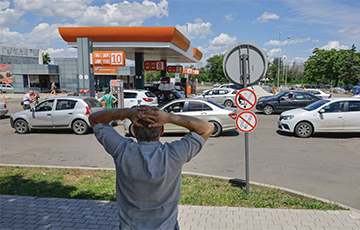
Government officials on bicycles and Cossacks at gas stations.
The governor of the Stavropol Krai Vladimir Vladimirov urged officials to walk or ride bicycles to conserve fuel. According to him, these restrictions on officials will save about 3,000 metric tons of fuel for other consumers, reports “Echo”.
In the Leningrad Region, regional government officials will be subject to the same fuel limits as all other residents of the region, according to the region’s governor Alexander Drozdenco. He stated that if the authorities are asking residents to “be understanding of the temporary fuel shortages,” then they must “lead by example.”
In the Sverdlovsk Region, some gas stations have held a raffle for Russian Lada cars, according to a reader of “European-Asian News.” He received a flyer at a gas station in the Kamyshlovsky District. The Russian news agency notes, however, that “a giveaway of a full can of gasoline would be more relevant for drivers right now.”
A resident of Krasnodar filmed gasoline prices at one of the “Atan” gas station chain’s locations. The footage shows that a liter of AI-92 costs 159 rubles, while AI-100 costs 269 rubles. One of the gas station employees explained these prices by saying that the station is a “Crimean branch.”
The day before, the governor of the Rostov Region Yuri Slyusar stated that residents of the region were “running amok” in lines at gas stations. He ordered Cossacks to be stationed at gas stations to maintain order. At the same time, Slyusar demanded that the Cossacks “not interfere with the operational process.”
In occupied Yevpatoria, most grocery stores have closed due to fuel shortages and power outages. Some refrigerators are turned off, while others are connected to generators; however, store owners cannot buy fuel to run them, since gas stations will only fill a car’s tank. Because of this, some business owners are forced to drive across the Crimean Bridge.
In Kurchatov, in the Kursk Region, gas stations have begun closing for several hours, causing lines to form in front of them.
“We’ve been waiting in Kurchatov for two hours. That’s because they’ve banned fuel sales. And yes, they’ll start selling not after the fuel truck arrives, but just whenever someone over there deems it necessary,” local residents said.
According to Reuters estimates, following the shutdown of several major refineries, Russian gasoline production meets only about 65% of seasonal demand. The daily shortfall has reached 40,000–45,000 metric tons—approximately 35% of summer consumption, which is estimated at 115,000–120,000 metric tons per day. Back in June, the shortfall was about 25%. Among the facilities that have halted production, the agency’s sources cite the Nizhny Novgorod “Norsi” refinery, as well as the Omsk and Saratov refineries. The Omsk refinery and “Norsi” were the two largest gasoline producers in Russia.
The problem is exacerbated by the fact that the attacks continue. In recent weeks, the Omsk, Moscow, Yaroslavl, Saratov, and Kuibyshev refineries, “Norsi,” “Taneco,” facilities in Ufa, and other oil refining sites have been attacked. On July 12, authorities in the Samara Region reported a new strike on an industrial facility; Russian media identified the target as the Syzran Oil Refinery, which has already been shut down multiple times following attacks.
The decline in production has been accompanied by a sharp rise in prices. According to Rosstat, gasoline prices in June rose by 6.88% compared to May and by nearly 20% compared to June of last year. AI-92 rose in price by 7.3% over the month, and AI-95 by 6.7%. During the week of June 30 through July 6, gasoline prices rose another 2.11%, and the price increase since the beginning of the year reached 13.93%—roughly three times the official inflation rate for the same period. Rosstat recorded price changes in 82 regions of the country.

Bank's name: Bank Millennium S.A.
Address: ul. Stanislawa Zaryna, 2A, 02-593, Warszawa
IBAN: PL97116022020000000216711123
SWIFT: BIGBPLPW
Name of the account holder: Fundacja “KARTA ‘97”
Purpose/title of payment: Donation for statuary aims
You can contact us by the e-mail [email protected]