
The U.S. Has Sent The Amphibious Assault Ship USS Tripoli With Marines To The Middle East
1- 15.03.2026, 15:28
- 2,726
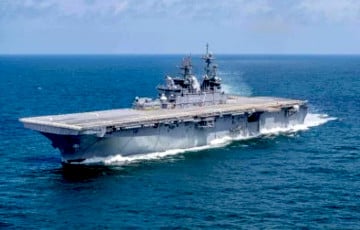
The ship can do things that aircraft carriers can't.
The America-class multipurpose amphibious assault ship USS Tripoli (LHA-7) has left its base in Sasebo, Japan, and is headed for the Middle East. On board is the 31st Marine Expeditionary Unit - about 2,500 Marines along with an aviation and combat component. According to U.S. officials, the deployment of this formation will take one to two weeks.
In practice, this means that one of the most flexible rapid response formations in the world will appear in the waters of the Middle East, writes Portal Stoczniowy.
The ship carries, among others, F-35B fighter jets capable of vertical landing, MV-22 Osprey transport aircraft, CH-53K heavy helicopters, AH-1Z attack helicopters and a Marine combat component capable of both sea and land operations.
The decision to send the unit was made at the request of U.S. Central Command (CENTCOM) and approved by the Secretary of Defense. However, the very fact of this decision demonstrates something far more significant than just another redeployment of ships in the region.
The power of aircraft carriers - and its limits
There are already three U.S. carrier strike groups operating in the Middle East. The USS Gerald R. Ford operates in the Red Sea, the USS Abraham Lincoln operates in the Arabian Sea, and the USS Harry S. Truman provides support in the eastern Mediterranean. In all, this means more than 200 deck aircraft, some 20,000 sailors, and a concentration of naval forces such as the world has not seen since the Persian Gulf War.
Although this capability is impressive, its capabilities in practice are fairly well defined. Aircraft carriers serve primarily to conduct intensive air operations from the deck of the ship.
The difference, however, is that they are not a tool for everything. They do not clear minefields, escort tankers through narrow straits, or conduct special operations in mountainous terrain. Nor are they a platform for capturing or guarding targets on land.
USS Tripoli is a ship with a different philosophy of action
This is where the role of the USS Tripoli comes into play. America type ships are designed as ships capable of conducting expeditionary operations that classic aircraft carrier groups are unable to realize.
A key element of this concept is the presence of the Marine Corps. Marine Expeditionary Unit (Marine Expeditionary Unit) is in practice a self-sufficient combat formation, including infantry, reconnaissance, sappers, specialists in neutralization of explosive devices and its own aviation component, providing rapid transfer of forces inland.
In an appropriate aviation configuration, the USS Tripoli can operate in the so-called Lightning Carrier concept, allowing up to 20 F-35B Lightning II aircraft to be based and fly intensively from the deck.
In practice, this leads some analyses to refer to ships of this class as "light aircraft carriers," although formally they remain multipurpose amphibious assault ships like America.
These aircraft are the only fifth-generation fighters capable of taking off from a short deck and making a vertical landing. They do not require the launch catapults or braking cables used on classic aircraft carriers.
Factually, this allows the ship to be used as a platform for air operations against land and sea targets, including coastal missile batteries.
Why the Marines are still being sent
Although the aviation component is important, sending the USS Tripoli is primarily operationally important at the surface action level.
The Marine Expeditionary Unit is trained for amphibious operations, operations in urbanized environments, combat in underground structures or hostage rescue missions. In recent years, these units have also intensively trained operations in rugged terrain and rapid force movement by helicopter.
In practice, this means the ability to seize or secure key installations that cannot be neutralized by airstrikes alone.
Operations that an aircraft carrier will not
From an operational standpoint, the USS Tripoli's arrival exposes the limitations of an air-only operation.
Although U.S. aviation can destroy targets on land and conduct deterrence actions, it does not address several key problems in the region.
First and foremost is the safety of shipping in the Strait of Hormuz. This narrow transport route, which is only a few dozen kilometers wide, can be paralyzed by even a small number of sea mines. In such a situation, the ability to escort merchant ships, conduct special operations on land and quickly deploy forces capable of responding in a crisis situation become key.
It is worth noting that the very redeployment of a ship of this class says a lot about the training of the U.S. military. Sending a multi-purpose landing ship with a Marine component of many thousands is not merely a show of force. In practice, it means preparing for operations that airstrikes alone will not solve, from securing shipping in the Strait of Hormuz to expeditionary operations conducted directly from the sea.

Bank's name: Bank Millennium S.A.
Address: ul. Stanislawa Zaryna, 2A, 02-593, Warszawa
IBAN: PL97116022020000000216711123
SWIFT: BIGBPLPW
Name of the account holder: Fundacja “KARTA ‘97”
Purpose/title of payment: Donation for statuary aims
You can contact us by the e-mail [email protected]