


A Record For Early Voting Was Set In The U.S. Congressional Elections
2- 31.10.2026, 21:37
- 2,776
The Democrats are leading in the polls.
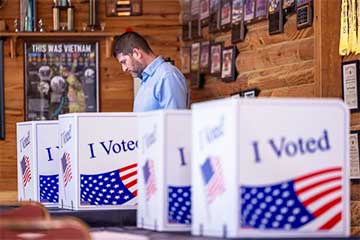
More than 50 million people have voted early in the U.S.—a record number for the midterm congressional elections, which will take place on November 3. This is according to the latest data from the University of Florida’s Election Lab. The previous record was set in 2022, when 45.9 million Americans voted before Election Day. At the same time, the latest polls show the Democratic Party holds a lead over the Republicans of about eight percentage points, according to The Insider.
As of October 31, 8:56 a.m. Eastern Time, Election Lab had recorded 50.34 million early ballots cast. That is approximately 4.4 million, or nearly 10%, more than the total number of early votes cast in the 2022 midterm elections. Meanwhile, there are still three days left until Election Day.
In the 27 states that publish data on voters’ party affiliation, 43.4% of early voters are registered Democrats, 31.6% are Republicans, and another 25% are not registered with either of the two major parties. The difference is 11.8 percentage points in favor of the Democrats. A total of 24.67 million people are included in this portion of the statistics.
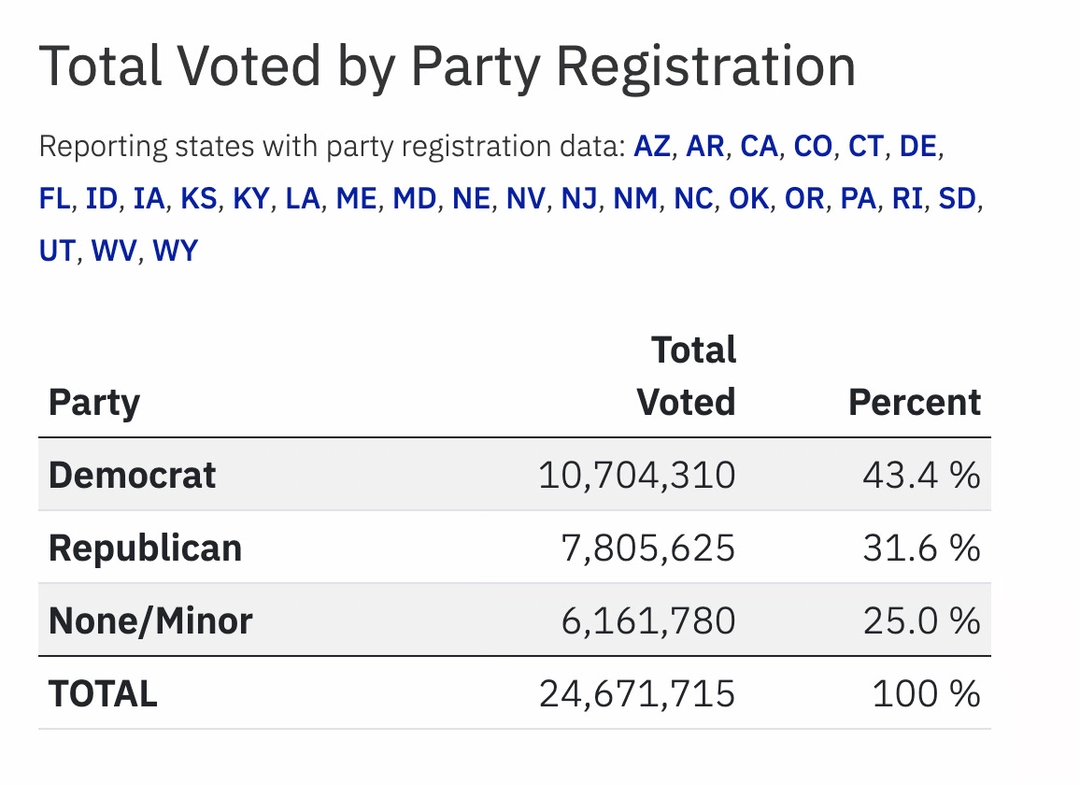
However, these figures do not mean that Democrats have already received 43.4% of the votes. This refers only to voters’ party affiliation. Furthermore, party registration is not tracked in all states, and Republican supporters traditionally tend to vote more often on Election Day itself.
The advantage of registered Democrats is not seen everywhere. For example, in Pennsylvania, they account for 65% of early voters, while Republicans account for 25%. In Florida, by contrast, Republicans lead Democrats by about two percentage points.
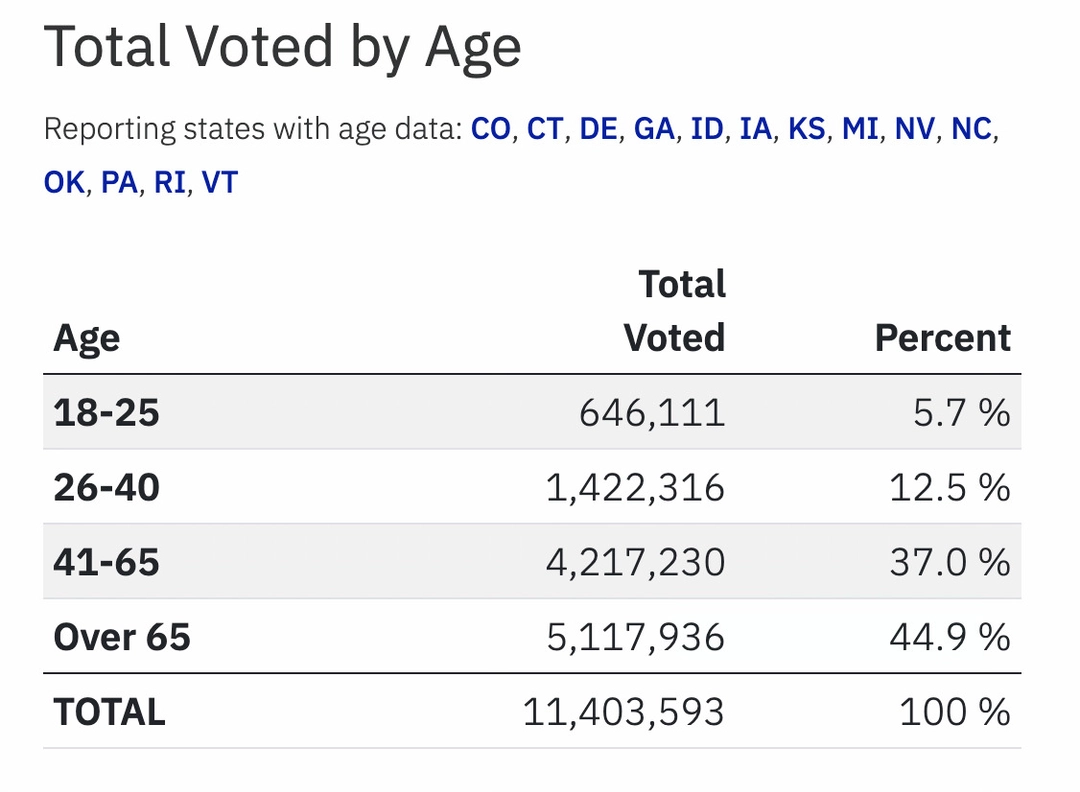
Election Lab data also shows high voter turnout among older Americans. In the 14 states that publish age-specific statistics, 44.9% of early voters are people over 65, and another 37% are voters between the ages of 41 and 65. Voters aged 18 to 25 account for only 5.7%. However, this data cannot be automatically extrapolated to the entire country, as it covers only a portion of the states.
Voter turnout has increased particularly noticeably in states where competitive Senate races are taking place. According to an analysis by the Associated Press, as of October 28, more than 6.3 million people had voted early in Texas—50% more than at the same stage of the 2022 election. In Maine, the increase was 44%; in Kansas, 34%; in Michigan, 32%; and in South Carolina, 83%.
What the pre-election polls show
As of the end of October, the average of national polls compiled by RealClearPolling stands at 51.4% for Democrats versus 43.2% for Republicans. The Democratic Party’s lead stands at 8.2 percentage points.
A Reuters/Ipsos poll conducted October 22–26 also showed a Democratic lead among likely voters—53% to 44%. Only 32% of Americans approve of President Donald Trump’s job performance. Even fewer respondents view his economic policies favorably: 25% approve of the president’s economic policies, and 20% approve of his approach to the cost of living.
This unfavorable situation for Republicans is also reflected in the assessments of congressional districts. On October 30, the Cook Political Report revised its assessments of several House districts in favor of the Democrats. According to analysts’ calculations, the party could gain between 12 and 25 additional seats compared to the current composition of the House. A majority requires control of at least 218 of the 435 seats.
In the Senate, Republicans currently control 53 of the 100 seats, while Democrats and two independent senators who vote with them hold 47. To secure a majority after the election, Democrats need to increase their representation by at least four seats: in the event of a tie, the vice president J.D. Vance will cast the deciding vote.
According to RealClearPolling, the race remains particularly tight in several states. In Texas, the average poll numbers for Democrat James Talalico and Republican Ken Paxton stand at 48.8% and 47%, respectively. In Iowa, Republican Ashley Hinson leads Democrat Josh Turek by just 0.5 percentage points, and in Maine, Democrat Troy Jackson leads incumbent Republican Senator Susan Collins by 1.4 percentage points. In Michigan, Democrat Abdul El-Sayed holds an average lead of 3.5 percentage points over Republican Mike Rogers.

Bank's name: Bank Millennium S.A.
Address: ul. Stanislawa Zaryna, 2A, 02-593, Warszawa
IBAN: PL97116022020000000216711123
SWIFT: BIGBPLPW
Name of the account holder: Fundacja “KARTA ‘97”
Purpose/title of payment: Donation for statuary aims
You can contact us by the e-mail [email protected]