


200,000 Russian Companies Have Run Out Of Money To Pay Their Debts
- 27.10.2026, 19:49
Credit risks will continue to rise.
The economic slowdown, falling profits, and high interest rates on loans have hit hundreds of thousands of Russian companies and self-employed individuals burdened with debt.
As of August 1, 2026, 28% of all borrowers from Russian banks were experiencing difficulties repaying their loans, according to analysts at Expert RA, citing statistics from the Central Bank of the Russian Federation, as reported by The Moscow Times.
Compared to the beginning of the year, the share of distressed borrowers has increased by 4 percentage points; compared to the pre-war period, it has more than doubled, and its current levels are the highest in the seven years of available statistics.
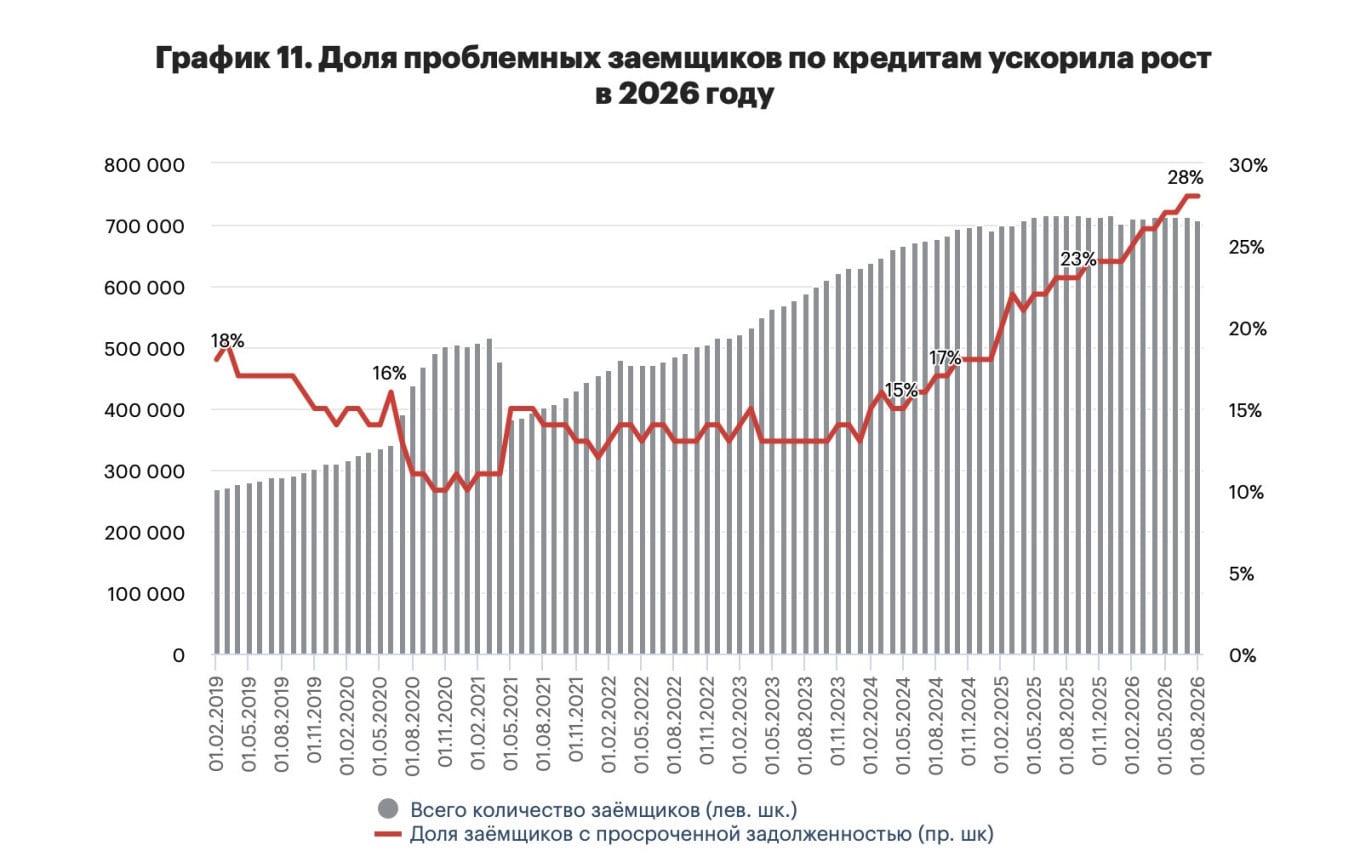
Approximately 200,000 legal entities and sole proprietors are unable to repay their loans and credits on time. Over the years of the war, more than 140,000 entrepreneurs and companies have been classified as “distressed” debtors, and compared to 2019 figures, their number has quadrupled (+150,000).
“The deterioration of key macroeconomic indicators has translated into financial stress for the real sector,” writes “Expert RA.” The military-driven economic boom of 2023–24 has run its course: GDP growth rates, which had been 4% per year or higher, have slowed to 0.6% (for the first half of this year); civilian industrial sectors have been stagnating or declining since 2024, and corporate profits—which could be used to pay down debt—have been shrinking for the second consecutive year.
According to Rosstat, the net financial result for the economy (profits minus losses) for January–June totaled 12 trillion rubles—1 trillion less than during the same period a year earlier, and 3 trillion rubles lower than the profits for the first half of 2024.
Companies have “fewer and fewer funds and sources of financing for expensive loans and borrowings,” notes “Expert RA.” This, as the agency notes, has already resulted in a series of defaults in the bond market: from January through September, 33 companies defaulted technically—9 more than in all of last year. Of those, 17 went into full-blown default.
“Credit risks will continue to grow,” warns “Expert RA.” Not even the chronically optimistic Ministry of Economic Development expects the economy to return to its previous growth rates: according to its estimates, GDP will grow by 1.2% next year, while investment will stagnate (+0.2%). Meanwhile, the Central Bank is maintaining a high key rate: at its October 23 meeting, it left it at 14% and raised its forecast for next year to 12.5–13.5%, even though at the beginning of the year it had projected a decline to 8–9%.
The Central Bank itself also sees an increase in the share of non-performing assets on bank balance sheets. According to its data, companies’ past-due debt accounts for only 3.7%, but the broader measure of non-performing loans has reached 12.9%. “In August, the portfolio of non-performing loans increased by 0.6 trillion rubles. This was mainly due to the deterioration of the financial situation of certain coal and electric power companies,” the Central Bank wrote.

Bank's name: Bank Millennium S.A.
Address: ul. Stanislawa Zaryna, 2A, 02-593, Warszawa
IBAN: PL97116022020000000216711123
SWIFT: BIGBPLPW
Name of the account holder: Fundacja “KARTA ‘97”
Purpose/title of payment: Donation for statuary aims
You can contact us by the e-mail [email protected]