

Yuri Felshtinsky Told Why He Wrote A Book About Natallia Radzina And Not Sviatlana Tsikhanouskaya
11- 22.01.2026, 16:15
- 17,298
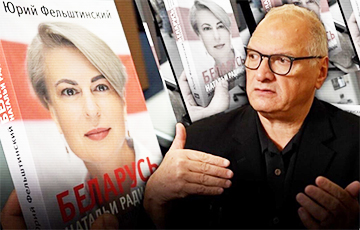
Collage: "Radyo Svaboda".
The American historian radically changed his view of Belarus.
Famous American writer Yuri Felshtinsky became a guest of the YouTube channel NEXTA. The author of the book "Natallia Radzina's Belarus. Journalist vs. Dictator," which was presented in Warsaw on January 16, told why Russia will not be able to stop democratic changes in Belarus, how to stop Russia's war against Ukraine, and pointed out the key importance of Belarus for the security of Europe.
At the very beginning of the conversation, Yuri told why he chose Natallia Radzina, editor-in-chief of Charter97.org, rather than Sviatlana Tsikhanouskaya, to write a book about Belarus:
- I was trying to identify the person through whom I could tell about Belarus to the modern reader. Frankly speaking, at some point I arranged a meeting with Sviatlana Tsikhanouskaya. I flew to Vilnius, talked to her, to people who worked in her headquarters. Then I flew to Washington, D.C., because part of Tikhanovska's team was there at the time. And, let's face it, it didn't seem to me that I would be able to tell about Belarus through the life and fate of Sviatlana Tsikhanouskaya. But with Natallia Radzina I somehow had a completely different level of contact.
We had known Natalia since about 2014. After the Russian invasion of Crimea, I became quite active in supporting Ukraine. Natalia interviewed me, then we met when I came to Europe. Then we spoke together at the Free Russia Forum, where I heard her lecture on the history of Belarus. This meeting, which is quite historical in the context of this book, was actually the beginning of the work on Natallia Radzina's Belarus. And I realized that through Natalia it is possible to explain to the reader what Belarus is.
Because I realized that my view of this country was absolutely wrong. I never looked at Belarus as a part of Europe. Rather, as a certain provincial part of Russia. And this view turned out to be absolutely wrong. Thanks to Natalia, Belarus opened up for me as a completely different country. And that was the main reason why I decided to tell a wide range of readers about it.
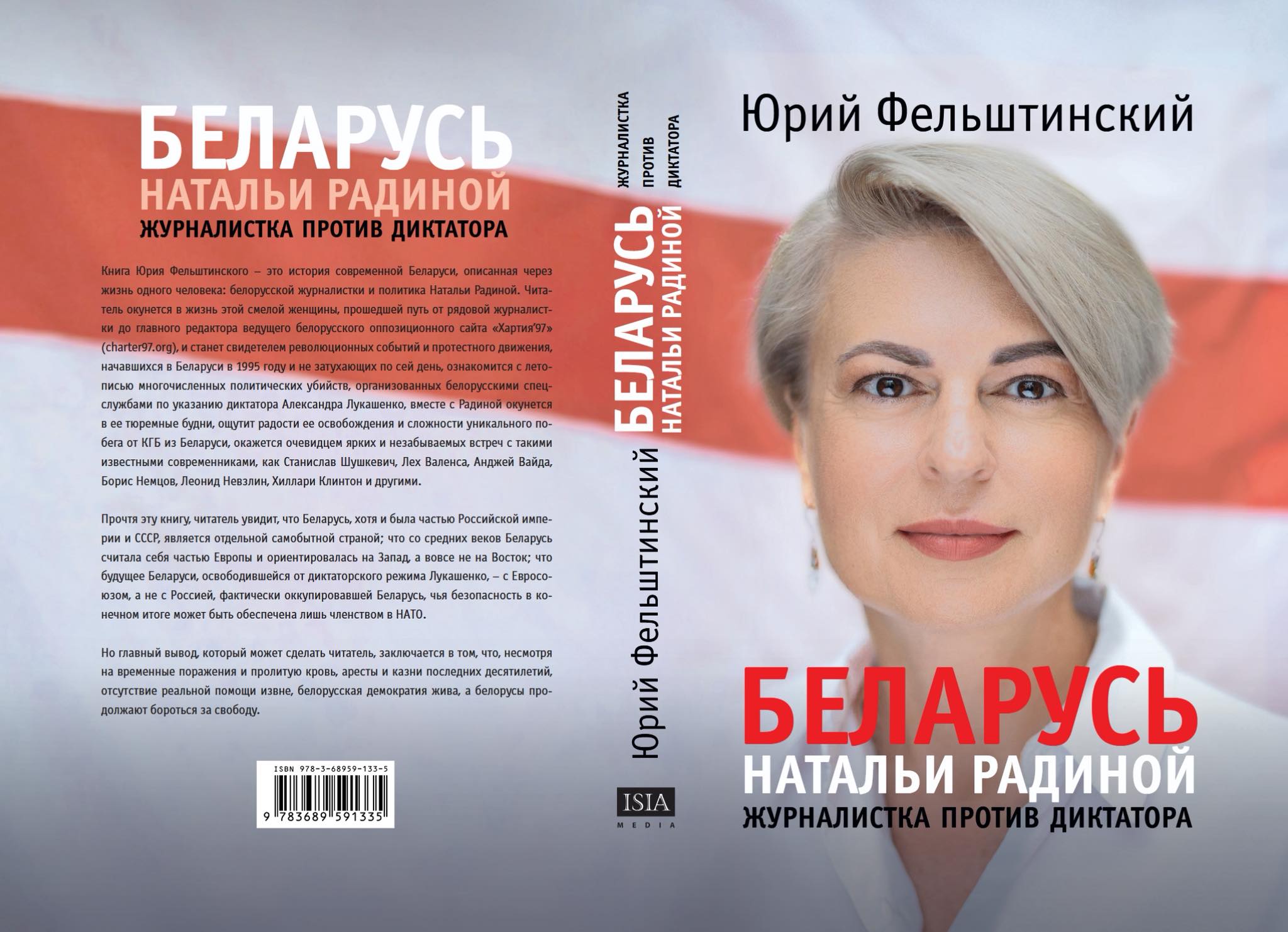
Yuri Felshtinsky told why Belarus should join NATO and why the ideas about "Finlandization" of our country are utopian and harmful:
- Words about "Finlandization" of Belarus sound funny today, because they can be understood in two ways, as "Finlandized" Finland has recently joined NATO. If we talk about the "Finlandization" of Belarus, which at the same time is a member of the Alliance, I think we have no objections to it.
Russian aggression has shown us that countries that have not had time to join NATO are in a very vulnerable position. We remember how Russian troops entered Georgia, how Russian troops attacked Ukraine twice. We know how difficult the situation is in Moldova, where Russian troops have been in Transnistria since the 1990s, without the invitation of the Moldovan side, and there is constant subversion. All these three countries - Georgia, Ukraine, Moldova - did not manage to join NATO.
Life experience has shown that a small European state can preserve its independence only if it is a part of serious interstate associations, such as NATO and the European Union. And that is why the issue of security and independence of Belarus, of course, in the current conditions should and can be solved only within the framework of membership in NATO and the EU.
An American writer believes that Putin is too late with the invasion of Europe:
- Every day Europe is getting stronger and stronger. I don't look at the state of affairs so skeptically. Before the Zapad exercises, which took place in September 2025, it was announced that Russia would transfer another 100,000 military personnel to Belarus to participate in the maneuvers. It became clear that it was not about the exercises, but about the invasion of either Eastern Europe or the second attempt to seize Kiev.
As a result, instead of 100 thousand people, three thousand arrived in Belarus. It became clear that Russia was not able, against the background of the unfinished war in Ukraine, to gather a new army for an invasion of Europe. And this, of course, has greatly changed the strategic situation, let's be frank.
But still Belarus remains the main springboard for the preparation of the Russian invasion of Europe. And as long as there is no regime change in Belarus, as long as Lukashenko is not removed from the political arena, Belarus will remain a springboard for the Russian invasion and for threats to Europe. Therefore, whoever controls Belarus actually controls the key to Europe's security. This is very important to realize. In this respect, Belarus is a strategically important territory.
Yuri Felshtinsky is sure that Lukashenko's change will trigger changes in Belarus and Russia:
- Let's be honest, regime change in Belarus is a fundamentally easier and more realistic project than regime change in Russia. In Russia, the state security as a department is in power. It is the most powerful structure, which employs hundreds of thousands, maybe millions of people, for which the entire state works today, and which has the economy of the entire Russian Federation at its disposal. For 25 years this agency has strengthened itself in power, has been leading the country since 2000, and it will be very difficult to remove them from power.
The Russian army traditionally does not take part in politics, and it will be difficult for unarmed people to fight with the FSB.
Lukashenko is a classic dictator. We see with what ease, for example, it is possible to solve the problem of dictatorship, as it was just done with Venezuela through the kidnapping of Nicolas Maduro. It is very easy to fight a dictator, because it is a question of eliminating just one person, while regime change in Russia will require fundamentally more.
American historian is sure that there are enough leaders in Belarus who can lead the country after democratic changes:
- I don't think there can be any difficulties with regime change in Belarus. Yes, we can assume that Russia will be interested in seeing Lukashenko replaced by a Belarusian leader equally obedient to the Kremlin.
But just because Russia succeeded with regard to Lukashenko and with Lukashenko does not mean that Russia will also be lucky next time. Therefore, there are limits to Russia's influence. It is not obvious that Russia will easily be able to subjugate Belarus next time.
There are quite a few, let's be frank, political leaders in Belarus who are certainly ready to assume both responsibility and power, and to run for president. It is clear that this issue will be decided at the elections, but it is more difficult to determine who in Russia can apply for the post of president, if circumstances permit. As for Belarus, we know that there are many candidates, and maybe it's a matter of opinion: someone may be better, someone may be worse, but none of them plans to be a pro-Russian dictator.
Yuri Felshtinsky believes that strikes on Moscow can stop Russia's war against Ukraine:
- In Russia, a human life costs nothing, everyone knows that. Russia is a big, rich country, the Kremlin has money for the war, the Russian Federation has raw materials that it can sell abroad and finance this war. Therefore, with all the numerous restrictive measures that are introduced against Russia, it is clear that it is impossible to stop this war through sanctions.
Russia is a country of one city, this city is Moscow. And absolutely everything in Russia is determined by Moscow and depends on it. And the war cannot be won if you do not have the right to strike at the enemy's territory. Ukraine was allowed to use western weapons to strike at its own occupied territory. It was a completely insane restriction.
Gradually it was lifted, already at the very end of Biden's administration (when Harris lost the election but he was still president) he finally lifted the restriction from banning the use of Western weapons to strike Russian Federation territory other than Moscow. However, it is quite obvious that the only pain point, the main nerve, the most vulnerable spot, the Achilles' heel, whatever you want to call it, is Moscow. All these years, both the Americans and the Europeans have forbidden Ukraine to consider striking Moscow.
If there is a political solution, if there is an understanding that in order to stop this war, it is necessary to change its format, to hit Moscow, then Putin will have a reason to sit at the negotiating table.
I do not think that Putin will sit at the negotiating table, but changing the format of the war will lead to the fact that not Putin will remain in the presidential chair, but some other person will sit there. It will be easier to start negotiations. It does not follow that these negotiations will be easy, that the war will end overnight, but it will follow that Russia will have reasons to consider ending this war.

Bank's name: Bank Millennium S.A.
Address: ul. Stanislawa Zaryna, 2A, 02-593, Warszawa
IBAN: PL97116022020000000216711123
SWIFT: BIGBPLPW
Name of the account holder: Fundacja “KARTA ‘97”
Purpose/title of payment: Donation for statuary aims
You can contact us by the e-mail [email protected]