

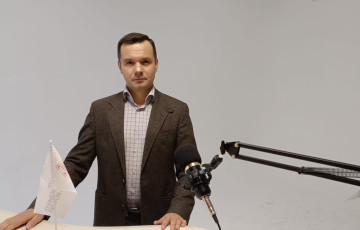
Maxim Pleshko: Closing The Border Has Blown Lukashenko's Fairy Tale Out Of Proportion
15- 18.09.2025, 15:33
- 36,308
Even China will have a hard time convincing Poland to open the border.
The closed Polish-Belarusian border was one of the main issues in talks between Polish Foreign Minister Radoslaw Sikorski and his Chinese counterpart Wang Yi. China promised a "frank conversation" with Lukashenko, but Warsaw insists: without an end to hybrid attacks, border security and the release of political prisoners, the border cannot be opened.
How much can the factor of Chinese transit through Belarus become an incentive for Beijing's pressure on Lukashenko? This is what Charter97.org asked the candidate of philosophical sciences, head of the Ukrainian Center for Belarusian Communications Maksim Pleshko:
- For years Lukashenko has been selling China a fairy tale about a "new silk road" through Belarus, positioning himself as a "gateway to Europe." But the closure of the Polish-Belarusian border has effectively scuttled those plans. The key hub - the terminal in Malashevichy - is paralyzed, and alternative routes through Ukraine or Lithuania are now unrealistic.
For Beijing, this is a signal: Belarusian transit is unreliable, too dependent on the political crisis and Moscow's decisions. Therefore, the "frank conversation" with Lukashenko is rather a demonstration of discontent. China is interested in preserving access to European markets, and this may become a factor of pressure on Minsk. But it should be understood: Beijing's real influence is limited, because Lukashenko is actually driven into complete dependence on the Kremlin.
In addition, the regime itself complicates the situation - when in Minsk instead of finding compromises only anti-Western slogans like "Poland is the enemy" are heard, Warsaw's trust becomes zero. Even China will find it difficult to convince Poland to restore transit under such conditions.
- What exactly does the Polish side mean by "border security"? What conditions does Warsaw consider necessary for its opening?
- Poland clearly formulates: the issue of the border is not about trade, but about security. Warsaw recalls Minsk's provocations and Moscow's destructive actions, in particular airspace violations by Russian drones.
"Security" in the Polish understanding means several things:
- cessation of hybrid attacks through artificially organized migration pressure;
- absence of military provocations and threats to Polish territory;
- reduction of hostility rhetoric that fuels the conflict.
Sikorski said bluntly: as long as there are "vatagas of pseudo-refugees roaming across the border, driven by Lukashenko", the opening of crossings is out of the question. That is, the key condition is a guarantee that the border will no longer be used as an instrument of blackmail.
Poland admits that keeping the border closed is costly for Warsaw itself, but emphasizes that security is more important than any economic losses.
- Can we expect that the issue of releasing political prisoners will be raised in the dialog with the participation of China?
- Yes, this issue is already built into Warsaw's demands: in addition to ensuring security and stopping hybrid attacks, the release of political prisoners is explicitly mentioned among the conditions for opening the border. That is, Poland insists that there can be no agreement without the humanitarian dimension.
For China, human rights are traditionally not a priority. But if Beijing really wants to play the role of a mediator in the dialog between Minsk and the West, it will not be able to completely ignore these demands. It is most likely that China will use the issue of political prisoners as an element of the "package of conditions" to demonstrate to the EU that it hears the European expectations.
At the same time, it would be naive to expect that it is Beijing that will become a real advocate of the Belarusian political prisoners. This issue will be heard, it will be on the table in any negotiations, but pressure on Lukashenko in this area will still remain the prerogative of the EU and Poland.

Bank's name: Bank Millennium S.A.
Address: ul. Stanislawa Zaryna, 2A, 02-593, Warszawa
IBAN: PL97116022020000000216711123
SWIFT: BIGBPLPW
Name of the account holder: Fundacja “KARTA ‘97”
Purpose/title of payment: Donation for statuary aims
You can contact us by the e-mail [email protected]