

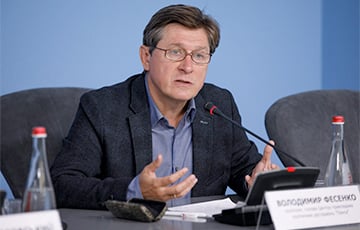
Volodymyr Fesenko: This Is Not The Final Round Of Negotiations
7- 18.08.2025, 15:33
- 14,616
What to expect from the meeting in Washington.
Ukrainian President Vladimir Zelensky's scheduled visit to the White House on Monday, August 18, and his meeting with his American counterpart Donald Trump could be a turning point. Will the Ukrainian president be able to resist the pressure to make concessions to Russia?
About this, Charter97.org spoke to Vladimir Fesenko, a well-known Ukrainian political scientist and head of the Penta Center for Applied Political Research:
- Unfortunately, we don't have an unambiguous answer to this question. Scenarios can be different. Everything depends on what leg Trump will get up from, what his mood will be in the morning, even what news he will see at the beginning of the day and with what mood he will come to the meeting with Zelensky. It is highly likely that Zelensky will certainly not repeat the mistakes that were made in the Oval Office on February 28. I think he will choose a more flexible tactic: he will defend Ukraine's interests and insist on the need to negotiate a ceasefire. All other issues are subject to negotiations. But it will have to be done as flexibly and delicately as possible, so as not to provoke conflict and tension with Trump.
There must be flexibility, political maneuvers, agreement to negotiate. It should not be discarded if Trump liked the idea of peace talks. But Zelensky should emphasize: a ceasefire can be negotiated much faster. The experience of many wars confirms this. For example, the Korean War and a number of others ended without a peace treaty. We can recall this and our sad experience with the Minsk agreements: a treaty can be signed, but each side will interpret it in its own way - and this was due to Russia's position. It is very important to carefully show the problem of this idea of a "peace agreement".
With regard to Ukraine's unilateral concessions, maximum caution is needed here. Zelensky should refer not only to the Constitution, but also to the position of Ukrainian society, which will not accept such concessions. Trump should realize that more than one person decides. If he, excuse me, does not care what is written in the Constitution, then he is obliged to take into account the opinion of voters. These are arguments that Zelensky can use.
It is crucial for Zelensky to feel the support of Europeans. Yes, there will be a one-on-one direct meeting with Trump at the White House. Perhaps J.D. Vance and Marco Rubio will be present. But Zelensky will know that he represents not only Ukraine, but also Europe. And Trump understands that. The support of allies strengthens Kiev's negotiating position.
I don't think there will be a solution to all the problems in Washington today. It will be discussed how and in what form to continue the negotiations, what should be their logic. Zelensky's agreement to all of Trump's demands will not be forthcoming. Zelensky already has experience in resisting Trump's pressure - both on the resource agreement and the Russian-Ukrainian war. Therefore, this situation is not new, and the current negotiations cannot be considered the final round. This is one of the first stages of real peace talks.
- Yesterday we heard different statements from representatives of the US administration. Spokesman Whitkoff said that Russia had already made concessions because it had decided not to take over all of Ukraine. Secretary of State Rubio was tougher. He recalled Russian losses and said that the U.S. does not support the idea of handing over Donbass to Russia. Does the US have a position? Or is it ad hoc and will be formed in the course of negotiations?
- Unfortunately, the US does not have a consistent position. We see how it has been changing. During the first six months of Trump's second presidency, it has fluctuated several times. At first, Washington's position was quite logical and realistic: we should only negotiate a ceasefire, and then we'll see. There was pressure on Zelensky to agree to just that. The problem was that Ukraine demanded security guarantees first, and then a ceasefire. The Americans refused to discuss guarantees. As a result, on March 11, Ukraine agreed to start with a 30-day cease-fire.
In April, the U.S. made concessions to Russia and offered its own version of the peace treaty, the "Kellogg's 22 points." They supported direct talks between Kiev and Moscow in Istanbul, but it became clear: Russia did not really want to negotiate. In July, Trump returned to the demand for a ceasefire and began threatening sanctions if Moscow did not agree. And now - another reversal. You see how much has changed in six months. This is Trump: he has no stable consistent position. Then he takes a realistic line, then under the influence of Vladimir Putin he begins to lean toward the idea of ending the war at the expense of Ukraine and its unilateral concessions.
After the talks in Alaska, Trump has again moved closer to Putin's position. The Europeans, along with Zelensky, will change his mind, but it is unlikely to succeed on the first try.
What is happening now - the meetings in Alaska and in Washington - is a fight over Trump's position. The Alaska round was unfortunately won by Putin: he managed to drag Trump closer to his position. It is now up to the Europeans to bring him back to a more realistic and pragmatic line, where a ceasefire and no unilateral concessions from Ukraine are at the center. In my view, this is just the beginning. A long, controversial and dramatic negotiation process awaits us.
- What will the "Coalition of the Resolute" countries do if Trump pushes Ukraine to make concessions?"
- They will support Ukraine. Not only the leaders of the "Coalition of the Resolute" but also the flexible negotiators will play an important role. I have high hopes for NATO Secretary General Mark Rutte, Finnish President Alexander Stubb, Italian Prime Minister Giorgio Meloni. German Chancellor Friedrich Merz, by the way, also found the optimal tone in the dialog with Trump.
European leaders will act in two directions: support Ukraine and speak with a common negotiating position. This seriously strengthens Kiev's position. Let me remind you that the "Coalition of the resolute" emerged in March after the negotiations in the Oval Office. At that time, its creation was a reaction to changes in the position of the United States and its desire to help Ukraine. Now the leaders of the coalition will actively work with Trump, gently and flexibly changing his mind. This is also helping Ukraine - correcting Trump's position.
Europeans are gradually promoting the idea of their participation in the peace talks. Indirectly, this is already happening: the very visit to Washington shows that Europe is actually participating in the negotiations, even if not directly, but influencing the process. In the future it will be necessary to formalize their participation.
I believe that Ukraine needs to change its approach: not a trilateral summit (Russia, USA, Ukraine), but a quadrilateral one. The only question is who will represent Europe: NATO Secretary General Mark Rutte, the leader of the largest EU country - Germany, or the head of the European Commission Ursula von der Leyen. There are options, we have to decide.
This is very important. Because if Trump does not change his position and insists on a comprehensive treaty, then at the trilateral summit there may be a situation when Trump and Putin will be against one Zelensky. And this is extremely dangerous. That is why I am not in favor of the "three leaders" format. Ukraine should seek the participation of Europe as a full-fledged party.

Bank's name: Bank Millennium S.A.
Address: ul. Stanislawa Zaryna, 2A, 02-593, Warszawa
IBAN: PL97116022020000000216711123
SWIFT: BIGBPLPW
Name of the account holder: Fundacja “KARTA ‘97”
Purpose/title of payment: Donation for statuary aims
You can contact us by the e-mail [email protected]