

Yauhen Afnagel: We Need Negotiations Leading To Real Results
6- 17.10.2025, 17:51
- 8,694
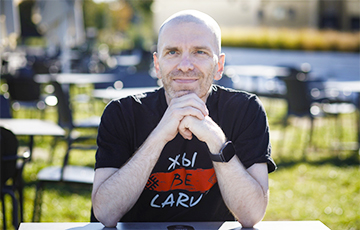
Photo: Vadim Zamirovsky
First the release of political prisoners and an end to domestic terror, and then the lifting of sanctions.
How to achieve the release of political prisoners? Why do sanctions work? What was not enough to defeat Lukashenko's regime in 2020? This is discussed in an interview with "Euroradio" told the former political prisoner, coordinator of the civil society company "European Belarus" Yauhen Afnagel. The site Charter97.org quotes the interview with small cuts.
- Good afternoon, Yauhen. First of all, I congratulate you on the fact that you are at liberty, that you already have a window on the side and no bars, that you can safely go where you need to go, solve your issues and so on. In short, to enjoy everything that freedom gives you. Nevertheless, how do you perceive the very fact that you are free but deported from the country, that you have no documents? That is, this whole process of your release, how do you feel about it, how do you perceive it? How do you assess it?
- First of all, I sincerely thank you for the congratulations, and not only for them, but also for the support that we, political prisoners, received from Belarusians, independent media, including Euroradio. We knew some news, being in captivity, we knew that we were remembered and talked about. This solidarity helped us a lot. And I am sure it will continue to help those political prisoners who remain there.
Unfortunately, I am not completely free and cannot go where I want to go. I would like to walk around Minsk today, but I don't have that opportunity yet. Nevertheless, of course, I am very glad that I can see the sky not through the bars, I can see a free European country, I can see acquaintances, friends, relatives. This is, of course, very important and very valuable.
- Natalia Dulina was very unhappy that she found herself deported to Lithuania, even though she was free, and said: "Look, I had two months left to serve my sentence. I had already planned that I would serve my sentence, get out and live in peace in Belarus, to do my business, but they didn't ask me. How do you assess how this process went for you?
- I think the word "deportation" is not quite correct, because you are deported from a foreign country, but we were thrown out of ours. It's not very pleasant to feel like a commodity, a thing. It is not pleasant when your fate is decided for you. Of course, along with the positive emotions that I, my friends and colleagues experienced when we were in Lithuania, all of us probably had negative emotions because we were not asked whether we wanted such a release, whether we wanted to be a commodity to be exchanged for some sanctions.
In Belarus there are 1300 recognized political prisoners, repression continues, and this issue is not raised at all. I have data from human rights activists from Dissidentby. This year alone, 1083 people have been brought to criminal responsibility, 370 of whom have already become political prisoners, 500 received household chemicals. These are also political prisoners. 67 people were released not after serving their time, but by deportation, as you said. The proportions are not at all in favor of reducing, if not ending, repressions in Belarus.
- Eugene, we will return to this problem and your vision of its solution a little later. I would like to go back to history a little bit. I read your interview and paid attention to the words that it is funny for you to read the statements of experts, political scientists, politicians, even journalists, who at the beginning of 2020 could not foresee how these elections would end, that they would end with such an upsurge, such a popular protest, such a revolution, not a revolution, this word is inappropriate here, but exactly such a protest.
- Remember 2017, the actions against the decree on "deadbeats". Even then it was clear that the protesters were not only those who came out on the Day of Will or on the "Charnobylskiy Shlyakh", but quite different people - factory workers, students, ordinary people, far from politics. Then a new force - bloggers, who allowed residents of different cities of Belarus to see that in fact everyone has the same problems. And there are a lot of us who want to change.
Then there was the celebration of the centenary of the Belarusian People's Republic, several actions in the center of Minsk, then there was the parliamentary campaign, which we, "European Belarus", used to get feedback from ordinary people - not those who take to the streets on traditional dates, but those who know nothing about the opposition, but are dissatisfied with the authorities. We saw that there were a lot of such people.
At the same time, social networks were developing, independent bloggers continued to work, and there were quite a few of them. At the beginning of 2020, it was already clear that there would be an explosion, there would be a revolution. Even if it is not completely finished, but it was a revolution, it continues.
- You remember how you led the columns from Malinovka to the center. Nevertheless, don't you think that the chosen tactic of peaceful resistance was a strategy of defeat from the beginning?"
- Don't confuse peaceful resistance with indecision. Peaceful resistance is also a strike. Peaceful resistance is also occupying buildings. Remember in 2001, when Zubr still existed, we occupied a building in the center of Minsk? At that time there were probably about 10,000 people on Oktyabrskaya Square, not many compared to 2020, but we occupied the building. It was an action of non-violent resistance.
In 2020, unfortunately, a lot of things didn't work out. The strike didn't work out. We had a document prepared by the Investigative Committee with reference to the Ministry of Taxes and Levies in the case file at the trial. It contained data on the losses of enterprises right after the election day - August 10, 11, 12, when the strike started at many of them. They tried to accuse us of preparation, that's why this document was in the case. It listed more than 100 enterprises: MZKT, MAZ, MTZ, BelAZ, BMZ and others. There were two columns of figures: the amount of losses the enterprise had incurred these days and the amount not received by the state budget. I realize that these figures may have been overstated, but they were very large figures. Then we reasoned and analyzed in the courtroom and realized that if the strike had lasted a month, the situation in the country would have been different. The state machine would not have been able to stand, because the losses would have been too great.
One of the most important methods of non-violent resistance - strike, refusal to cooperate with the regime - was not used. We would go out to protest on Sunday, and then work for the regime for a whole week - going to work, paying taxes. Many people still came out to rallies in their yards, gathered on Independence Square, in front of television. People wanted changes, were ready to sacrifice something for them. But, unfortunately, there was no corresponding call. On the contrary, when we were negotiating about the strike with both the headquarters of Viktor Babariko and the headquarters of Svetlana Tikhanovska before the election day, they did not listen to us and said: "No, don't. We will act by legal methods, we don't need to go to the streets, we don't need any strikes. We will wait for the elections, and then we will sue and so on." Although, when we met with Sergei Tikhanovsky before his arrest, he was an advocate of resolute non-violent action.
- Let's return to today. There is talk now that we still need to continue to push for release. We need to make concessions to the regime, we need to freeze sanctions and bring back European ambassadors. No one is openly talking about turning the page yet, but there may be hints of that somewhere. We need to release them on the terms we can get today. What is your take on this process? Do you support the release through the lifting, freezing of sanctions, partial legitimization and return of ambassadors?
- I will say right away that the release of all political prisoners is my dream and goal. I will fight for it, I will do everything possible for it. This is one of the most important tasks for today. But look at what is happening. Can we talk about liberation? We, 51 people, were deported in exchange for some concessions to Lukashenko, the same sanctions against Belavia.
And the West is limited in such concessions, because there are key points for the regime - Belavia, Belaruskali, oil products, oligarchs, banks. 50 people for Belavia, for example, 100 people for Belaruskali, 300 for oil products, and then everything will be over, and thousands of people will remain behind bars. How will they be released? Does anyone think about it?
First the release of political prisoners and, most importantly, the cessation of terror inside the country, and then the lifting of sanctions. No sane person would oppose negotiations. Negotiations are necessary, but negotiations from a position of strength, negotiations leading to a real result.

Bank's name: Bank Millennium S.A.
Address: ul. Stanislawa Zaryna, 2A, 02-593, Warszawa
IBAN: PL97116022020000000216711123
SWIFT: BIGBPLPW
Name of the account holder: Fundacja “KARTA ‘97”
Purpose/title of payment: Donation for statuary aims
You can contact us by the e-mail [email protected]