
Erdogan Is Turning His Back On Putin
- 7.06.2026, 18:17
- 5,888
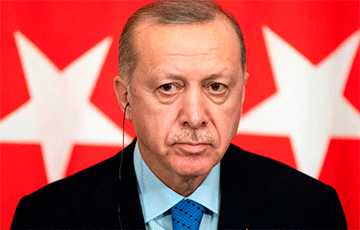
The turning point was the fall of Bashar al-Assad's regime.
The partnership between Turkey and Russia, which was formed largely due to the war in Syria about a decade ago, is gradually losing strength. Against this background, Ankara is helping to strengthen Ukraine's position in the Middle East, a region where Moscow has long maintained significant influence. This is the subject of a column for The New York Times by Gyonyul Tol, a senior fellow at the Middle East Institute.
The relationship between Turkish President Recep Tayyip Erdogan and Russian dictator Vladimir Putin has always remained complicated. During the Syrian conflict, the countries supported opposite sides: Turkey sided with rebels seeking to overthrow Bashar al-Assad, while Russia defended the incumbent regime. However, over time, Moscow and Ankara found a compromise.
The Turkish military operation in northern Syria in 2016 was made possible by Russia's agreement to control Syrian airspace. In return, Ankara reduced its support for rebel groups. Such arrangements reflected a broader pattern of cooperation in which both sides effectively recognized and reinforced each other's influence in Syria.
The benefit for the Kremlin was that Turkey effectively acquiesced to Russia's strengthening position in Syria and other parts of the Middle East, and contributed to divisions within Western alliances. Erdogan, on the other hand, gained an important regional partner at a time when relations with NATO were cooling.
Initially, Turkey looked like the less influential member of this tandem. However, after Russia's full-scale invasion of Ukraine, the situation changed. Finding itself under Western sanctions, Moscow became much more dependent on Ankara, which refused to join the restrictions. Turkey has become one of the key centers of Russian trade, investment and energy cooperation, while strengthening its own position.
The turning point was the fall of Bashar al-Assad's regime at the end of 2024. Russia, focused on the war against Ukraine, was unable to support him. As a result, Moscow had to find common ground with the new Syrian leadership led by Ahmed al-Sharaa, despite the fact that Russian airpower had previously conducted years of strikes against the forces now in power. At the same time, Turkey, which supported the Syrian opposition, has become the main external player in the country.
According to the author, this opens up new opportunities for Ankara: to strengthen its position in NATO, adjust relations with Russia and at the same time help Ukraine expand its influence in the Middle East.
In the spring, Ukrainian President Vladimir Zelensky visited Syria for the first time, using a Turkish state plane. During talks with Ahmed al-Sharaa and the Turkish foreign minister, defense and energy cooperation were discussed. Ankara is involved in reforming the Syrian army, and Ukraine can offer its own experience in military production and the use of drones, accumulated during the years of war with Russia.
In parallel, Kiev is developing contacts with the Persian Gulf countries. After Iranian Shahed-136 drones attacked the states of the region, Ukraine offered Qatar, Saudi Arabia and the UAE to share their practical experience in air defense. These same drones are also actively used by Russia against Ukrainian cities.
Turkey, which has strong ties to the Gulf states, sees the increased Ukrainian presence as a complement to its own regional strategy. For Russia, which has long built security and economic relations with the region's monarchies, this means an additional loss of influence.
The author notes that Ukraine needs new allies and markets, and increased cooperation with Middle Eastern countries strengthens its international security role. Turkey's support demonstrates the weakening of the Kremlin's ability to influence global processes and indicates a serious transformation of Turkish-Russian relations.
According to Tola, Ankara is adhering less and less to the policy of balancing between Moscow and NATO. The weakening of Russian positions has allowed Turkey to promote its own interests more freely, and Ukraine is becoming one of the main beneficiaries of this situation.

Bank's name: Bank Millennium S.A.
Address: ul. Stanislawa Zaryna, 2A, 02-593, Warszawa
IBAN: PL97116022020000000216711123
SWIFT: BIGBPLPW
Name of the account holder: Fundacja “KARTA ‘97”
Purpose/title of payment: Donation for statuary aims
You can contact us by the e-mail [email protected]