

Trump Is Angry, Putin Is Afraid
9- Igor Petrenko
- 6.04.2026, 14:36
- 6,268
You can't write NATO off.
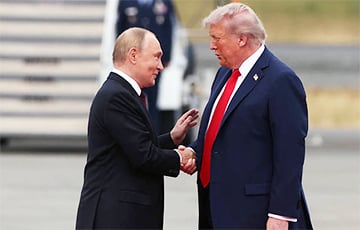
US President Donald Trump has once again called NATO a "paper tiger". And this time, not in passing, but with special emphasis. In an interview with ABC News, he admitted that he used his call for allies to help in the Strait of Hormuz as an "experiment" - a test of readiness. The allies refused, and Trump summarized, "They have no ships, they have nothing, and Putin is absolutely not afraid of them." And he added that the issue of U.S. withdrawal from NATO "is not just under consideration anymore - it's beyond consideration."
But what's true here and what's a political game, and what follows for Ukraine?
First, is NATO really a "paper tiger"? In terms of numbers, no. All 32 member states have reached the 2% of GDP defense spending target for the first time in history. At the June 2025 summit in The Hague, a new target of 3.5% of GDP for "hard defense" and another 1.5% for security-related spending by 2035 was agreed upon.
The Baltic states, Poland, and the Scandinavians are already spending 3-4% of GDP. The Netherlands plans to increase the number of armed forces from 70,000 to 200,000. Germany must double its defense budget to 162 billion euros by 2029. The EU will spend 88 billion euros on defense procurement in 2024 - a 39% year-over-year increase. This is not "paper." This is real rearmament, albeit late.
But second, there is a nuance that Trump captures precisely: NATO is a defense alliance, and it operates by consensus. When Washington asked for help in an offensive operation against Iran, the allies refused, and technically had the right to do so. Article 5 provides for collective defense in response to attack, not participation in other people's wars of choice. Spain closed airspace to U.S. planes. Italy refused to allow a warplane to land. This is not weakness. It is a structural feature of the alliance that Trump is deliberately presenting as betrayal.
Third, is Putin afraid of NATO? Here it is worth distinguishing rhetoric from reality. Putin has spent years constructing the narrative that NATO is an aggressive bloc surrounding Russia. But his actual behavior suggests otherwise: he attacked Georgia, which was not in NATO. It attacked Ukraine, which was not in NATO. It never once touched the territory of any Alliance member state. This is the best proof that Article 5 works as a deterrent - at least for now.
At the same time, Trump is not entirely wrong in the sense that European armies are still incapable of waging large-scale war without American logistics, intelligence, aerial refueling and command.
According to McKinsey, military equipment stocks in European NATO countries are still below 2021 levels - due to weapons transfers to Ukraine, decommissioning of old systems and long lead times for producing new ones. And fragmentation of platforms in Europe is four times higher than in the United States. That is, the money is already there, but the actual combat capability is still being pulled up.
Now about Ukraine. Ukraine's Permanent Representative to NATO Alena Hetymanchuk reacted to Trump's statements in a paradoxically optimistic way. Her position: if the U.S. withdraws from the Alliance, it could open up more opportunities for Kiev to integrate. The logic is simple: it was Washington that for years blocked giving Ukraine a clear timeframe for accession. Without an American veto, the Europeans could be more decisive. Hetymanchuk also noted that Ukraine is the only country that is already actually putting NATO's Strategic Concept into practice.
But there is another side. Without the United States, NATO loses more than half of its defense potential. For Ukraine, this means that even if it joins the "Eurocentric" Alliance, its security guarantees will be significantly weaker. That is why Kiev is in parallel looking for an "Article 5-type agreement" - legally binding guarantees of sovereignty, even without formal membership.
There is another important point that is often overlooked. A law passed by Congress in 2023 prohibits the president from single-handedly withdrawing the U.S. from NATO without the consent of two-thirds of the Senate. Ironically, the author of this law was none other than Marco Rubio - Trump's current Secretary of State. In 2023, he wrote on social media, "No president should be able to withdraw from NATO without the consent of the Senate." Today, the same Rubio says NATO is a "one-way street" that needs to be "rethought." Senate Democratic leader Chuck Schumer has already promised that the Senate will not vote to withdraw.
What do we end up with?
NATO is not a "paper tiger," but neither is it the machine it should be. European rearmament is real, but slow.
Trump is using the Iran crisis as an excuse to apply pressure, but his threats are limited by law. And Putin fears NATO only as much as the alliance shows unity (and it is this unity that Trump is most effectively destroying).
Ukraine in this situation should remember that relying solely on NATO is risky. But it is also risky to write the Alliance off. We must have various security agreements and build up our own defense capabilities. We must make the most of the window of opportunity that is opening now.
Igor Petrenko, unian.net

Bank's name: Bank Millennium S.A.
Address: ul. Stanislawa Zaryna, 2A, 02-593, Warszawa
IBAN: PL97116022020000000216711123
SWIFT: BIGBPLPW
Name of the account holder: Fundacja “KARTA ‘97”
Purpose/title of payment: Donation for statuary aims
You can contact us by the e-mail [email protected]