

The Historic Artemis 2 Lunar Mission Has Been Successfully Completed
21- 11.04.2026, 8:13
- 13,296
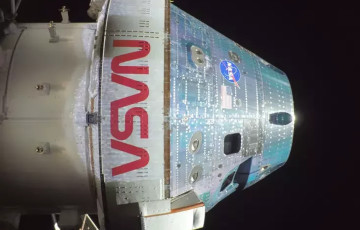
"The Orion has landed in the Pacific Ocean.
NASA's Orion spacecraft with four astronauts on board has successfully landed in the Pacific Ocean off the coast of California. The Artemis 2 expedition - the first human mission to the moon in more than half a century - has been completed, writes BBC.
The landing took place as planned, around 17:08 local time on the US west coast (03:08 on April 11, Minsk).
After the reentry, the Orion crew had difficulty establishing satellite phone communication with the rescue team, and the astronauts had to coordinate with rescuers through the flight control center in Houston. However, Orion's landing itself went perfectly, with NASA calling it a "textbook landing."
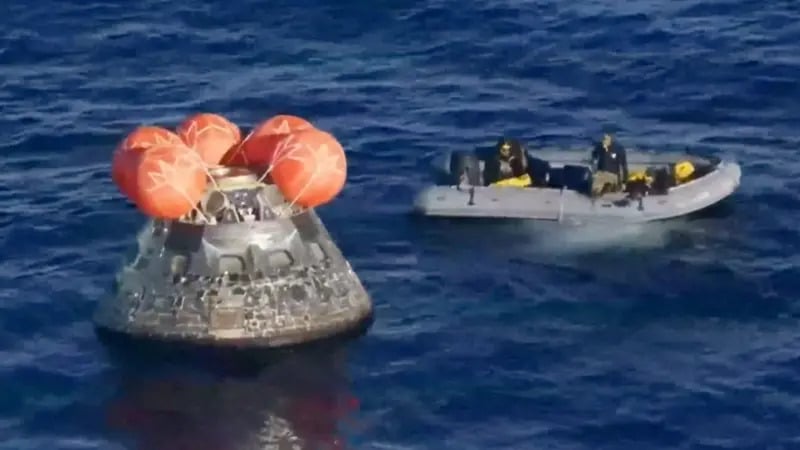
The four astronauts are reportedly "in great shape."
NASA chief Jared Isaacman described in incredibly emotional terms how the sight of the mission crew's reentry rendered him speechless.
"Jared the child can't believe what he just saw. This is just the beginning," he said. - 'We're back in the business of sending astronauts to the moon and getting them back safely.'"
Remember how the return to Earth took place.
Module detachment
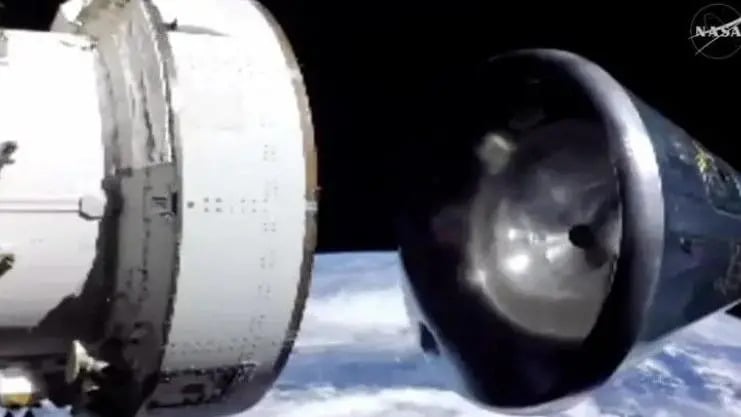
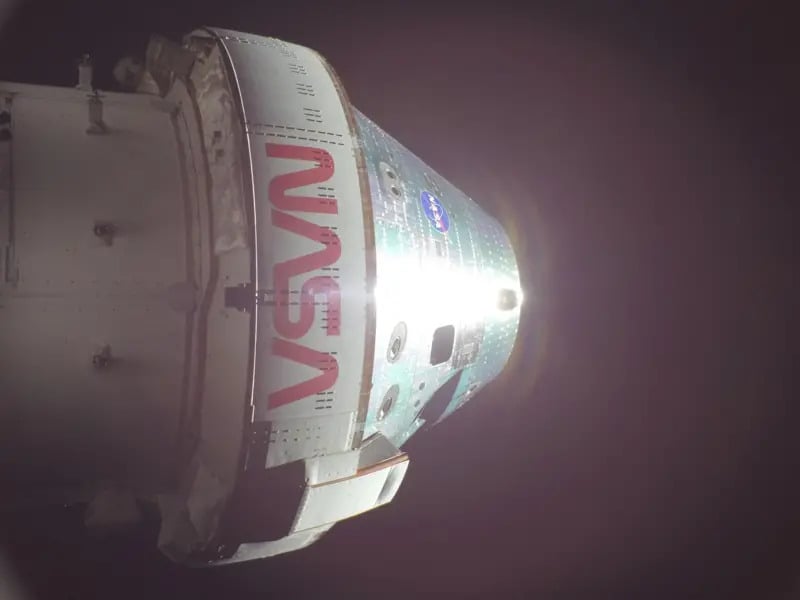
About 25 minutes before Orion entered Earth's upper atmosphere, the service module that had supported the mission for 10 days detached from the craft.
The crew module, which was returning to Earth, deployed to enter the atmosphere with its super-fire-resistant shield forward.
The final corrective maneuver began, locking the capsule at the precise approach angle for re-entry into Earth's atmosphere.
Atmospheric re-entry
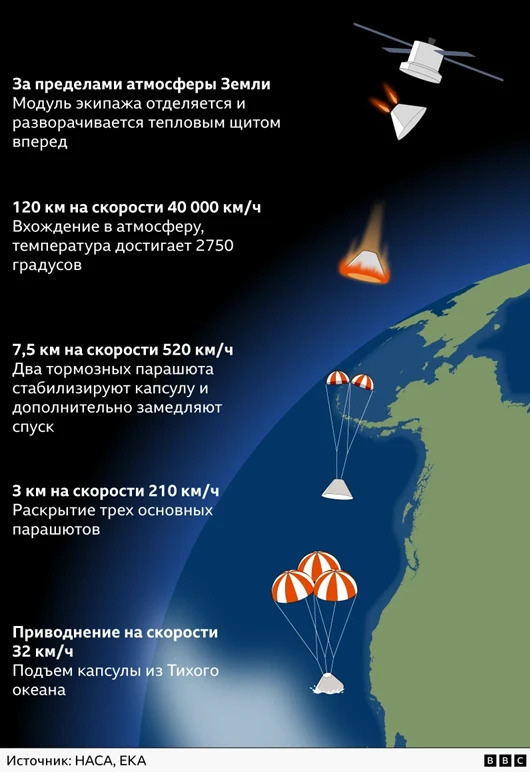
The Orion returning from the Moon was entering the atmosphere at a speed not seen since the Apollo era - 25,000 miles per hour, or nearly 40,000 km/h.
The ship was therefore entering the atmosphere on a very gentle trajectory, and maintaining a precise angle of entry was critical. The heat shield can withstand temperatures up to 5000 degrees Fahrenheit (over 2700 Celsius) - only twice as "cold" as the surface of the Sun - but if the angle of entry had been even one degree greater, the temperature would have been much greater, and the ship and crew would have burned up.
In the first, unmanned Artemis mission, the heat shield was seriously damaged, but engineers said they solved the problem by adjusting the re-entry angle.
And besides, NASA experts said, the shield still did its job: the temperature inside the capsule did not exceed dangerous levels, and if the astronauts had been in the capsule then, they would have remained unharmed.
From Space to Ocean
The atmospheric passage phase - from re-entry to reentry - took only about 13 minutes.
In the first half of this journey, the capsule lost contact with Earth for about 6 minutes: the rushing spacecraft heats up the air so much that electrons burst out of oxygen and nitrogen atoms and form a charged plasma, which blocks radio signals.
At this stage, the ship braked simply "against the atmosphere". Then, when the speed dropped from 40,000 km/h to hundreds of kilometers per hour, Orion released the first two braking parachutes with a dome diameter of only 7.6 meters. With their help, the fall speed was dropped to about 500 km/h.
Then it was the turn of the auxiliary small parachutes, which pulled the three main parachutes with a dome diameter already more than 35 meters. On them, at a speed of about 20 miles (more than 32 kilometers) per hour, Orion and "plummeted" into the Pacific Ocean.
Docking and evacuation
As explained by NASA experts, the Orion could land at any angle: after landing on the perimeter of the ship automatically inflated floats that brought it to the correct position.
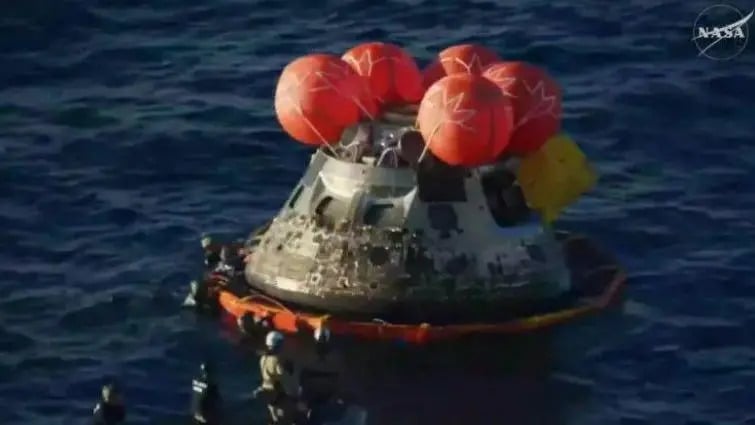
NASA and U.S. Coast Guard ships waited for Orion in a large, hundreds of kilometers across, docking area.
About an hour after docking, the Orion module's side hatch opened to let the specialists in.
Four people must enter the module, which is quite cramped inside, so that each astronaut can undergo an individualized physical assessment.
After the initial assessment, a medic inside the Orion capsule confirmed that all four crew members were feeling fine.
NASA said there was "no rush" to evacuate the astronauts, prioritizing their safety.
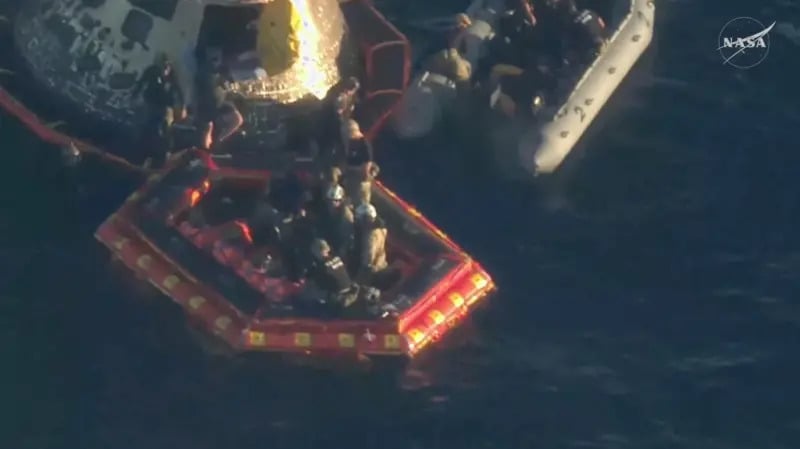
After assessing the astronauts' physical condition, they were moved one by one onto an automatically inflated, raft-like ramp attached to the craft. Crew commander Reed Wiseman was the last to leave the ship.
The helicopters took the astronauts aboard the military transport ship USS John P Murtha, which will take them to San Diego Naval Base.

Bank's name: Bank Millennium S.A.
Address: ul. Stanislawa Zaryna, 2A, 02-593, Warszawa
IBAN: PL97116022020000000216711123
SWIFT: BIGBPLPW
Name of the account holder: Fundacja “KARTA ‘97”
Purpose/title of payment: Donation for statuary aims
You can contact us by the e-mail [email protected]