
Naval News: The Question Of Withdrawal Of The Russian Fleet From The Black Sea Is On The Table
3- 10.04.2026, 7:40
- 9,638
The balance of power has shifted.
Russia's problems in the Black Sea look serious, but in fact they are deeper and more systemic than they appear at first glance. It's not just about ship losses or temporary setbacks, but a fundamental shift in the balance of power that calls into question the very presence of the Russian fleet in the region, writes Naval News.
Since the start of the full-scale war, Russia has effectively lost control over a large part of the Black Sea. While in 2022 Moscow dominated the sea, today the situation has changed radically: Ukraine, without a full-fledged fleet, has managed to impose new rules of the game and deprive the enemy of freedom of action, the publication says.
Russian ships can no longer operate safely in the western part of the Black Sea and near the Ukrainian coast. Any appearance there is associated with a high risk of strikes - both missile and sea drone strikes. This means that the fleet has ceased to fulfill its key functions: pressure on the Ukrainian coast, control of maritime communications, support operations from the sea, the material notes.
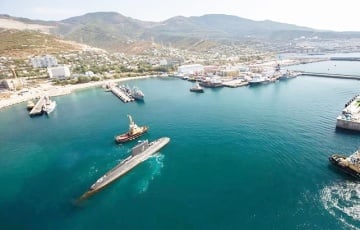
Factually Russia has lost the initiative and is forced to act reactively. One of the most noticeable consequences was the gradual displacement of the fleet from Crimea. Sevastopol, which for many years was considered Russia's main stronghold in the region, is no longer a safe base. Constant attacks on infrastructure, ships and air defense systems forced Moscow to move ships to Novorossiysk. But this solution creates new problems: the distance to the war zone increases, operational efficiency decreases, and logistics become more complicated. Thus, even retaining part of the fleet, Russia loses its effectiveness, the material says.
At first glance, the transfer of the base in Novorossiysk looks logical. However, this port is not able to fully replace Sevastopol. It is worse protected geographically and less convenient for power projection in the western part of the Black Sea. In addition, the very concentration of ships in one place creates additional risks, especially given the development of Ukrainian long-range weapons. As a result, Russia finds itself in a situation where even "safe" zones are gradually ceasing to be such, analysts say.
A separate problem is the limited maneuver. The Black Sea is actually turning into a closed space for the Russian fleet. The possibility of transferring ships is limited, and access to other theaters of war is complicated. Even theoretical options of withdrawal - for example, through inland waterways - have serious limitations on the size of ships and technical parameters. This creates a "trap" effect: the fleet cannot act effectively, but it is also unable to completely withdraw, the newspaper writes.
The key factor of change is the emergence and mass use of maritime drones. Ukraine has staked on an asymmetric strategy, where cheap and numerous means are capable of damaging more expensive and complex systems. This has changed the very logic of naval warfare: large ships have become vulnerable, the cost of defense has risen, and the traditional advantages of the fleet are leveled. Russia, despite attempts to adapt, has so far failed to respond effectively to this threat, the publication says.
Even if Russia tries to rebuild its fleet, it will have to take into account the new reality: the vulnerability of large ships, the effectiveness of drones, and the limited basing. This means that the old model of maritime dominance no longer works. And, as analysts emphasize, Russia has not yet demonstrated that it can adapt to these changes.

Bank's name: Bank Millennium S.A.
Address: ul. Stanislawa Zaryna, 2A, 02-593, Warszawa
IBAN: PL97116022020000000216711123
SWIFT: BIGBPLPW
Name of the account holder: Fundacja “KARTA ‘97”
Purpose/title of payment: Donation for statuary aims
You can contact us by the e-mail [email protected]