

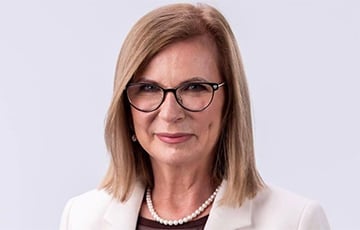
Małgorzata Gosiewska: Poland will be Belarus's advocate on its path to the European Union
6- 6.03.2026, 23:37
- 12,074
The return of Belarusians to Europe is only a matter of time.
The head of the European Parliament delegation for relations with Belarus, former Deputy Marshal of the Polish Sejm Małgorzata Gosiewska, is a unique politician.
In Polish and European politics she belongs to a rare type of people for whom the ideas of her compatriot Jerzy Giedroyc about the independence of Ukraine and Belarus are not an empty phrase.
From the first days of Russia’s war against Ukraine in 2014, Gosiewska was among those who demanded a firm and principled reaction from the West, and regarding Belarus she insists: Belarusians are a European nation that has nothing in common with Lukashenko’s regime. Today Małgorzata Gosiewska fights for Belarusians not only from the podium of the European Parliament, but also in courts, defending the right of former political prisoners to remain in Poland.
In an interview with Charter97.org, the Polish politician explained why Belarus is personally so important to her, what the EU strategy toward the Lukashenko regime should be, how Poland can help Belarusian refugees, and expressed confidence that Warsaw will become an advocate for Belarusians on their path to the EU.
“The West must learn lessons from history”
— You head the European Parliament delegation for relations with Belarus. Many note that for a long time the Belarusian issue in Europe has not been handled by someone so deeply engaged in our problems. Why did you decide to deal with Belarus? Today it is not talked about much in Europe, there are many other more popular topics.
— Of course, in the European Parliament it is clear that Ukraine is the main issue, and Belarus is considered only in the context of the Russian military threat. I find this unacceptable, because we have no strategy not only toward the Lukashenko regime but also regarding assistance to the Belarusian opposition in exile.
Why is Belarus important to me? I truly became interested in your country in 2005–2006, during my first term in the Polish Sejm, when Belarus was preparing for presidential elections. During that period my party, Law and Justice, became closer to the Belarusian Popular Front. We signed an agreement on joint cooperation, and held a series of meetings and discussions.
I came to Belarus before the elections and joined the campaign team of presidential candidate Alexander Milinkevich. Not as an observer, but, let’s say, in the role of active support. These were my first meetings and observations of what the Belarusian opposition was doing. This was important to me because in some sense I came from the Polish opposition of the 1980s and actively participated in the Independent Students’ Union. Perhaps my interest in Belarus was to some extent nostalgia for something important that ultimately motivated me.
I was in Molodechno, met with students and young activists; together we distributed Milinkevich’s campaign leaflets and went door to door. Belarusians often let us into their homes and spoke openly with us. However, later we learned that the places where we had been received were often searched, and the local KGB followed our trail. This became an important lesson for me — do no harm. In the end we returned to a safe country, while those who stayed in Belarus found themselves in a difficult situation.
Then election day came and we became observers. Although we did not have the necessary documents, we tried to enter polling stations and observe the voting process. After the polling stations closed, we returned to Minsk, to October Square, where people gathered outraged by the scale of election fraud. We helped set up the tent camp (during the 2006 protests a tent camp appeared on October Square in Minsk — Note by Charter97.org), and later were forced to leave for Poland when it was dispersed.
I still remember the calls from my new Belarusian friends who were being arrested and beaten. It was a dramatic experience that has stayed with me and still motivates me to support Belarusians.
Later there were frequent trips to Minsk for Freedom Day and assistance to Belarusian students here in Poland. In some sense I was a co-author of the Kastus Kalinowski scholarship program and support program for Belarusian students. I remember speaking to Belarusian students at Freedom Day in Yanka Kupala Park in Minsk and telling them that after returning to Poland we would help those who would be expelled from universities. That help became the Kastus Kalinowski program.
In the summer of 2006 my parliamentary office became a real contact point where students received full information about how to move around Warsaw, received paper maps (because Google Maps did not exist yet), transport tickets, and various types of assistance for people who had arrived in a foreign country.
— So you did not hesitate long when in 2024 you were offered to become head of the delegation for relations with Belarus?
— To be honest, I was active from the beginning and wanted to lead this delegation. Parties in the European Parliament distribute representation in different delegations depending on their size. We, the European Conservatives and Reformists, fought to deal with Belarus. From the start I tried to enter this delegation, and most importantly — to lead it, so that it would not become a “dead body”.
I know how much can be done when leading a delegation, so I try to react to what is happening in Belarus and also to voices appearing in the European Parliament that do not help this country.
— What voices do you mean?
— From the very beginning there were deputies calling not to impose sanctions but to lift them and find understanding with Lukashenko. I have spoken about this several times: some politicians suggested buying political prisoners from the dictator, or that part of our delegation should go to Belarus and start dialogue.
— Can you name those behind such proposals? Or at least the countries?
— Austria, Germany. I think it is not accidental that Germany suggested that part of the Belarusian opposition move to Berlin.
— Do you mean Viktor Babariko and Maria Kolesnikova?
— You named those names. I do not think it is a coincidence; rather it is a new trend aimed at splitting the Belarusian opposition and bringing it closer to the Lukashenko regime. Austrian politicians who proposed dialogue with the regime did not even hide the fact that Austrian companies conducted business in Belarus (for example, A1 Telekom Austria Group — Note by Charter97.org). Let us also remember agricultural enterprises owned by German politicians, though of a lower rank, which mainly used the labor of political prisoners. I mean the enterprise “Tsybulka-Bel”, owned by Alternative for Germany deputy Jörg Dornau, which used the labor of Belarusian political prisoners.
— In your opinion, what should the EU policy toward Belarus be today?
— The West must learn lessons from history: we have repeatedly seen attempts to warm relations with the Lukashenko regime and lift sanctions. I remember 2006 — suppression of protests, arrests, trials. Then Lukashenko was frightened by the war in Georgia in 2008 and began trying to maneuver between the West and Russia. For him this is natural: one foot here, the other there — take money from Russia but not completely antagonize the West. And the West naively accepted this game, giving without demanding anything and assuming it was dealing with a solid partner.
But neither Putin nor Lukashenko are such partners. They are not European politicians with whom you can sign agreements and expect them to be fulfilled. They will not be fulfilled, because for Putin and Lukashenko attempts at dialogue from the West are interpreted as weakness. If you try to talk to a dictator from such a position, it is a losing position from the start. If dialogue is conducted (and it must be), it should be from a firm and principled position — with demands.
In Belarus there are officially more than a thousand political prisoners. If we speak about Poland — there is the extremely important case of Andrzej Poczobut. Civil society has been destroyed in Belarus: NGOs have been liquidated, political parties cannot operate, and restrictions have even affected the Catholic and Protestant churches. The new rules introduced in July requiring re-registration have limited religious activity and hit this sphere hard. Lukashenko saw a threat here as well.
The democratic world cannot accept such severe restrictions affecting all areas of everyday life for Belarusians. There should be no discussion of any “liberalization of sanction pressure”. On the contrary. If we speak about sanctions against Russia, I think there is still room for maneuver regarding Belarus. These sanctions could be strengthened.
We can also act through third countries, for example China, which has a vital interest in transport routes through Belarus to Europe. Beijing builds part of its trade on this corridor. As we see, such a dialogue format works.
“It’s good that Lukashenko is afraid”
— It is also clear that sanctions against Lukashenko cannot be lifted because of the war against Ukraine in which he participates. How do you assess US policy toward Lukashenko’s regime?
— It is difficult to evaluate. On the one hand many people have been released and specific lives saved — we must not forget that. Without dialogue between the US and the regime this would not have happened. However, I worry that this dialogue and the liberalization of sanctions might go too far.
I try to understand US policy in the context of the threat of a real war. We see this threat in analyses from the American side and understand that it is real. Every attempt to pull the Belarusian regime away from Russia’s geopolitical order is significant. However, I closely watch what the US is doing and try to convey information to Americans about how barbaric and inhumane Lukashenko’s regime is so that the American side understands when it is time to stop.
— Do they hear you?
— I hope so. We also want to strengthen this dialogue with a special report about the crimes committed by Lukashenko and his regime — a report that will be impossible to ignore.
— We also see that Lukashenko is very afraid of Trump, especially after the special operation in Venezuela.
— That is very good — let him be afraid. The Americans have shown that at some point they can resort to more decisive actions than just dialogue.
— After Trump came to power, the editor-in-chief of Charter97.org, Natalia Radina, wrote an article titled “Lukashenko and Putin Will Not Survive Trump’s New Term”. Do you think such a development is possible?
— I do not know when or how it will happen, but we must be ready and active and cannot leave Belarusians alone. We must support the Belarusian opposition and independent media so that those inside the country understand what is happening in the world and know that they have support and solidarity — and that abroad there are people who could take power after Lukashenko leaves. Without this understanding Belarusians will not go out into the streets.
I believe — and also understand from conversations and analyses that I receive — that the spirit of struggle lives in Belarusians. It has been somewhat suppressed, but people are ready to act. As soon as something changes in the context of the war in Ukraine or unrest begins in Russia, Belarusians will take to the streets.
However, the Belarusian people must know they have our support and representatives ready to return and assume power. For this, Belarusian independent media are needed — and they must receive support from the European Union and its member states. Unfortunately, they do not receive enough support today.
“For a struggling Belarus, the Polish experience is important”
— The struggle of the Polish people has always been an example for us. Do you see similarities between Poland’s struggle against communism and Lukashenko’s regime today?
— Yes, but our situation was very different. In Poland there were huge enterprises and it was easier to organize underground activities relying on trade union leaders. Worker protests also appeared during the 2020 protests in Belarus, but they were too weak.
Poland had a completely different path — protests by workers, students, and the intelligentsia that for a long time acted separately. In 1976 there were workers’ protests in Radom, Płock, Ursus, Warsaw and other cities caused by a huge rise in food prices. This led to the unification of workers and the intelligentsia. The intelligentsia provided legal assistance to the protesters, which eventually led to their success.
There was also the pilgrimage of John Paul II, which helped Poles unite and see how many of them there were. Without these two events — the unity of workers and intelligentsia in 1976 and the Pope’s pilgrimage to Poland — the emergence of the large “Solidarity” movement in 1980 and its eventual victory would have been impossible.
— If we take 1989 in Poland, it largely happened because of problems within the USSR. If the Soviet Union had not collapsed, perhaps Poles would have had to fight longer?
— I think the economy of the Polish People’s Republic was on the brink. The communists understood perfectly well that they could not maintain the system without some agreements with the opposition. That is why they agreed to the Round Table negotiations. This should also be a lesson for Belarus. The Round Table was not a bad path, but it was wrong to rigidly and blindly stick to the agreements concluded there.
— What criticisms do you have of the Round Table?
— Peace agreements, partially free elections, and the opposition entering politics and parliament were a good path. But the absence of lustration, allowing communists to remain in politics, and the harsh economic policy of Leszek Balcerowicz (former Deputy Prime Minister of Poland — Note by Charter97.org), which led to rising unemployment and the bankruptcy of many key Polish companies, along with a lack of reforms, led us to the situation we are in today.
Former communists still hold high positions — one is Speaker of the Sejm, the second person in the state, with access to state secrets.
Many important Polish enterprises disappeared — shipyards, automotive and steel plants. Often German companies took their place, implementing a policy of eliminating competitors. This meant our economic growth was not as fast as it could have been and caused huge social costs.
“It is important to clearly separate Belarusians from the Lukashenko regime”
— You became head of the delegation when the war had already lasted two years. Attitudes toward Belarusians have changed. Many forget they came to Europe because they fought for freedom and democracy. Today we are often treated as Russians and aggressors. There is great distrust of Belarusians, including in Poland. How can Europeans understand that we are not enemies?
— To a large extent this is a task for the Belarusian opposition. As a delegation we can organize conferences, meetings, and prepare resolutions so that Belarusians are not forgotten.
In my interviews I clearly separate Belarusians from Lukashenko’s regime. This difference must be explained to the international community. It was not Belarus that supported Russia’s war against Ukraine — it was Lukashenko’s regime. It is not Belarus that conducts hybrid war against NATO, Lithuania and Poland — it is Lukashenko’s regime.
We must speak about this clearly. And we must support Belarusian independent media. They should tell the stories of Belarusians living inside the country and abroad and inform the international community about what is happening in Belarus. But of course they need funding.
— Recently there was news that Belarusian doctors are being dismissed in Latvian hospitals. Could something similar happen in Poland?
— Many Belarusian specialists work in Poland, not only in hospitals. They are wonderful people who contribute greatly to the Polish economy. Belarusians pay taxes and pension contributions and live legally in our country. They remain Belarusians but are not isolated.
There are no historical conflicts between us, unlike Polish-Ukrainian relations. There is a strong mental and spiritual connection between us.
I do not see anti-Belarusian sentiment in Poland, but studies show sympathy for Belarusians is decreasing. Therefore journalists and politicians must work with public opinion.
Returning to Belarusian doctors — there are many of them here, but it is not easy for them on the Polish labor market. Medical chambers often create obstacles to obtaining work permits. This process does not always end in favor of Belarusian doctors unless there is intervention.
A similar situation concerns former political prisoners who come to Poland after release from Lukashenko’s prisons. This is related to the problematic Dublin Regulation and its unjustified application.
Note from Charter97.org: The Dublin Regulation determines which EU country must consider an application for international protection. Usually it is the country that issued the entry document or residence permit, or the first EU country the person entered.
“I am ashamed that this happened in Poland”
— The Dublin Regulation is not appropriate for Belarusians today because people are forced to leave the country. Some flee through Russia and can only enter Lithuania, and many are forcibly taken there.
— I understand this very well, but I see misunderstanding from the Office for Foreigners. On the one hand we must consider the possibility that some people from Ukraine or Belarus might work for Russia. But that is why intelligence services exist — to identify and deport such people.
Each case involving Belarusians persecuted by Lukashenko’s regime must be considered individually.
Unfortunately the Office for Foreigners often produces template decisions. We see identical arguments in refusals, sometimes with mistakes in names or facts. It shows there is a prepared refusal before the case is examined.
Fortunately we managed to block such decisions in the Voivodeship Administrative Court. We have already won three cases.
The case of Nelli Vodonosova shows the stress caused by such bureaucratic errors. I attended her court hearing and saw her despair. The case was won, but she is no longer with us.
Another outrageous case concerns Natalia Podlevska. Her case was also won in court in October 2025, yet she remains in Lithuania without the right to return to Poland.
She was detained by border guards two days before the hearing, given 10 minutes to pack, handcuffed and taken to Poznań. She spent the night in a cell with two men and the next day was transferred to Lithuania. She was deprived of the opportunity to present her position in court and suffered severe psychological stress. Natalia suffers from PTSD after what she endured under Lukashenko.
This is a violation of human rights in Poland, a democratic EU member state.
“Andrzej Poczobut is a symbol of the Belarusian struggle for democracy”
— Hybrid attacks from Belarus against Poland continue. First migrant attacks, now balloons. What could Poland’s response be?
— Opening the border unconditionally was not a good decision. It showed weakness rather than strength. Such decisions may be made only after certain conditions are fulfilled, and they were not.
For Poland the issue of political prisoner Andrzej Poczobut must be raised.
If we had remained in power in Poland, Poczobut would already be free. According to a proposal by minister Mariusz Kamiński, the US side agreed to exchange the pseudo-journalist and Russian spy Pablo González (Rubtsov) for Poczobut’s release. Unfortunately the exchange did not happen.
Poczobut remains imprisoned for the fifth year under unimaginable conditions.
— Thanks to you he received the European Parliament’s Sakharov Prize.
— It is a great honor and a success for Poland, but above all it is a symbol of the Belarusian struggle for democracy.
Andrzej has Polish roots and actively participated in the life of the Polish diaspora in Belarus, working on issues of language, culture and schools. But he also honestly reported on events in Belarus, especially the 2020 protests.
He knew what risks he faced but refused to leave the country. We must fight for his life.
— Belarusians were deeply impressed by the words of Polish President Karol Nawrocki during the ceremony in Vilnius dedicated to the anniversary of Kastus Kalinowski’s uprising. The president said Belarusians are a European nation and Belarus will be in Europe. Is Poland ready to be an advocate for democratic Belarus on its path to the EU?
— Poland has always been such an advocate. Despite political disputes, support for democratic Belarus is quite unified.
We will be an ambassador for democratic Belarus on its path to the EU. It is important to emphasize that Belarusians are Europeans, not Russians. They do not share the Russian mentality — they believe in democracy and Western values.
I am convinced that the spirit of freedom still lives within Belarusians, even though it is currently suppressed by Lukashenko’s regime. It is only a matter of the right moment, and we will again see Belarusians fighting for democracy.
— Thank you very much.

Bank's name: Bank Millennium S.A.
Address: ul. Stanislawa Zaryna, 2A, 02-593, Warszawa
IBAN: PL97116022020000000216711123
SWIFT: BIGBPLPW
Name of the account holder: Fundacja “KARTA ‘97”
Purpose/title of payment: Donation for statuary aims
You can contact us by the e-mail [email protected]