


Kremlin Faces Dilemma Over WSU Successes
1- 20.03.2026, 9:53
- 10,882

ISW analysts assessed the situation in the Alexander direction.
Ukraine's defense forces have recently advanced in the Oleksandrovskyi direction. At the same time, Ukraine's defenders are effectively holding back the advance of the Russian invaders.
This has left the Russian command facing several dilemmas, and the likely effectiveness of the enemy's planned spring-summer offensive is also in question. The situation was described by the Institute for the Study of War (ISW).
The defense forces have presented the occupiers with a dilemma
The recent Ukrainian advances in the Aleksandrovskyi direction and the continued success of Ukraine's defensive lines in containing the advance of Russian forces have forced the Russian military command to face competing tactical and operational dilemmas on the battlefield.
Ukrainian military observer Konstantin Mashovets wrote on March 19 that Russian forces do not have enough forces to simultaneously capture Orekhov in western Za. one offensive.
Mashovets noted that the Ukrainian defensive line along the Konskaya River, which runs through Orekhov, and recent Ukrainian advances in the Aleksandrovskyi direction, which are diverting Russian forces from efforts in the Orekhov area from the east, are preventing Russia from capturing the town.
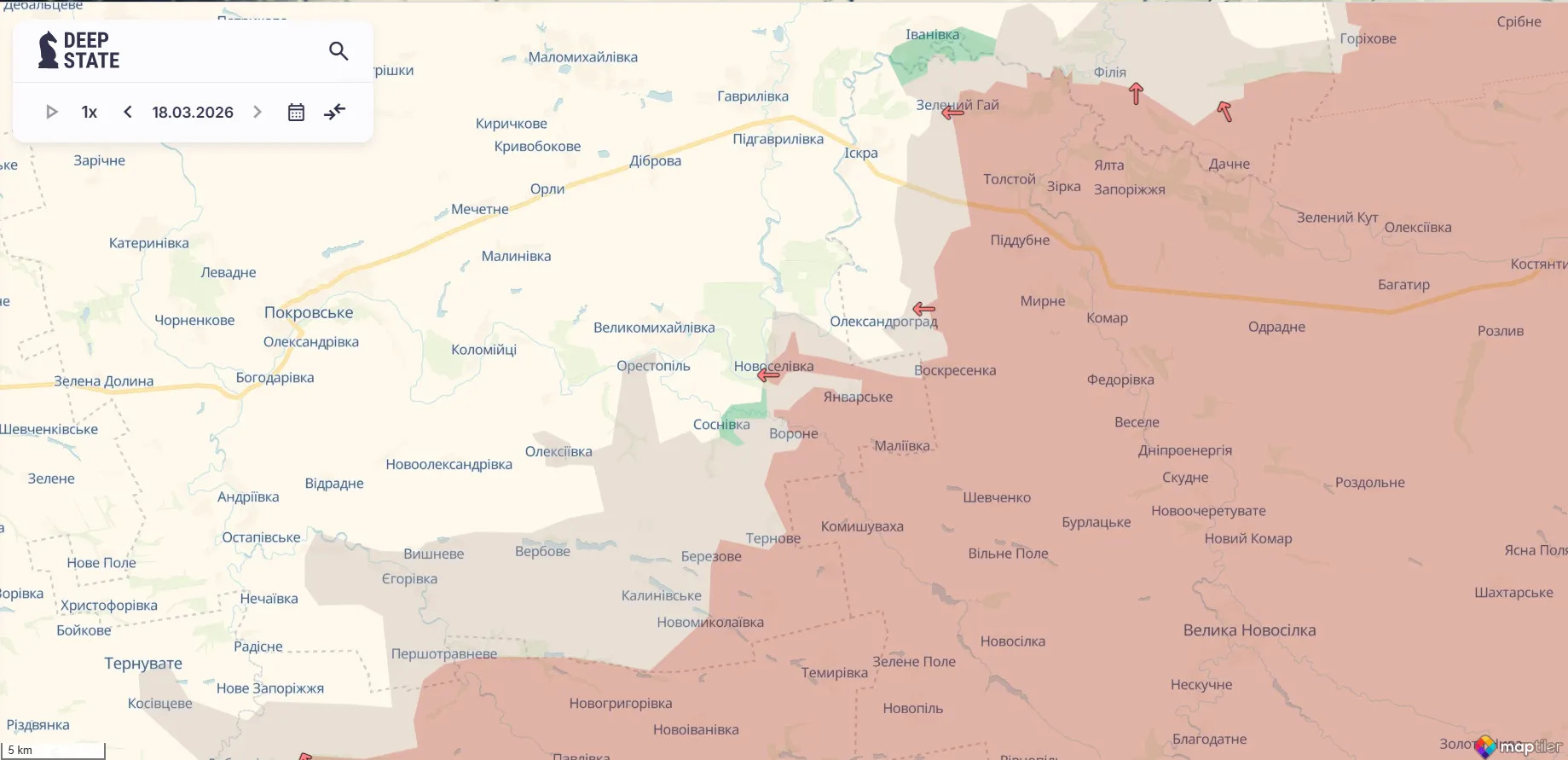
According to the columnist, Russian forces may have to move reinforcements from the Kherson direction to carry out such efforts in the west of the Zaporizhzhya region. After all, the Russians are trying to simultaneously advance on the belt of fortresses, attack Dobropillya and Kupyansk and create a "buffer zone" in the north of Kharkiv and Sumy regions.
Mashovets noted a week earlier that Russia's offensive on Dobropillya would force Russian forces to redirect resources from efforts to seize Ukraine's belt of fortresses to significantly reinforce the depleted 51st Combined Arms Army (formerly the "1st Army Corps of the "DNR") and the Russian Armed Forces' 2nd Combined Arms Army in the area.
The columnist also believes that Russian forces cannot use the hypothetical mobilization to quickly build up human resources for such an effort because they lack the time to train recruits for a summer offensive.
The ISW believes that the competing dilemmas that Ukraine has imposed on Russian military commanders have likely derailed Russian preparations for their 2026 spring/summer offensive.
Thus, according to Mashovets, there are no credible reports yet of Russian forces moving significant formations into the 58th Army's zone of operations west-south of Orekhov. Without this, it is hard to imagine the Russians conducting a major offensive against Zaporizhzhya in the spring or summer.
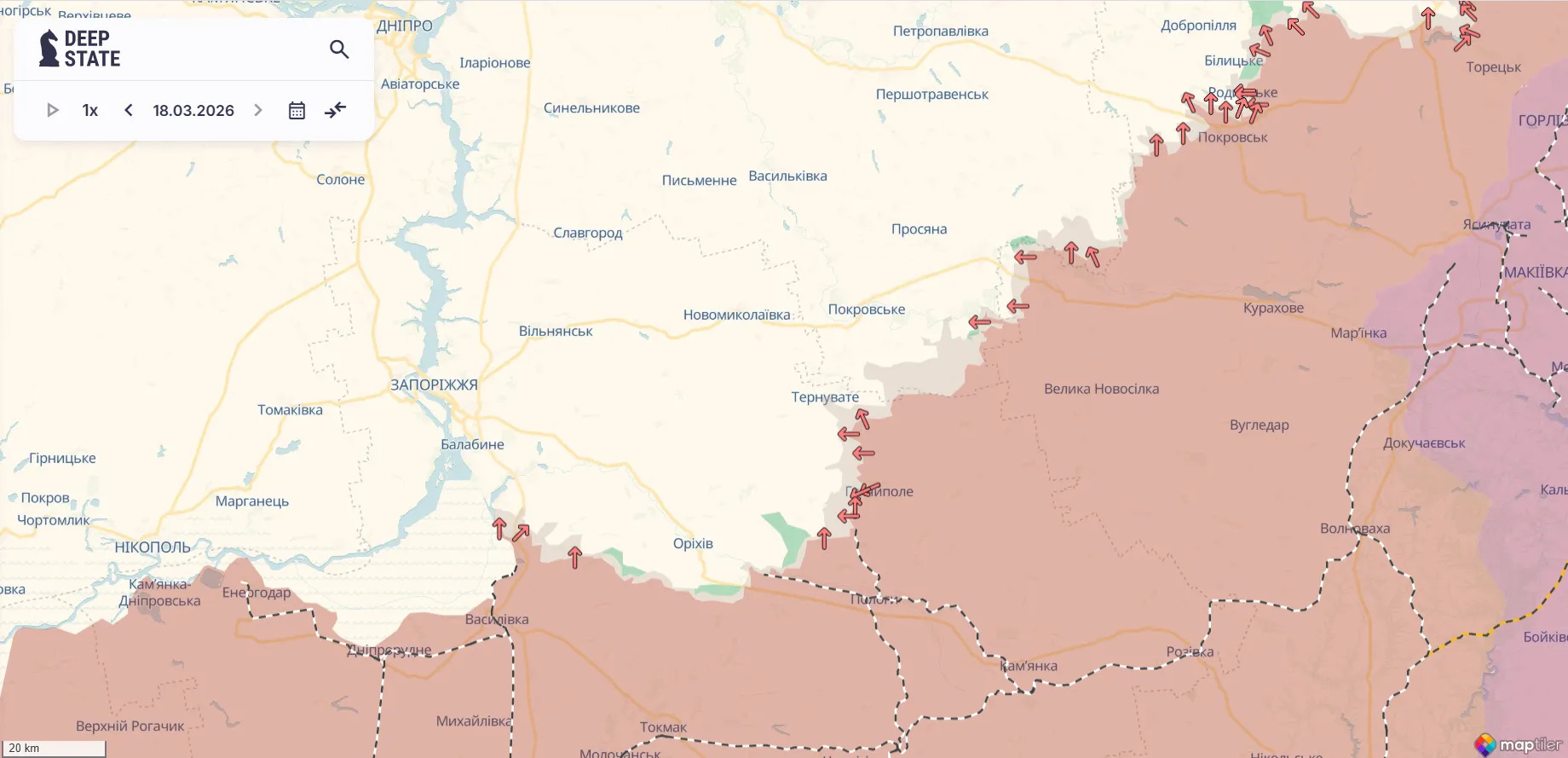
Mashovets said that Russian troops are amassing infantry southwest of Orekhov for offensive efforts against the city and against Novopavlovka (just northwest of Orekhov), but that this buildup is insufficient given the occupiers' lack of gains in the west and northwest.
A representative of the Ukrainian brigade operating in the Kramatorsk (Konstantinovka) direction reported on March 19 that the intensity of Russian attacks in this direction is relatively low, and that Russian forces were unable to achieve even a tactical advance northeast of Konstantinovka before Moscow's "deadlines" of March 10 (to wedge between Mayskiy and Markov) and March 15 (to seize the Seversky Donets-Donbass canal in this area).
The speaker noted that Ukrainian troops do not observe a large accumulation of Russian heavy equipment in the Kramatorsk direction, which could indicate that Russia is preparing for an offensive.
"Russia's inability to achieve even a tactical advance to seize favorable initial positions in the Kostyantynivka-Druzhkovka tactical area for the expected spring-summer 2026 offensive against the Ukrainian fortress belt directly undermines Russia's ability to achieve significant success in the expected offensive," the speaker said.

Bank's name: Bank Millennium S.A.
Address: ul. Stanislawa Zaryna, 2A, 02-593, Warszawa
IBAN: PL97116022020000000216711123
SWIFT: BIGBPLPW
Name of the account holder: Fundacja “KARTA ‘97”
Purpose/title of payment: Donation for statuary aims
You can contact us by the e-mail [email protected]