

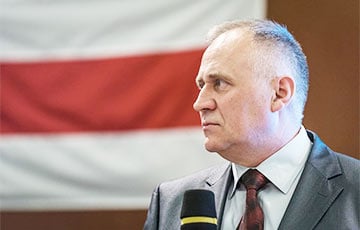
Mikalai Statkevich Said That His Stroke In The Colony Was Deliberately Provoked
5- 19.03.2026, 11:35
- 3,580
Instead of life-saving medication, he was given aspirin.
Former political prisoner, leader of the Belarusian opposition Mikalai Statkevich said that he had intentionally caused a stroke in the colony by replacing one of the necessary drugs with aspirin. The politician writes about it in his Telegram channel:
- I was punished 6 times in a row with 6 months of solitary confinement - there is a type of punishment in the special regime with a maximum term of 6 months - a cell of 1x3 meters, with "walks" for half an hour a day in a not much larger, almost deaf metal box under a metal roof with artificial light even during the day.
It's a bit hard not to see the sky above me for years, even through the netting.
And 1-2 times every month to get to the SHIZO, where I spent a total of about a year. Such things have never been done to anyone there. Experienced detainees said that I was being "put to death, like, for natural causes".
Mikalai Statkevich said that he did not receive messages from his relatives, and his wife Marina Adamovich was seriously and dangerously ill, which put a lot of pressure on him:
- It came to the point that one of the heads of the institution through another prisoner gave me a "humane" proposal: to ask for a "covered" prison, where conditions are incomparably milder. I sharply refused, because in these places any manifestation of weakness would only provoke increased pressure.
I resisted their plans, I tried to save myself - I walked a lot even in that cell, did at least some physical exercises, read a lot of literature on philosophy and social psychology, when they still gave books from the library, tried to learn English, until they began to take away textbooks, in the SHIZO I thought over a fairly large text on the genesis of human morality, a person's choice of a model of behavior, the moral choice of whether or not to be a prisoner. Now I will have to find time and restore this text, because I don't like unfinished business.
So I kept a pretty good shape for such conditions and three kovids.
At least I had enough strength for a "spurt" at the limit. But during the refusal to be deported, I understood perfectly well that they would not let me go free just like that, and I was preparing for the worst.
Mikalai Statkevich says that after the second covid in Gomel pre-trial detention center doctors prescribed him certain medications:
- Marina sent them to me in the colony, with frequent interruptions, but they reached me and I was given them. It was the only means of communication between us for 3 years. Because when I received a medical parcel, I knew that Marina was alive. And she tracked those parcels by code and knew the same when they were taken from the post office.
But since September last year my whereabouts were simply hidden, so, accordingly, Marina did not know where I was, in the colony she was told that I was not there, and her medical parcels did not arrive.
I was told that they would issue their "analogs". So, for example, the prophylactic agent for blood clotting "Xarelto" was replaced by aspirin.
Then in the prison hospitals the doctors laughed at me for some reason because of this substitution and said that such a substitution for post-coital problems is inadmissible, that it caused my stroke.
The former political prisoner writes that there is every reason to believe that this stroke was provoked artificially and deliberately:
- But the doctors in the prison hospitals, thank them, did everything to minimize its consequences. It didn't affect any of the physical functions of my body, except speech.
Now I feel fine, my blood pressure is a constant 120/80 for me. Have started exercise classes again. I regularly do online classes with speech therapist Mrs. Julia, a Belarusian who lives in the USA, and to whom I am very grateful that after a hard day's work she finds time and energy to help me. My speech is slowly recovering, but it still needs time.
But the authorities periodically raise my emotional tone. Apparently, to speed up recovery from the stroke."

Bank's name: Bank Millennium S.A.
Address: ul. Stanislawa Zaryna, 2A, 02-593, Warszawa
IBAN: PL97116022020000000216711123
SWIFT: BIGBPLPW
Name of the account holder: Fundacja “KARTA ‘97”
Purpose/title of payment: Donation for statuary aims
You can contact us by the e-mail [email protected]