

Russian Regional Budgets Have A Record "hole" In Their Budgets
10- 6.02.2026, 15:13
- 4,526
The picture for Russians is not a happy one.
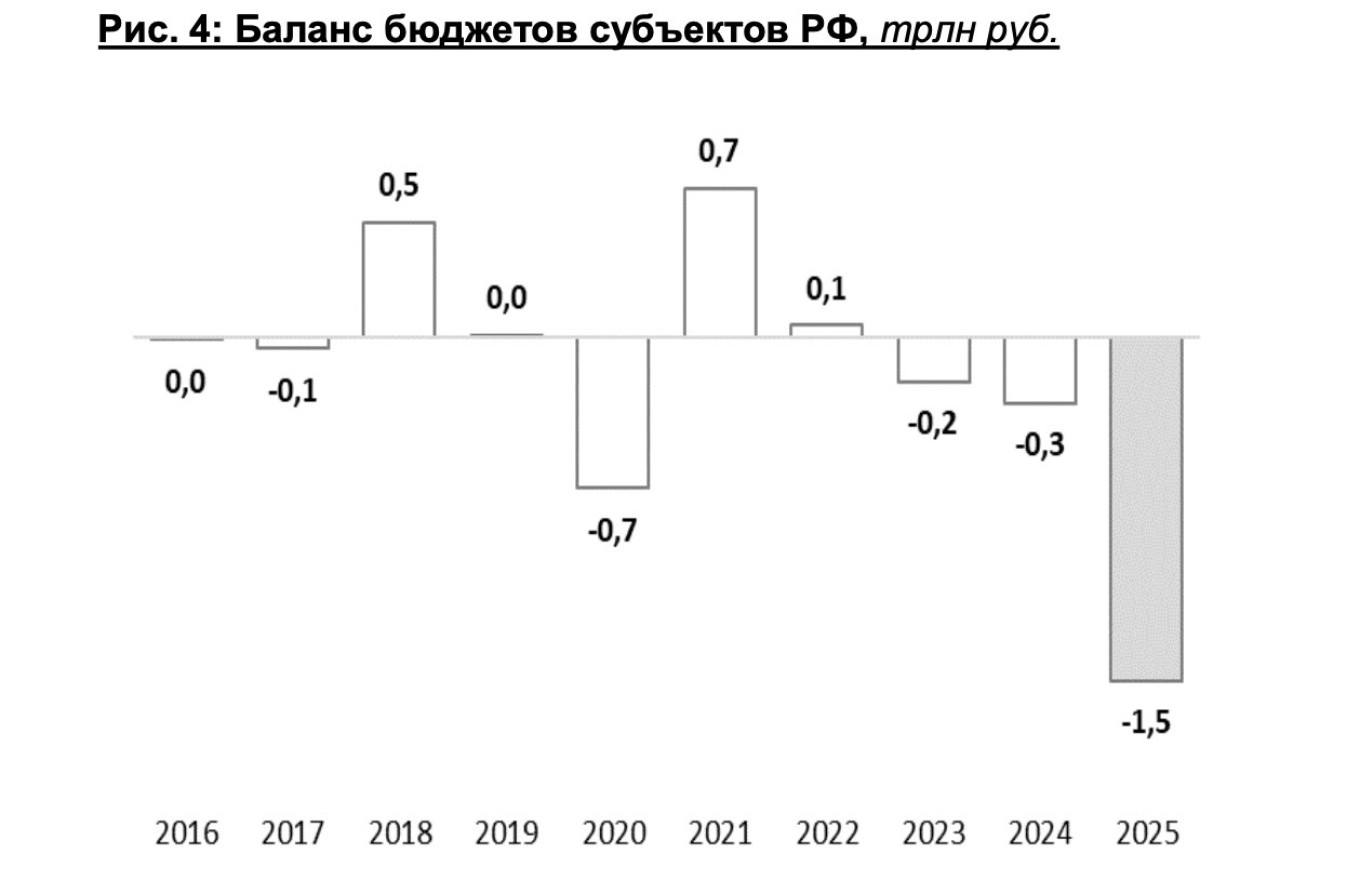
Russian regions ended 2025 with a total local budget deficit of 1.538 trillion rubles, the RF Ministry of Finance reported.
As compared to last year, the "hole" in the budgets of the subjects increased 5 times, relative to 2023 - almost 8 times, and its final size became unprecedented in 20 years of available statistics. The previous record was set by the regions during the pandemic crisis (Br677 billion in 2020), but it was exceeded twice.
At the end of the year, revenues to the regions of the key income tax decreased by 8.5% to Br5.278 trillion, while total revenues increased by only 4.8% to Br25.87 trillion. At the same time, expenditures increased by 10% and reached Br27.408 trillion.
"The picture is quite sad," states economist Natalya Zubarevich. Detailed data is still available for the first nine months of last year, and it shows that 52 subjects had budget deficits. "The worst situation is in the Kemerovo and Vologda regions, where the deficit is 25% (of their own revenues), in the Arkhangelsk, Murmansk, Tyumen regions (20-22%), in the Irkutsk region and Komi (17-18%)," Zubarevich lists.
It is indicative that the increase in the budget deficit of the regions occurred in the context of an increase in the tax burden, which "should have supported the revenue base of the budget in the broad sense," Alfa Bank chief economist Nataliya Orlova points out.
The governors did not receive additional help from the federal treasury: transfers - 3.96 trillion rubles - remained almost at the level of last year and lower than in 2023. As a result, the authorities had to patch the "holes" at the expense of debt: its size at the end of the year reached Br3.5 trillion and became the maximum for 15 years.
"The regions began to have cash gaps," says Zubarevich: because of this, they had to borrow money from banks "at insane interest rates". And in some subjects, a crisis of non-payment of public sector employees' salaries began. In particular, teachers and doctors in the Kemerovo region, medical workers in Khakassia, firefighters from the Trans-Baikal Territory, and employees of the Siberian Branch of the Russian Academy of Sciences were left without money.
Waiting for relief of problems to the regions in 2026 is hardly worth it, Zubarevich believes: due to the increase in taxes, business will lose profits, and the subjects - profit tax; the race of salaries is slowing down, and with it - the revenues from personal income tax. The economy is slipping into stagnation and, possibly, recession; the risks of the budget situation have become "maximum", Zubarevich emphasizes: "There are no simple ways to solve this situation.

Bank's name: Bank Millennium S.A.
Address: ul. Stanislawa Zaryna, 2A, 02-593, Warszawa
IBAN: PL97116022020000000216711123
SWIFT: BIGBPLPW
Name of the account holder: Fundacja “KARTA ‘97”
Purpose/title of payment: Donation for statuary aims
You can contact us by the e-mail [email protected]