


More Powerful Than ATACMS And Will Reach Moscow: What We Know About The New Ukrainian FP-9 Missile
7- 5.02.2026, 19:15
- 5,748
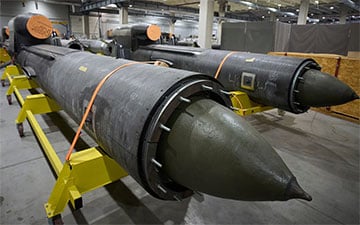
The rockets are currently undergoing final tests.
Ukrainian defense company Fire Point is preparing to put FP-7 and FP-9 ballistic missiles into service. The new developments are much cheaper than Western analogs, and their range allows hitting strategic objects deep behind the Russian rear.
According to RBC-Ukraine with reference to the interview of the company's co-founders Irina Terekh and Denis Shtilerman for Deutsche Welle.
According to the developers, the FP-7 missile is a budget analog of the US ATACMS system. It has a range of up to 300 kilometers and is designed for precision strikes at short distances.
The more powerful modification - FP-9 - is capable of hitting targets at a distance of 800-850 kilometers and carries a warhead weighing 800 kg.
"800 kilometers is Moscow, it's St. Petersburg," Stilerman stressed.
In turn, Terekh noted that unlike drones or cruise missiles, ballistic missiles have a much higher chance of penetrating the three air defense circuits around the Russian capital.
"It will be much easier to hit Moscow with ballistics. You have to realize that neither cruise missiles nor drones in any large percentage that can inflict significant damage on Moscow or its infrastructure will get there. So the only hope is in ballistics with a high target hit rate. More than 1,200 meters per second," she said.
The missiles are currently undergoing final tests. However, they are expected to be codified and officially adopted into service as early as February this year.
The speed of development is explained by the lack of bureaucracy and simplification of procedures for the defense sector of Ukraine (we are talking, in particular, about the decree № 256 of March 2022). For comparison, similar programs in France or the Russian Federation took more than 15 years.
"Even experienced countries with a strong missile program have spent decades to develop ballistic missiles. France, for example, with its M51 ballistic missile took 15 years. S-400 - the Russian complex was also developed for 15 years," Stilerman noted.
The priority of Fire Point for the current year is the development of ballistic weapons, and in the perspective of two to three years - the construction of an anti-ballistic air defense shield for the whole of Europe.
This defense system will operate on the basis of open architecture, which will ensure complete independence of software from specific manufacturers or countries.
One of the key objectives of the project is to radically reduce the cost of air defense. Currently, it costs about $6 million to shoot down one Russian Iskander missile, but Fire Point aims to reduce this price to $1-1.5 million.
This result is planned to be achieved through the use of the FP-7 missile. It is a composite and much cheaper version of the S-400 system's counterparts, has simplified controls and is protected from any remote tampering or disabling.

Bank's name: Bank Millennium S.A.
Address: ul. Stanislawa Zaryna, 2A, 02-593, Warszawa
IBAN: PL97116022020000000216711123
SWIFT: BIGBPLPW
Name of the account holder: Fundacja “KARTA ‘97”
Purpose/title of payment: Donation for statuary aims
You can contact us by the e-mail [email protected]